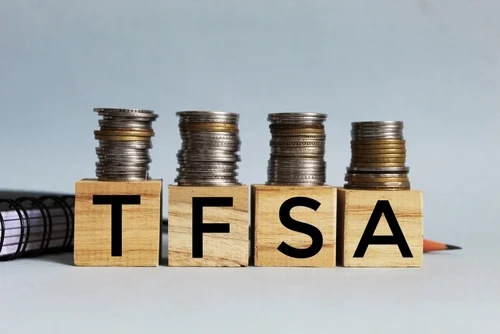
When you’re weighing a TFSA vs savings account, the key differences are tax treatment and contribution rules. A TFSA generally lets your money grow free of Canadian income tax, with tax-free withdrawals, while a regular savings account has no contribution limit, but the interest it earns counts as taxable income.
Comparing the two is one of the first financial decisions you may face after moving to Canada, and it’s worth getting right early on. At Remitly, we know that settling into a new banking system comes with a learning curve, so this guide breaks down how each account works, what the Canada Revenue Agency’s (CRA) rules mean for your money, and a practical “two-bucket” framework for using both.
Quick answer: A TFSA (tax-free savings account) shelters your investment growth from income tax and lets you withdraw funds tax-free, with access depending on what you hold. A savings account has no contribution limit, but its interest is taxable. Using both can help separate your goals; a TFSA for tax-free growth and a savings account for everyday access.

What is the difference between a TFSA and a savings account?
A TFSA is a registered account that lets Canadian residents grow savings and investments generally free of Canadian income tax. You don’t get a tax deduction for the money you put in, but eligible interest, dividends, and capital gains are generally tax-free, as are withdrawals.
A regular savings account is a standard, non-registered account offered by banks and credit unions. There’s no annual limit on how much you can deposit, and you can move money in and out subject to the provider’s terms, but any interest you earn is taxable income you’ll need to report.
A common misconception is that a TFSA is just a high-interest place to park cash. In reality, it’s an account wrapper that can hold cash, guaranteed investment certificates (GICs), exchange-traded funds (ETFs), mutual funds, stocks, and bonds. The tax-free treatment applies to eligible earnings from these investments, not only interest earned on cash.

How does a TFSA work? Key rules every Canadian should know
To open a TFSA, you need to have reached the age of majority in your province or territory and have a valid Social Insurance Number (SIN). Most provinces set the age of majority at 18, though it’s 19 in British Columbia, New Brunswick, Newfoundland and Labrador, Nova Scotia, and the three territories. For eligible Canadian residents, contribution room starts accumulating at 18, even where you must wait until 19 to open an account.
According to the Canada Revenue Agency (CRA), the TFSA annual contribution limit for 2026 is $7,000. If you’ve been a Canadian resident for tax purposes throughout the period since 2009 and were already at least 18 that year, your cumulative lifetime contribution room reaches $109,000 in 2026, assuming you’ve never contributed. This is the sum of the annual limits, not a permanent lifetime cap.
For newcomers, contribution room starts accumulating when you become a Canadian resident for tax purposes, provided you’re at least 18. You do not receive room for earlier years when you were not a resident.
A few rules govern how your contribution room moves:
- Your contribution room adds up every year you’re eligible, whether or not you open an account. Your available room is shared across all your TFSAs.
- Unused room carries forward with no expiry, so skipping a year doesn’t cost you the space.
- When you withdraw money from a TFSA, that amount is added back to your contribution room, but only on January 1 of the following calendar year, not immediately. You can recontribute in the same year if you have sufficient unused contribution room.
- Contributing more than your available room triggers a CRA over-contribution tax of 1% per month on the highest excess amount in that month. Withdraw any excess promptly to limit further charges.
Keeping track of your available room matters, so use your contribution and withdrawal records before adding money. The TFSA information in your CRA account is not updated in real time, and it may not reflect recent transactions.
Note: Re-contributing withdrawn funds in the same calendar year, before your room resets, is one of the most common ways Canadians accidentally over-contribute.

What can you hold inside a TFSA?
A TFSA is a registered account wrapper that can hold a range of eligible savings and investments: cash, GICs, stocks, exchange-traded funds (ETFs), mutual funds, and bonds. This flexibility is part of why the account’s name is a bit misleading. “Savings account” undersells what it can actually do.
One exception is worth knowing: dividends from foreign holdings, such as US stocks, can be subject to foreign withholding tax even inside a TFSA. The Canadian tax exemption does not prevent another country from taxing those dividends.
Despite this flexibility, many Canadians still use their TFSA the way they’d use a basic savings account. A November 2025 TD survey found that 39% of TFSA holders surveyed were not investing the money inside their accounts.
Holding cash suit short-term goals but relying on cash for longer-term goals could mean missing opportunities for growth. Your investment choices should reflect your time frame and comfort with risk. For a closer look at how the account works, see our guide to how a TFSA works.

How does a regular savings account work in Canada?
A regular savings account works differently from a TFSA in one key way: it isn’t a registered account, so there’s no annual limit on deposits and no CRA rules on contribution room. You can open one, add money whenever you like, and withdraw it without restriction.
The catch is tax. Any interest you earn on a savings account is taxable income, which you must report on your T1 tax return. Your bank generally provides a T5 slip, but the CRA requires you to report the interest even if no slip is issued. For example, when the amount is less than $50.
Rates vary widely depending on the bank and any promotion running at the time. According to Ratehub.ca (retrieved September 16, 2026), EQ Bank’s Personal Account was listed at 2.75% and Oaken Financial’s savings account at 2.80%. Its comparison also listed introductory rates of 4.50% for Tangerine and 4.60% for Simplii Financial, each for the first five months. Both were running introductory promotional rates above 4.50% for new deposits during their first five months.
Ratehub’s overview quoted high-interest savings account (HISA) rates of roughly 1.50% to 4.75%, including promotional offers; not a range of standard ongoing rates. Check eligibility requirements, the rate after the promotion ends, and any conditions attached to an advertised rate before opening an account. Rates can change.
Minimum balance requirements and monthly fees also vary by provider. Some HISAs have no monthly fees, but withdrawals or transfers can still carry charges. It’s worth checking the fine print before you choose where to keep your cash.
If you’re comparing your options, our roundup of the best high-interest savings accounts in Canada provides a starting point for comparing providers.

TFSA vs savings account: side-by-side comparison
| Feature | TFSA | Savings account |
| Annual contribution limit | $7,000 (2026, per CRA), plus unused room and eligible withdrawals from previous year; subtract contributions already made this year | No limit |
| Tax on earnings | Generally free of Canadian income tax; foreign withholding tax can apply | Taxable as income (reported on a T5) |
| Tax on withdrawals | None | None. Interest earned is taxable, not the withdrawal itself |
| Investment options | Cash, GICs, stocks, ETFs, mutual funds, bonds | Cash only |
| Who can open one | Canadian residents who’ve reached the age of majority (18 or 19, by province or territory) with a SIN | Eligibility varies by institution; youth accounts are also available |
| Best for | Tax-efficient saving and investing for short- or long-term goals, depending on the holdings | Everyday access and short-term cash needs |
The core trade-off is straightforward: a TFSA offers tax advantages within contribution rules, while a savings account lets you deposit and withdraw without tracking contribution room. Neither account is inherently better; the right choice depends on how soon you’ll need the money and how much TFSA room you still have available. Access to money inside a TFSA depends on what you hold and the provider’s terms.

Which account should you choose? A practical framework for Canadians
Rather than treating this as an either/or choice, it helps to think in terms of two buckets: one for frequently used cash, one for savings towards your goals.
If you have TFSA room and a medium-term goal, such as saving $6,000 toward a car in three years, a TFSA can be a tax-efficient home for that money. Consider a TFSA savings account or a GIC that matures before you need the funds. Holding stocks could expose your savings to a market drop just before the purchase. Keep money for regular expenses in your separate cash bucket.
If you’ve maxed out your TFSA room, a high-interest savings account is a reasonable place for additional short-term savings, even though the interest will be taxable. For example, a household with no TFSA room could put an extra $2,000 for an upcoming move into a HISA. It’s also worth checking whether you have RRSP room that fits your goals (more on that below), since eligible contributions can be deducted from your taxable income.
If you need an emergency fund, prioritize a savings account, or a TFSA holding readily accessible cash. For example, a newcomer household with $3,000 in emergency savings could keep it in an accessible HISA, separate from money earmarked for regular transfers to family abroad. If considering a cashable GIC, check redemption conditions and processing times first. The point of an emergency fund is that it’s there when you need it, not that it earns the highest possible return.
In practice, using both buckets is a useful staring point. A TFSA for tax-efficient saving toward your goals, and a savings account for money you move frequently. Keeping accessible cash separate from longer-term investments means you’re less likely to be forced into selling investments at an inconvenient time just to cover an unexpected expense.
If your medium-term goal is specifically a first home, it’s worth looking at the First Home Savings Account (FHSA) too. Introduced in 2023, it combines tax-deductible contributions with tax-free qualifying home-purchase withdrawals for eligible first-time buyers, and it can work alongside a TFSA rather than instead of it.

TFSA vs savings account vs RRSP: how do they fit together?
An RRSP (Registered Retirement Savings Plan) adds a third option, mainly aimed at retirement. Unlike a TFSA, eligible RRSP contributions reduce your taxable income when you claim the deduction, which can be in the contribution year or a later year.
Withdrawals are generally taxed as income when you take the money out. Check your latest CRA notice of assessment for your personal RRSP contribution room. If you’re weighing your options there, our guide to RRSP withdrawal strategies walks through how to plan withdrawals tax-efficiently.
| TFSA | Savings account | RRSP | |
| Contributions | Not deductible | Not deductible | Deductible from taxable income within your deduction limit |
| Growth | Tax-free | Taxable | Tax-deferred |
| Withdrawals | Tax-free | No tax on withdrawals; interest earned is taxable | Taxed as income |
| 2026 contribution limit | $7,000, plus unused room and eligible prior-year withdrawals, less contributions already made this year | No limit | New room: generally18% of prior year’s earned income, up to $33,810, subject to pension adjustments; unused room carries forward |
| Best for | Tax-free growth, any goal | Everyday access, short-term cash | Retirement saving, reducing taxable income when deductions are claimed |
FAQs
What’s the TFSA contribution limit for 2026?
According to the CRA, the TFSA annual contribution limit for 2026 is $7,000. If you’ve been a Canadian tax resident every year since 2009, were at least 18 that year, and have never contributed, your cumulative contribution room reaches $109,000. Unused room carries forward indefinitely, and previous-year withdrawals also restore room.
Can I have both a TFSA and a savings account?
Yes, you can hold both at the same time. A TFSA works well for tax-free saving and investing, while a regular savings account lets you move cash without tracking contribution room. A TFSA can also hold accessible cash, so choose your savings products according to your goals and withdrawal needs.
What happens if I over-contribute to my TFSA?
The CRA charges a tax of 1% per month on the highest excess amount in your TFSA during each month an excess exists. If you accidentally over-contribute, withdrawing the excess as soon as possible limits further charges, but does not erase tax already owed.
Do TFSAs really offer better interest rates than savings accounts?
Not automatically. A TFSA’s return depends on what you hold inside it. A TFSA holding only cash may earn a similar rate to a regular savings account. Compare equivalent savings products and their promotional terms. Investments such as stocks have variable returns rather than a guaranteed savings rate; the TFSA’s main advantage is its tax treatment.
Can newcomers to Canada open a TFSA?
Yes. Once you’re a Canadian resident for tax purposes, have reached the age of majority in your province or territory, and have a valid Social Insurance Number, you can open a TFSA without a waiting period. Contribution room starts accumulating at age 18 while a resident. You do not receive room for years before Canadian residency.
Should I choose a TFSA or an FHSA?
It depends on your goals. The FHSA (First Home Savings Account) offers eligible first-time buyers deductible contributions and tax-free qualifying home-purchase withdrawals. A TFSA is more flexible and suits any savings goal, but contributions are not deductible. You can use both accounts together if you meet their eligibility requirements and have available contribution room.
Key takeaways
- A TFSA lets your eligible savings and investments grow generally free of Canadian income tax, with tax-free withdrawals. Foreign dividend withholding taxes can still apply.
- The CRA’s TFSA annual contribution limit for 2026 is $7,000, with cumulative contribution room of $109,000 for someone who was at least 18 in 2009, has been a Canadian tax resident every year since, and has never contributed.
- Interest earned in a regular savings account is taxable income, which must be reported on your tax return even if you do not receive a T5 slip.
- A practical two-bucket approach pairs a TFSA for tax-efficient saving toward your goals with a savings account for frequently accessed cash. A TFSA can also hold accessible cash for short-term needs.
- Over-contributing to a TFSA triggers a CRA tax of 1% per month on the highest excess amount.
- During each month an excess exists. Withdrawing the excess promptly limits further charges but does not erase tax already owed.
Conclusion
When comparing a TFSA vs savings account, consider using both: a TFSA for tax-efficient saving toward your goals and a regular savings account for cash you move frequently. Check your TFSA information through your CRA account, then use your own contribution and withdrawal record to calculate your available room, since the displayed figure may not reflect recent transactions.
If you’re also working on your credit history as a newcomer, our guide to building credit in Canada is a good next step, and Remitly can help you send money to loved ones abroad as you build your financial life in Canada.
This article is based on the current guidance from the Canada Revenue Agency (CRA), Canadian financial institutions, and other named sources on TFSAs, savings accounts, contribution limits, and tax rules.
Last reviewed: November 2026.