TL;DR
- Switzerland’s official currency is the Swiss franc (CHF), not the euro.
- The CHF has been the Switzerland currency since 1850 and remains one of the world’s most actively traded currencies.
- Twint, Switzerland’s mobile payment app, generally isn’t accessible to Canadian travellers, but major credit cards are widely accepted.
- The Swiss franc is also legal tender in Liechtenstein.

What is Switzerland’s currency?
Switzerland’s official currency is the Swiss franc, abbreviated CHF, not the euro. Although several neighbouring countries use the euro, Switzerland has never joined the European Union, and the franc reflects that independence. Prices use the code CHF or the abbreviation Fr., since the currency has no distinct symbol of its own. With how unique of a currency it is, it’s not surprising that there are so many interesting CHF facts. Don’t assume eurozone prices or exchange rates carry over once you cross into Switzerland. Here at Remitly, we help Canadians send money and travel with more confidence, and knowing your destination’s currency is a good place to start.

A brief Swiss franc history
Before Switzerland unified, each canton issued its own coins, creating a confusing patchwork of coinage. The 1848 Constitution gave the federal government sole authority over currency, and the 1850 Federal Coinage Act made the Swiss franc the country’s single official currency. Switzerland then joined the short-lived Latin Monetary Union in 1865 with France, Belgium, Italy, and Greece, before managing the franc independently after the union dissolved in the 1920s. That history of steady, centralized control still underpins the franc’s reputation for stability.

Swiss franc denominations: banknotes and coins
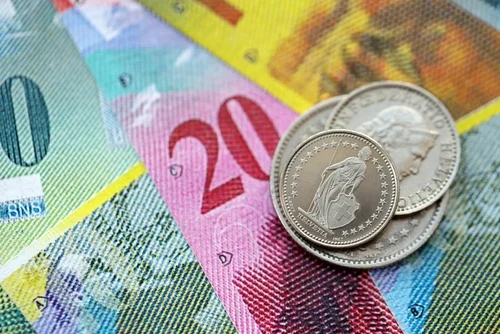
Banknotes come in six denominations: 10, 20, 50, 100, 200, and 1,000 francs. Coins run from 5, 10, and 20 centimes up to half, 1, 2, and 5 francs. The current banknote series, issued by the Swiss National Bank under the theme “the many facets of Switzerland,” uses a cotton-polymer blend with modern security features, per snb.ch. Subunit names vary by region: rappen in Swiss German, centime in French, centesimo in Italian, and rap in Romansh. It’s worth keeping some coins handy for transit machines and market stalls that don’t take cards. Switzerland’s currency independence stands out next to which countries do use the euro just across its borders.

The CHF currency code comes from Latin
CHF comes from the Latin words Confoederatio Helvetica franc. Confoederatio Helvetica means “Swiss Confederation,” and the Latin name avoids favouring any of Switzerland’s four official languages, which is also why you won’t see a symbol like $ or £ next to CHF prices.

The Swiss franc is the last franc in Europe
Switzerland is the only European country that still issues its own franc. The franc traces back to French currency reforms; Belgium and Luxembourg both used their own francs before switching to the euro, and outside Europe, only the CFA franc, used across West and Central Africa, remains active.

The Swiss franc is one of the world’s most traded currencies
The Swiss franc remains one of the most actively traded currencies globally, with the Bank for International Settlements’ 2025 Triennial Survey ranking it among the world’s top-traded currencies by daily turnover. Much of that demand reflects its safe-haven reputation, which is also part of why it tends to hold its value well against the Canadian dollar over time.

The CHF was previously pegged to foreign currencies
The franc was once pegged at a fixed parity to the French franc under the Latin Monetary Union. More recently, the Swiss National Bank set a widely watched cap of 1.20 CHF to 1 EUR between 2011 and 2015 to stop the franc from becoming too strong for Swiss exporters, before abandoning it and letting the franc float freely.

Swiss currency is partially backed by gold
Swiss voters removed the franc’s formal gold link in a 1999 referendum, then rejected a 2014 proposal for higher mandatory gold reserves. The SNB still holds a portion of its reserves in gold today, a detail it reports in its annual report.

The Swiss franc is official currency in Liechtenstein
Liechtenstein doesn’t issue its own currency, so the Swiss franc is legal tender there. The two countries share a customs and currency union, which is why Liechtenstein has no central bank of its own.

Switzerland has its own dominant mobile payment system: Twint
According to the Swiss Payment Monitor, conducted jointly by the University of St. Gallen and ZHAW Zurich University of Applied Sciences, Twint is clearly the dominant mobile payment app in Switzerland. The catch: Twint generally requires a Swiss bank account, so it typically isn’t available to Canadian travellers. Foreign Apple Pay and Google Pay don’t work through it either, since they rely on cards issued outside Switzerland. Visa and Mastercard remain widely accepted in Swiss cities, so a Canadian card covers most day-to-day spending without Twint.

Practical tips for Canadians using CHF in Switzerland
Switzerland has a reputation for being expensive. Per Numbeo’s cost-of-living data, an inexpensive restaurant meal runs about 25 CHF, a cappuccino around 5 CHF, and a one-way transit ticket roughly 3.50 CHF, noticeably higher than in most Canadian cities. It’s worth confirming Switzerland’s visa requirements for Canadians before you book, since Switzerland sits outside the EU’s common visa area. A few other things help:
- Cash vs. card: Cards are widely accepted in cities, but carry some franc cash for smaller shops and rural areas.
- Euro near the border: Some border-town shops accept euros, but usually give change in francs.
- Foreign transaction fees: Check whether your card charges one before you travel.
- Budgeting ahead: It’s worth reading up on budgeting for a longer stay in Switzerland so daily costs don’t surprise you.

Frequently asked questions about Switzerland’s currency
Q: What is Switzerland’s official currency?
A: The Swiss franc (CHF), not the euro, as Switzerland has never joined the European Union.
Q: Does Switzerland use the euro?
A: No. Switzerland uses the franc everywhere, though some border-town shops may accept euros, usually giving change back in francs.
Q: What does CHF stand for?
A: Confoederatio Helvetica Franc, the Latin name for Switzerland, which avoids favouring any one of its four official languages.
Q: Can I use my Canadian credit card in Switzerland?
A: Yes. Visa and Mastercard are widely accepted. Ask your card issuer about foreign transaction fees before you go.
Q: Is the Swiss franc a safe-haven currency?
A: Yes. Investors often turn to it during global uncertainty, which is part of why it tends to hold its value well over time.
Q: Is the Swiss franc used in any other countries?
A: Yes, it’s also the official currency of Liechtenstein, thanks to a long-standing currency union between the two countries.
Key takeaways
- Switzerland’s official currency is the Swiss franc (CHF), not the euro, shown using the code CHF or Fr. rather than a symbol.
- The franc remains one of the world’s most actively traded currencies, per the Bank for International Settlements’ 2025 Triennial Survey, largely due to its safe-haven reputation.
- Banknotes range from 10 to 1,000 francs, and coins from 5 centimes to 5 francs.
- Twint, Switzerland’s dominant mobile payment app, generally isn’t available to Canadian travellers without a Swiss bank account, though Visa and Mastercard are widely accepted.
- Switzerland’s cost of living runs high by most standards, a factor closely tied to Switzerland’s minimum wage, among the highest in the world.
Conclusion
Switzerland’s franc has stood apart from the euro for more than 170 years, and that independence still shapes prices and payments for visitors today. If you’re planning a trip or sending money to family or friends in Switzerland, it helps to understand CHF first, and Remitly can help with sending Switzerland money from Canada to Europe when you’re ready.
Last reviewed: November 2026.