Quick Answer
- A business cheque is a cheque issued by a company, rather than an individual, to pay suppliers, employees, service providers, or other business expenses.
- Before depositing one, check the payee, date, numerical and written amounts, MICR line, and signature to make sure the information is complete and consistent.
- The MICR line identifies the payment details, including the cheque number, five-digit transit number, three-digit institution number, and account number.
- Verify before you deposit. Look for mismatched details or suspicious requests, particularly if someone pressures you to deposit a cheque and quickly return part of the money.
- Deposited funds may not be available immediately. Canadian banks can place holds on cheque deposits, and stale-dated or incorrectly completed cheques may also require additional attention.
What is a business cheque? (Quick answer)
A business cheque is issued by a company, not an individual, and is widely used to pay suppliers, employees, and service providers in Canada. Payments Canada sets the standard format federally regulated banks follow, which is why a cheque from one Canadian bank reads much like one from another. This guide, part of the Remitly blog’s banking guides for Canada, walks through what each field means.
Quick answer: There are five Canadian business cheque parts to check: the payee line, the numerical and written amounts, the date, the MICR line (cheque number, five-digit transit number, three-digit institution number, and account number), and the signature line. Confirm all five before you deposit the cheque.
Cheques from federally regulated banks are often printed in both English and French, reflecting Canada’s official languages.

The parts of a Canadian business cheque
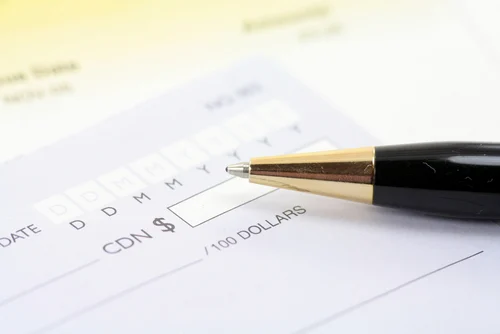
Here’s what you’ll find on a business cheque, from top to bottom:
- Payee line
- Date line
- Amount box (numerical)
- Amount line (written out)
- Memo line
- MICR line
- Cheque number
- Signature line
Payee line
The payee line has to show the recipient’s exact legal or registered business name. A cheque made out to a nickname or an outdated trading name can be delayed or refused at deposit. Sole proprietors sometimes see extra scrutiny here, since provincial registration rules mean a person’s legal name and their business’s registered name aren’t always identical. This is worth confirming with your bank, or reviewing the steps for opening a business bank account, if you’re unsure.
Date line
Cheques older than six months (stale-dated) may not be honoured by Canadian banks. This is common practice among Canadian banks, per guidance from the Canadian Bankers Association, rather than a fixed rule, so it’s usually simpler to request a replacement than assume an old cheque will clear. A post-dated cheque works the other way. It carries a future date, though banks can’t always catch one presented early.
Amount box and amount line
The amount box holds the numerical figure, such as $1,250.00, while the amount line spells it out in words. If the two don’t match, Canadian banking practice treats the written amount as accurate, so it’s worth checking both agree before you sign or deposit. A box reading “$1,250.00” next to a line reading “one thousand two hundred five dollars” would typically be processed for the lower, written amount.
The MICR line
You will find an MICR line on Canada cheques, which is a sequence of numbers crucial for processing. MICR stands for Magnetic Ink Character Recognition, and reading left to right it lists the cheque number, the transit number, the institution number, and the account number:
- Cheque number: matches the number printed in the top right corner.
- Transit (Branch) Number (5 digits): Identifies the branch where the account is held.
- Institution Number (3 digits): Identifies the bank or credit union.
- Account number: identifies your specific account at that institution.
Some of the more common institution numbers for Canadian banks are:
- RBC (Royal Bank of Canada): 003
- TD Canada Trust: 004
- Scotiabank: 002
- BMO: 001
- CIBC: 010
Credit unions have their own institution numbers, listed in Payments Canada’s directory.
Signature line
A business cheque needs the signature of someone authorized to sign for the company, often called a signing officer. Many businesses require two signatures once a cheque passes a certain amount, an added safeguard against one person authorizing a large payment alone. It’s worth checking that the signature looks handwritten rather than stamped or photocopied, since a copied signature is a common warning sign.

How to verify a Canadian business cheque before depositing
A quick check across a few fields can save you a bounced deposit or worse. Here’s how to verify a Canadian business cheque:
- Confirm the payee line matches your business’s exact registered name.
- Check that the date isn’t stale-dated (over six months old) or postdated further out than you expected.
- Make sure the numerical amount in the box and the written amount on the line agree.
- Compare the institution number on the MICR line against the bank name and logo printed on the cheque. A mismatch is a warning sign.
- Look for physical security features, such as a watermark or a distinct paper texture; a cheque that feels unusually thin or glossy is worth a second look.
- Be cautious if whoever handed you the cheque pressures you to deposit it quickly and send back part of the funds, as the Canadian Anti-Fraud Centre flags this as a common cheque scam. Reviewing general online banking safety habits helps too.
How to endorse and deposit a business cheque in Canada
Once you’re ready to deposit, you need to first know how to endorse a cheque in Canada correctly, so it clear without delay.
- Flip the cheque over and sign your name on the back, matching how it’s signed on the front.
- Write “For Deposit Only” with your account number for added security.
- If you’re depositing by mobile app, follow your bank’s specific instructions. Most ask you to add “for mobile deposit only” beside your signature.
You can deposit a business cheque in person, through an ATM, or using your bank’s mobile app. If you make an endorsement error before depositing, voiding a cheque and requesting a fresh one is usually simpler than correcting it.
The Financial Consumer Agency of Canada notes that banks can generally hold cheque funds for up to four business days, or up to seven for a cheque over $1,500 into an account open less than 90 days.

Frequently asked questions about Canadian business cheques
What is the MICR line on a Canadian cheque?
The MICR line is the row of numbers along the bottom of a cheque, printed in ink that banking equipment reads automatically. On a Canadian business cheque, it lists the cheque number, a five-digit transit number, a three-digit institution number, and the account number.
How long is a business cheque valid in Canada?
Cheques older than six months (stale-dated) may not be honoured by Canadian banks. This is common practice rather than a fixed law, so it’s worth asking the issuer for a replacement instead of assuming it will still clear.
What happens if a cheque has the wrong business name on it?
A cheque made out to the wrong name, a nickname, or an outdated trading name may be refused at deposit, since the payee line must match your business’s registered name. Asking the issuer for a corrected cheque is usually easier than trying to have the original accepted.
What do the numbers at the bottom of a cheque mean?
The numbers along the bottom make up the MICR line, which identifies the cheque and the account it’s drawn on: the cheque number comes first, followed by the five-digit transit number, the three-digit institution number, and the account number, in that order.
What should I do if I think a cheque is fraudulent?
Don’t deposit it. Contact your bank and the issuing bank to verify it directly, and report the attempt to the Canadian Anti-Fraud Centre. Be especially cautious if someone asks you to deposit a cheque and quickly send back part of the funds, as this is a common cheque scam in Canada.
Can I deposit a business cheque into my personal account?
Canadian banks require cheques made out to a business be deposited into a business account of the same name. Sole proprietors are sometimes an exception, since their personal and business names can be treated as the same. It’s worth checking with your bank if you’re unsure.
What is a post-dated cheque?
A post-dated cheque carries a future date because the person writing it doesn’t want it cashed until then. Canadian banks can’t always catch a post-dated cheque presented early, so the date alone isn’t a guarantee it won’t be processed sooner.
Key takeaways
- A Canadian business cheque’s MICR line packs four details into one row: the cheque number, a five-digit transit number, a three-digit institution number, and the account number.
- When the numerical and written amounts on a cheque don’t match, Canadian banking practice treats the written amount as the accurate one.
- A stale-dated cheque in Canada is generally a check after six months of its date, though individual banks can still choose to honour one.
- The Financial Consumer Agency of Canada lets banks hold cheque funds up to four business days, or up to seven for cheques over $1,500 into newer accounts.
- Being asked to deposit a cheque and quickly return part of the funds is a common cheque fraud in Canada that the Canadian Anti-Fraud Centre warns against.
Last reviewed: November 2026.