

The Remote Jobs Index 2026
Remote work is no longer the exception. Five years after the start of the pandemic, Americans were still working from home for an average of 1.6 days per week, while in the UK this figure remained at 1.8 days per week, according to the Stanford Institute for Economic Policy Research (opens in new window) (SIEPR)1.
There are 31 countries where more than half of all LinkedIn job listings are for remote roles, according to publicly available data analyzed by Remitly in May, 2026. But equally, employers in some of the most desirable digital nomad destinations2, such as the UK, Thailand or the U.S., list just one in 10 roles or fewer as remote.
To find out which countries have the most remote work availability overall, and also specifically for entry-level roles, Remitly searched LinkedIn using the country and job category filters. We calculated the percentage of the thousands of job listings in each location tagged as remote and the average number of applicants to estimate the level of competition for remote jobs around the world. Note: This report is not affiliated with or endorsed by LinkedIn.
There are 31 countries where more than half of all LinkedIn job listings are for remote roles, according to publicly available data analyzed by Remitly in May, 2026. But equally, employers in some of the most desirable digital nomad destinations2, such as the UK, Thailand or the U.S., list just one in 10 roles or fewer as remote.
To find out which countries have the most remote work availability overall, and also specifically for entry-level roles, Remitly searched LinkedIn using the country and job category filters. We calculated the percentage of the thousands of job listings in each location tagged as remote and the average number of applicants to estimate the level of competition for remote jobs around the world. Note: This report is not affiliated with or endorsed by LinkedIn.
Key findings
- China has the fewest remote jobs available, with just 2.7% of LinkedIn listings tagged “remote.”
- Just 7.6% of job vacancies in Australia are remote, 8.4% in the U.S. and 10.1% in the UK.
- In Europe, the countries with the highest percentage of entry-level positions among remote vacancies are Bosnia and Herzegovina (9.1%), Moldova (8.3%) and Iceland (8.3%).
- More than 90% of jobs advertised in the African countries of Equatorial Guinea, Congo, Cape Verde and Sierra Leone are tagged as remote work.
- Some 12.1% of remote job ads in Laos are listed as entry-level positions — the most of any country.
- There are just 21 applicants on LinkedIn per remote job listing in Morocco, making it the country with the least competition for remote work.
The UK, U.S. and Australia among countries with fewest remote jobs
First, we calculated the percentage of available jobs in every country that are tagged as remote work. The country with the lowest proportion of remote jobs is China*, where just 2.7% of LinkedIn listings are for remote work. We also found three anglophone countries among the bottom fifteen: Australia (7.6%), the U.S. (8.4%) and the UK (10.1%).
A 2025 report3 from the Australian Digital Inclusion Index found that 68.4% of professionals and 45.3% of clerical workers work from home rather than onsite at least once per week, indicating that hybrid rather than fully remote work is more common.
*LinkedIn is officially blocked in China. However, unofficially, residents may still access it via a VPN. Additionally, job vacancies posted with a Chinese location are attractive to foreigners who may move to China (opens in new window) for work.
A 2025 report3 from the Australian Digital Inclusion Index found that 68.4% of professionals and 45.3% of clerical workers work from home rather than onsite at least once per week, indicating that hybrid rather than fully remote work is more common.
*LinkedIn is officially blocked in China. However, unofficially, residents may still access it via a VPN. Additionally, job vacancies posted with a Chinese location are attractive to foreigners who may move to China (opens in new window) for work.
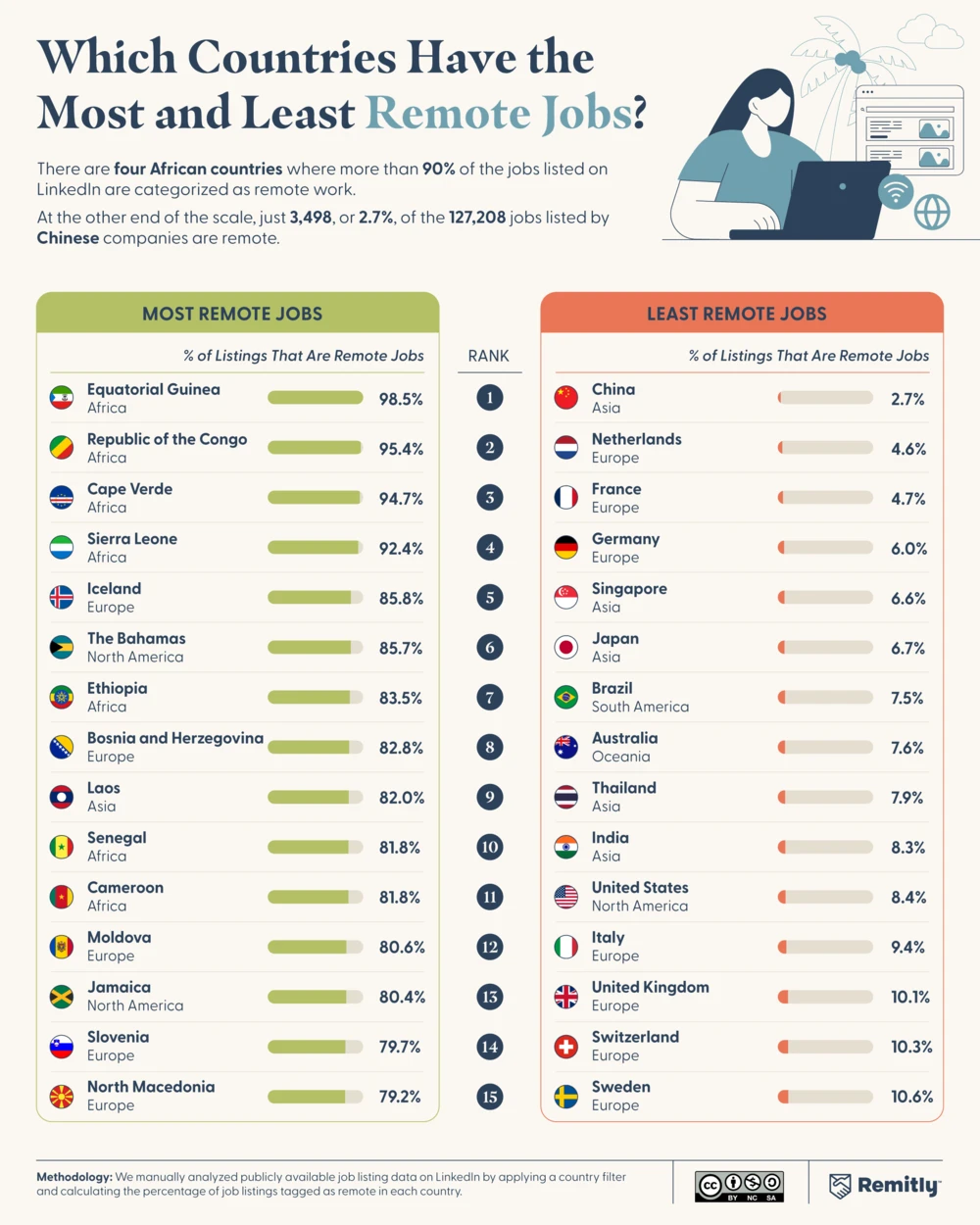
The countries where it’s easier to find remote jobs advertised are mostly in Africa, Central and Eastern Europe, and — just outside the top 15 — Spanish-speaking countries, including Bolivia (opens in new window) (78.1%), Uruguay (73.2%) and Venezuela (64.7%).
Those who speak English may find it easier to operate in Sierra Leone (opens in new window) (92.4%), the Bahamas (85.7%), Cameroon (81.8%) or Jamaica (80.4%), where English is a major language, if not the most common.
Those who speak English may find it easier to operate in Sierra Leone (opens in new window) (92.4%), the Bahamas (85.7%), Cameroon (81.8%) or Jamaica (80.4%), where English is a major language, if not the most common.
Just 8.4% of U.S. job ads are tagged for remote work
Next, we broke down our results by continent. The U.S. (8.4%) and Canada (13.7%) have among the lowest proportions of remote jobs available in North America and globally.
Employers in the U.S. have gradually repealed work-from-home policies since the pandemic. In 2025, 54% of Fortune 100 desk workers were mandated to work in the office full-time, up from just 5% two years earlier4.
Employers in the U.S. have gradually repealed work-from-home policies since the pandemic. In 2025, 54% of Fortune 100 desk workers were mandated to work in the office full-time, up from just 5% two years earlier4.
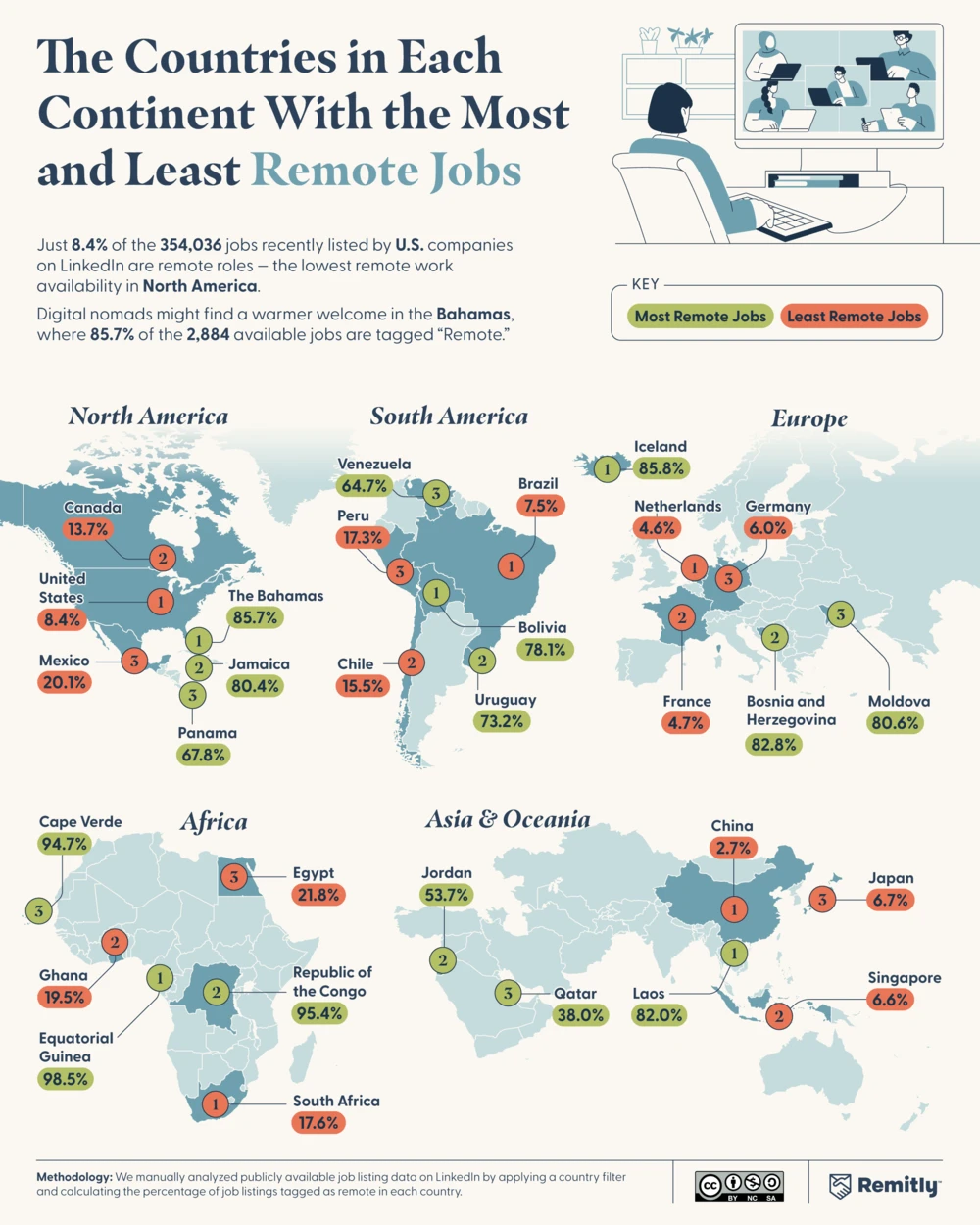
There are better pickings for remote work seekers in the Bahamas (opens in new window) (85.7%), Jamaica (80.4%) and Panama (67.8%). Foreigners who already work remotely may also stay in the Bahamas for up to a year with a Bahamas Extended Access Travel Stay (BEATS) permit — although successful applicants face a permit fee of up to $1,000 USD per person5.
In Europe, Iceland (opens in new window) (85.8%), Bosnia and Herzegovina (82.8%) and Moldova (80.6%) have the highest proportions of remote job listings on LinkedIn. On the flipside, we found that only 4.6% of jobs in the Netherlands are advertised as fully remote, even though since 2016, employees have had the right to request to work remotely6 — some of the time, at least.
In Europe, Iceland (opens in new window) (85.8%), Bosnia and Herzegovina (82.8%) and Moldova (80.6%) have the highest proportions of remote job listings on LinkedIn. On the flipside, we found that only 4.6% of jobs in the Netherlands are advertised as fully remote, even though since 2016, employees have had the right to request to work remotely6 — some of the time, at least.
Laos is a hiring hotspot for remote jobs at entry level
Entry-level remote jobs represent a great opportunity for those fresh out of education to work while they travel or for those in an industry that discourages remote work to get started in a more amenable sector. To find where such jobs are most prevalent, we first filtered for remote vacancies and then for entry-level remote jobs for each location on LinkedIn’s job platform, and compared the two figures.
We found that the most promising destination for entry-level remote work is Laos (opens in new window), in Asia, where 12.1% of remote job listings are also listed as entry level. However, the majority of the most opportune places are African and European, including Cape Verde (10.5%), Ethiopia (10.0%) and Bosnia and Herzegovina (9.1%).
We found that the most promising destination for entry-level remote work is Laos (opens in new window), in Asia, where 12.1% of remote job listings are also listed as entry level. However, the majority of the most opportune places are African and European, including Cape Verde (10.5%), Ethiopia (10.0%) and Bosnia and Herzegovina (9.1%).
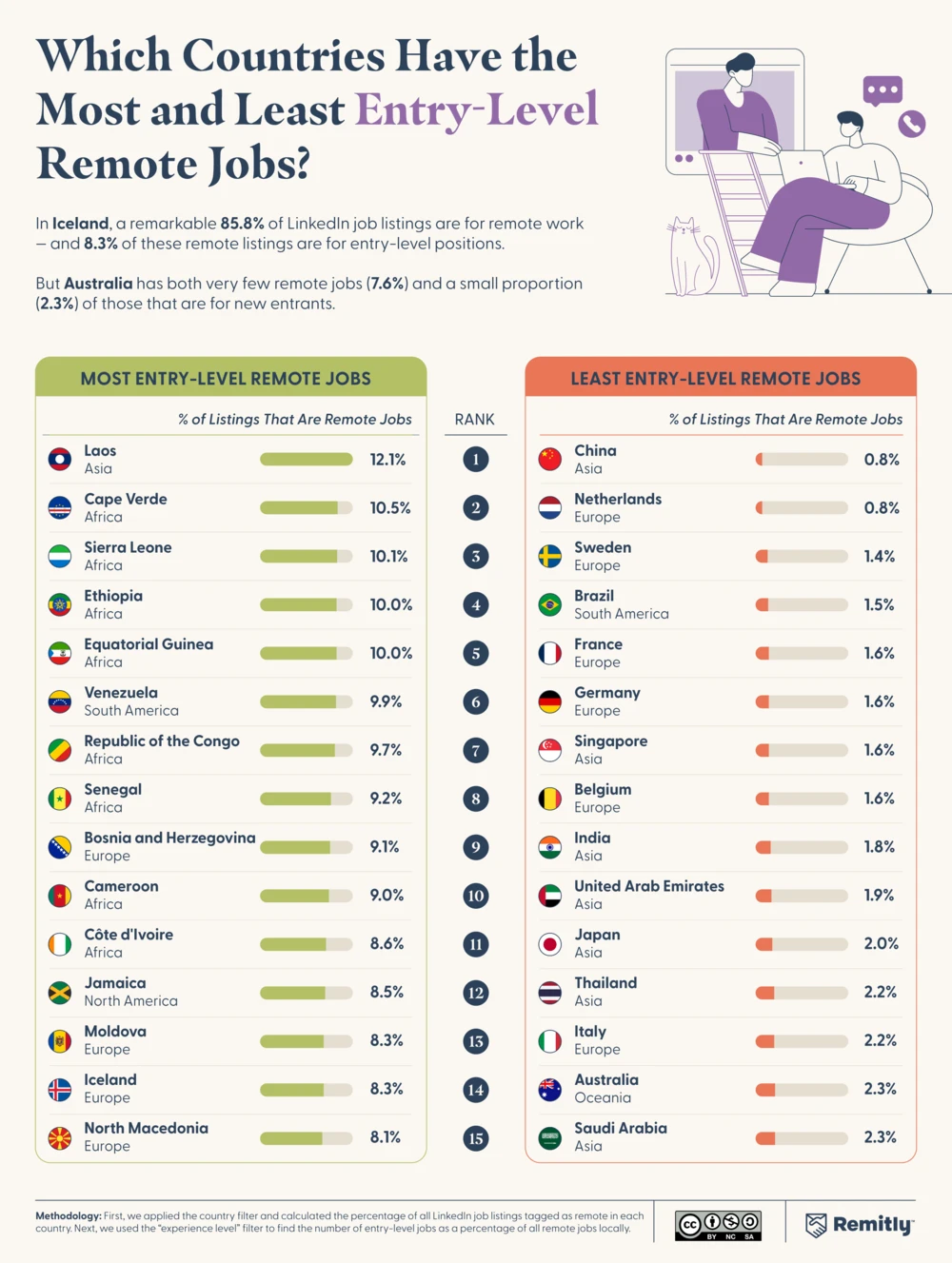
At the other extreme, just 0.8% of remote job ads in China or the Netherlands are for entry-level positions. The UK (2.9%) and the U.S. (3.6%) also have a fraction of the entry-level remote jobs offered by some of their neighbors.
The number of entry-level jobs (remote or otherwise) in the UK has reportedly fallen by one-third7 between 2022 and 2025. Financial Times chief data reporter John Burn-Murdoch has argued that remote work itself has made UK firms more reluctant to take on junior employees, who may be harder to onboard and train remotely8.
The number of entry-level jobs (remote or otherwise) in the UK has reportedly fallen by one-third7 between 2022 and 2025. Financial Times chief data reporter John Burn-Murdoch has argued that remote work itself has made UK firms more reluctant to take on junior employees, who may be harder to onboard and train remotely8.
Brazil among South American countries with fewest remote entry-level positions
Our research shows that the South American countries with the highest percentage of remote jobs classed as entry level are Venezuela (9.9%), Bolivia (7.9%) and Uruguay (7.9%).
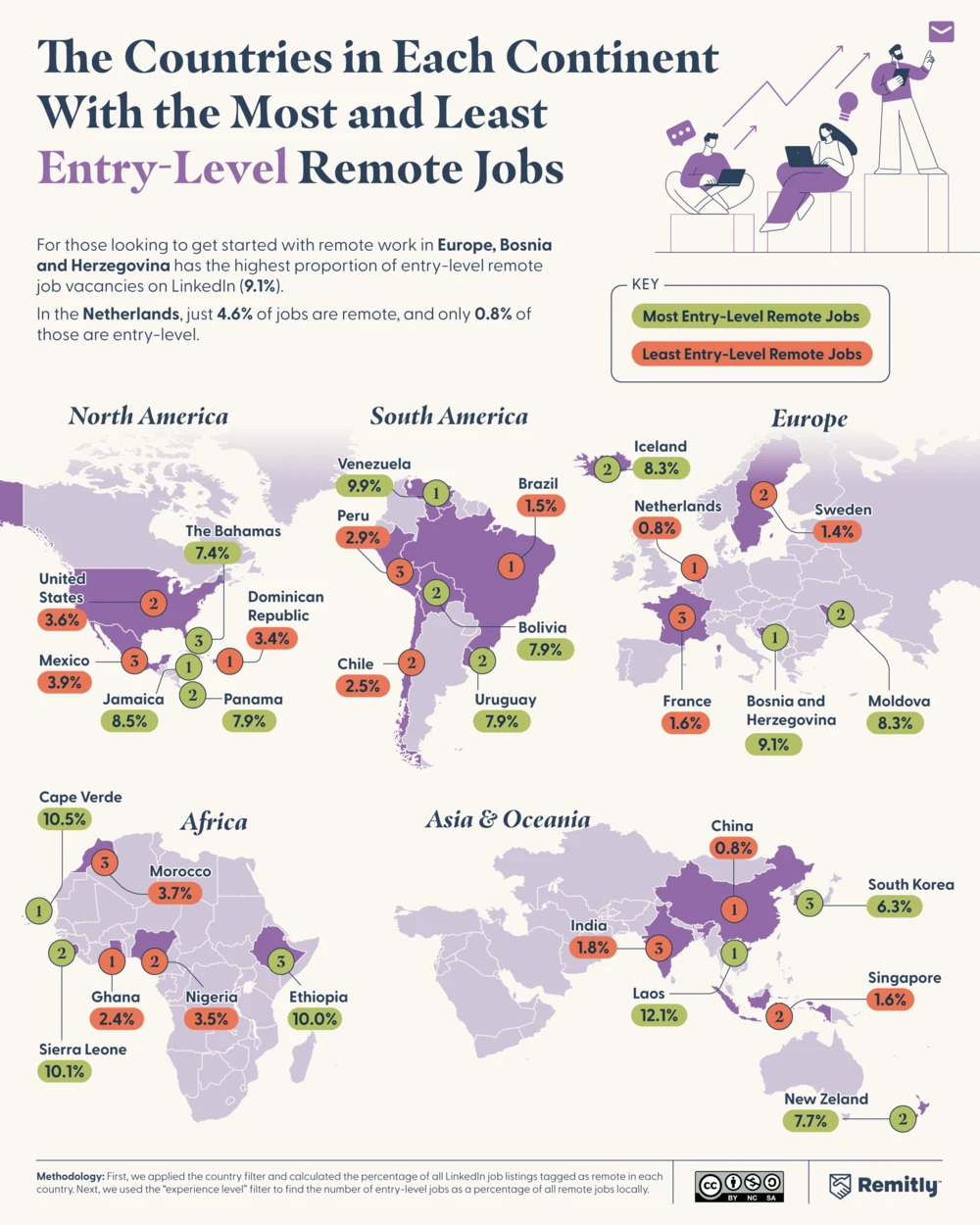
Brazil (opens in new window), on the other hand, has the world’s seventh-lowest proportion of remote vacancies (7.5%), and just 1.5% of these jobs are entry level.
Brazil’s digital infrastructure has vastly improved in recent years. But a lack of appropriate hardware at household level, plus strict labor laws protecting employees from the additional costs involved with a remote work setup, may discourage employers from creating remote (particularly entry-level) roles9.
Brazil’s digital infrastructure has vastly improved in recent years. But a lack of appropriate hardware at household level, plus strict labor laws protecting employees from the additional costs involved with a remote work setup, may discourage employers from creating remote (particularly entry-level) roles9.
The U.S. is among the most competitive markets for remote work
Finally, we looked at the level of competition for remote jobs in every country by comparing the number of remote job ads on LinkedIn with the number of applicants.
There are an average of 983 job applications per remote role in Qatar (opens in new window) — the fiercest competition of any country. This application rate is closely followed by India (964 applications per vacancy) and the U.S. (905). A falling number of vacancies in the U.S. since 202210, along with a trend of firms issuing back-to-office mandates, has made every remote role a hot property.
There are an average of 983 job applications per remote role in Qatar (opens in new window) — the fiercest competition of any country. This application rate is closely followed by India (964 applications per vacancy) and the U.S. (905). A falling number of vacancies in the U.S. since 202210, along with a trend of firms issuing back-to-office mandates, has made every remote role a hot property.
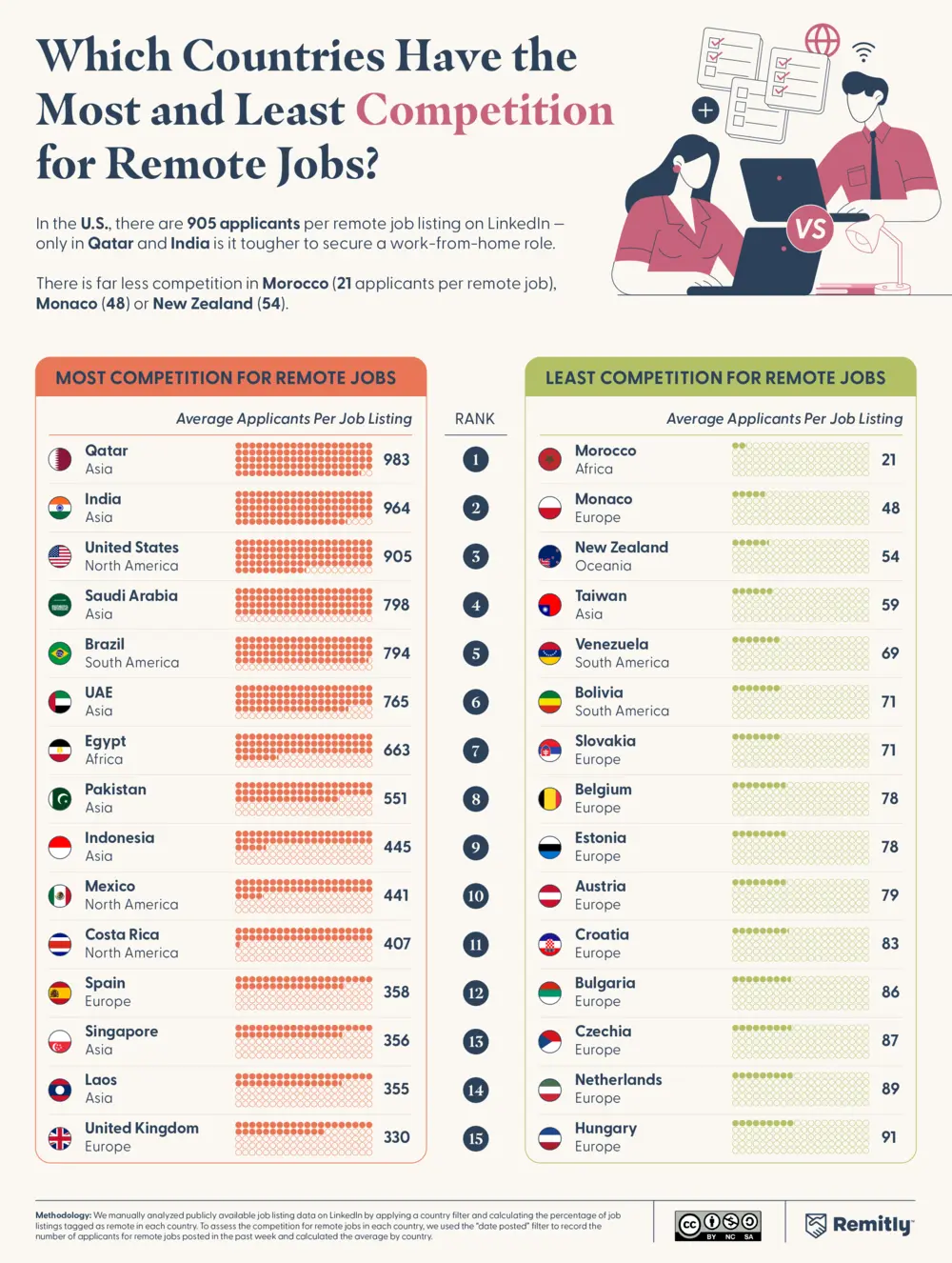
The country with the least competition for remote jobs is Morocco, with 21 applications per vacancy, followed by Monaco (48 per vacancy) and New Zealand (54).
The availability of remote work has soared in New Zealand, reportedly rising from just 1.3% of job ads in February 202011 to 21.6% according to the figures in Remitly’s study. Digital nomads may do an unlimited amount of work for overseas companies while holding a visitor visa but require a different visa if they are to do remote work for a New Zealand company12.
The availability of remote work has soared in New Zealand, reportedly rising from just 1.3% of job ads in February 202011 to 21.6% according to the figures in Remitly’s study. Digital nomads may do an unlimited amount of work for overseas companies while holding a visitor visa but require a different visa if they are to do remote work for a New Zealand company12.
How to get a competitive edge when applying for remote work
There can be between a few dozen and nearly 1,000 applicants for each remote vacancy, depending on the country in which you find yourself. Here are some tips on how to give yourself a competitive advantage when applying for a remote role.
- Describe your remote experience. If you’ve done remote work before, flag it on your resume, including details of how you managed your time to complete specific deliverables. Ask previous remote employers for a testimonial to show you are trusted.
- Network endlessly. Build trust with potential future employers by following up on applications that were ultimately unsuccessful. If you’re already traveling, use social media and meet-up services to connect with other expats locally.
- Figure out where the market is viable. Use Remitly’s figures above to identify potential destinations with a high proportion of remote jobs and low competition. You will need to check each country’s rules for foreigners working remotely for a local or overseas employer.
Methodology
We manually analyzed around 7.8 million job listings from LinkedIn Jobs to determine the availability and competition for remote jobs around the world throughout May 2026.
First, we applied the country filter and calculated the percentage of all job listings tagged as remote jobs in each country. Next, we used the “experience level” filter and calculated the percentage of remote jobs tagged as entry level.
To assess competition for remote jobs in each country, we used the “Date posted” filter to record the number of applicants for jobs posted in the past week in order to calculate the average per job by country.
Trademarks, trade names and logos displayed are registered trademarks of their respective owners. No affiliation or endorsement of Remitly should be implied. Note: This report is not affiliated with or endorsed by LinkedIn.
References
[1] Stanford Institute for Economic Policy Research (SIEPR) (2025). Working from Home in 2025: Five Key Facts. https://siepr.stanford.edu/publications/essay/working-home-2025-five-key-facts (opens in new window)
[2] Pumble (2025). Digital Nomad Statistics for 2025. https://pumble.com/learn/digital-nomad-visa/statistics/ (opens in new window)
[3] Australian Digital Inclusion Index (2025). Case study: The uneven shift to remote work in Australia. https://digitalinclusionindex.org.au/case-study-the-uneven-shift-to-remote-work-in-australia/ (opens in new window)
[4] Fortune (2025). For the first time since COVID, more than half of Fortune 100 desk workers are mandated to fully return to work, report finds. https://fortune.com/2025/07/18/return-to-office-hybrid-work-fortune-100-companies (opens in new window)
[5] The Islands of the Bahamas (2026). The 411 On Living in The Bahamas. https://www.bahamasbeats.com/faq (opens in new window)
[6] IamExpat (2025). Working hours in the Netherlands. https://www.iamexpat.nl/career/working-in-the-netherlands/working-hours (opens in new window)
[7] The Guardian (2025). Number of new UK entry-level jobs has dived since ChatGPT launch – research. https://www.theguardian.com/business/2025/jun/30/uk-entry-level-jobs-chatgpt-launch-adzuna (opens in new window)
[8] Financial Times (2026). What if remote working, not AI, is to blame for weak junior hiring? https://www.ft.com/content/2205e2d0-50dc-4e80-9bf7-78d0272276c0 (opens in new window)
[9] Human Resource Development International (2022). Connecting and relating in Brazil: implications of remote work. https://www.tandfonline.com/doi/full/10.1080/13678868.2022.2048435 (opens in new window)
[10] Trading Economics (2026). United States Job Openings. https://tradingeconomics.com/united-states/job-offers (opens in new window)
[11] SEEK (2024). Work-from-home rate still high in New Zealand. https://nz.seek.com/about/news/article/economist-insight-jan24 (opens in new window)
[12] Immigration New Zealand (2026). Working remotely in New Zealand on a visitor visa. https://www.immigration.govt.nz/visit/checking-or-changing-the-conditions-of-your-visitor-visa-or-nzeta/working-remotely-in-new-zealand-on-a-visitor-visa/ (opens in new window)
First, we applied the country filter and calculated the percentage of all job listings tagged as remote jobs in each country. Next, we used the “experience level” filter and calculated the percentage of remote jobs tagged as entry level.
To assess competition for remote jobs in each country, we used the “Date posted” filter to record the number of applicants for jobs posted in the past week in order to calculate the average per job by country.
Trademarks, trade names and logos displayed are registered trademarks of their respective owners. No affiliation or endorsement of Remitly should be implied. Note: This report is not affiliated with or endorsed by LinkedIn.
References
[1] Stanford Institute for Economic Policy Research (SIEPR) (2025). Working from Home in 2025: Five Key Facts. https://siepr.stanford.edu/publications/essay/working-home-2025-five-key-facts (opens in new window)
[2] Pumble (2025). Digital Nomad Statistics for 2025. https://pumble.com/learn/digital-nomad-visa/statistics/ (opens in new window)
[3] Australian Digital Inclusion Index (2025). Case study: The uneven shift to remote work in Australia. https://digitalinclusionindex.org.au/case-study-the-uneven-shift-to-remote-work-in-australia/ (opens in new window)
[4] Fortune (2025). For the first time since COVID, more than half of Fortune 100 desk workers are mandated to fully return to work, report finds. https://fortune.com/2025/07/18/return-to-office-hybrid-work-fortune-100-companies (opens in new window)
[5] The Islands of the Bahamas (2026). The 411 On Living in The Bahamas. https://www.bahamasbeats.com/faq (opens in new window)
[6] IamExpat (2025). Working hours in the Netherlands. https://www.iamexpat.nl/career/working-in-the-netherlands/working-hours (opens in new window)
[7] The Guardian (2025). Number of new UK entry-level jobs has dived since ChatGPT launch – research. https://www.theguardian.com/business/2025/jun/30/uk-entry-level-jobs-chatgpt-launch-adzuna (opens in new window)
[8] Financial Times (2026). What if remote working, not AI, is to blame for weak junior hiring? https://www.ft.com/content/2205e2d0-50dc-4e80-9bf7-78d0272276c0 (opens in new window)
[9] Human Resource Development International (2022). Connecting and relating in Brazil: implications of remote work. https://www.tandfonline.com/doi/full/10.1080/13678868.2022.2048435 (opens in new window)
[10] Trading Economics (2026). United States Job Openings. https://tradingeconomics.com/united-states/job-offers (opens in new window)
[11] SEEK (2024). Work-from-home rate still high in New Zealand. https://nz.seek.com/about/news/article/economist-insight-jan24 (opens in new window)
[12] Immigration New Zealand (2026). Working remotely in New Zealand on a visitor visa. https://www.immigration.govt.nz/visit/checking-or-changing-the-conditions-of-your-visitor-visa-or-nzeta/working-remotely-in-new-zealand-on-a-visitor-visa/ (opens in new window)
Beyond Borders: The Official Remitly Blog

Digital Nomad Visa 101: How to Work Remotely in a New Country
Read more (opens in new window)
Best Payment Methods for Freelancers with International Clients
Read more (opens in new window)
Top 10 High Quality of Life, Low Cost of Living Countries 2025
Read more (opens in new window)This publication is provided for general information purposes only and is not intended to cover all aspects of the topics discussed herein. This publication is not a substitute for seeking advice from an applicable specialist or professional. The content in this publication does not constitute legal, tax, or other professional advice from Remitly or any of its affiliates and should not be relied upon as such. While we strive to keep our posts up to date and accurate, we cannot represent, warrant or otherwise guarantee that the content is accurate, complete or up to date.