

The Global Freelancer Pay Gap Report
The principle of “equal pay for equal work” is enshrined in national legislation and international human rights laws1. But for freelancers trading their time and skills on the open market, the issue may seem less clear-cut. Gig work can be more precarious than regular employment and hiring practices are sometimes opaque. In offering competitive rates (opens in new window), freelancers may undervalue their labor and miss out on their due worth.
As Remitly’s new study reveals, this could particularly be the case for women, who must navigate the structural inequalities of the broader world of work alongside internalized prejudices when setting their freelance rates.
Indeed, Remitly for Freelancers (opens in new window) found that, when comparing rates for 58,261 freelancers across similar roles globally, women charge 19% less per hour than men. This creates a Freelancer Equal Pay Day of March 11 — the day in the year when women freelancers working the same hours as men since January 1 effectively stop working for free and start earning the same as men.
To identify the freelancer pay gap globally and for each country, we analyzed the listed hourly rates of freelancers in the featured roles (e.g., Project Managers) for each major work category (e.g., Admin & Support) on the gig work platform Upwork. Note: This report is not affiliated with or endorsed by Upwork.
As Remitly’s new study reveals, this could particularly be the case for women, who must navigate the structural inequalities of the broader world of work alongside internalized prejudices when setting their freelance rates.
Indeed, Remitly for Freelancers (opens in new window) found that, when comparing rates for 58,261 freelancers across similar roles globally, women charge 19% less per hour than men. This creates a Freelancer Equal Pay Day of March 11 — the day in the year when women freelancers working the same hours as men since January 1 effectively stop working for free and start earning the same as men.
To identify the freelancer pay gap globally and for each country, we analyzed the listed hourly rates of freelancers in the featured roles (e.g., Project Managers) for each major work category (e.g., Admin & Support) on the gig work platform Upwork. Note: This report is not affiliated with or endorsed by Upwork.
Key findings
- Women freelancers charge an average of 19.0% less than men globally.
- The worst-affected job category in the study is Finance and Accounting, where freelance women charge 26.1% less than men.
- In Design and Creative categories, the largest pay gap is for YouTube Video Editors (23.4%).
- In the U.S. (16.9%) and Canada (16.2%), the overall freelancer pay gap is higher than in the UK (15.4%).
The freelancer pay gap is 19% globally
First, we calculated average freelancer rates around the world using the stated charges of freelancers in featured roles of the major freelance categories. We found that women charge an average of $31.33 USD per hour, which is 19.0% less than men ($38.66 USD).
By comparison, United Nations2 data puts the gender pay gap across all (not just freelancer) work of equal value at 23%, with an even wider wage gap for women with children. And across all paid work, regardless of equal value, the World Inequality Report 2026 found the pay gap per hour to be 39% (rising to 68% when “unpaid domestic and care labor is included”3).
If you need to pay a freelancer in another country, consider using Remitly Business (opens in new window), which supports over 100 currencies.
By comparison, United Nations2 data puts the gender pay gap across all (not just freelancer) work of equal value at 23%, with an even wider wage gap for women with children. And across all paid work, regardless of equal value, the World Inequality Report 2026 found the pay gap per hour to be 39% (rising to 68% when “unpaid domestic and care labor is included”3).
If you need to pay a freelancer in another country, consider using Remitly Business (opens in new window), which supports over 100 currencies.
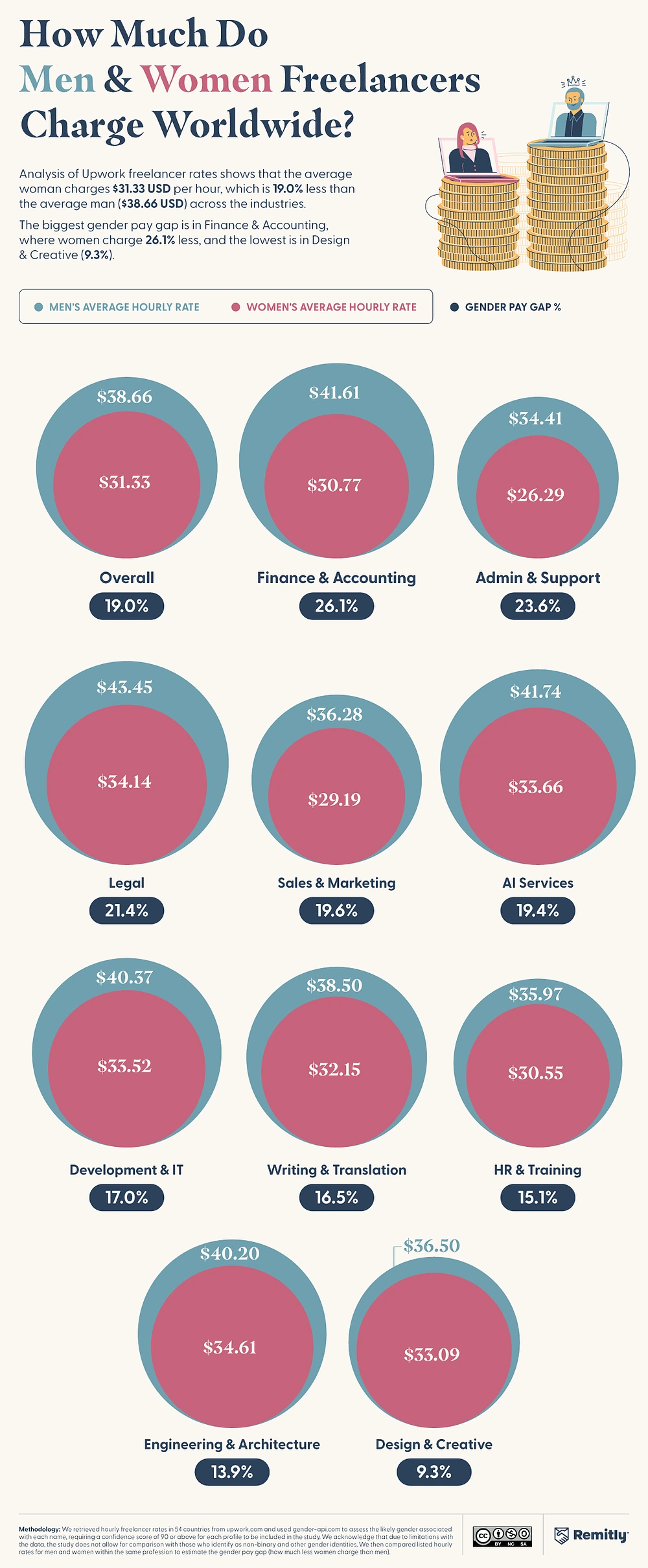
However, the extent of the freelancer pay gap differs significantly between job categories. We found that the average woman freelancing in Finance and Accounting charges 26.1% less than the average man. That gap is 2.8 times larger than in the Design and Creative category, where women charge 9.3% less than men. We explore some of these categories and their roles further below.
European and Asian countries among those with the biggest freelancer pay gap
Our next graphic illustrates the gap between how much men and women charge for their freelance work in each country. Of those countries in our data analysis, Thailand has the largest pay gap of the countries with available data, with women ($30.68 USD per hour) charging 51.7% less than men ($63.57 USD).
While five of the 10 countries with the biggest freelancer pay gap are in Asia, four are in Europe. The European Union (EU) reports that the general pay gap for work of equal value (including both freelancers and permanent employees) is 11%, far below the freelancer pay gaps of Hungary (45.0%), the Czech Republic (40.1%) and Romania (33.3%)4. (Please note the fourth European country, Georgia, is not yet an EU member.)
While five of the 10 countries with the biggest freelancer pay gap are in Asia, four are in Europe. The European Union (EU) reports that the general pay gap for work of equal value (including both freelancers and permanent employees) is 11%, far below the freelancer pay gaps of Hungary (45.0%), the Czech Republic (40.1%) and Romania (33.3%)4. (Please note the fourth European country, Georgia, is not yet an EU member.)
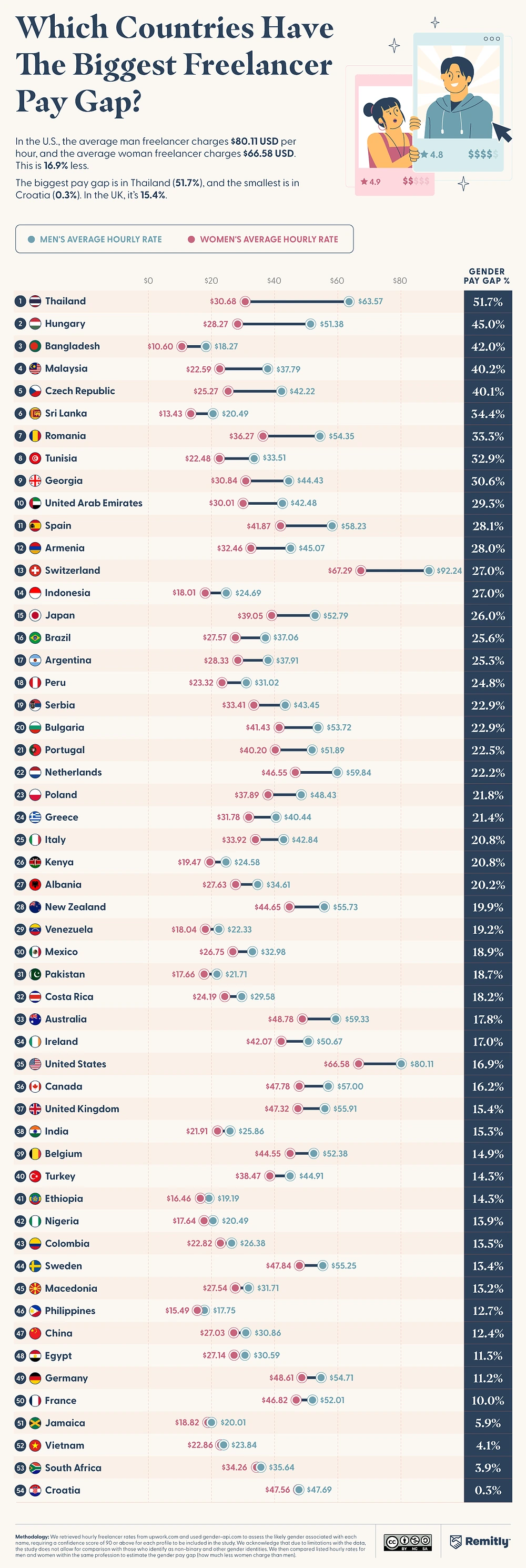
Australia (17.8%), Ireland (17.0%), the U.S. (16.9%), Canada (16.2%) and the UK (15.4%) rank in a row with the 33rd-37th biggest freelancer gaps out of 54 countries with available data.
In the UK, the Association of Independent Professionals and the Self-Employed (IPSE) found that nearly half (49%) of self-employed women worry about their finances “all or most of the time,” compared to 37% of men5. They also found that only a third (33%) of freelancers claimed their full 39-week maternity allowance while pregnant, with 30% claiming none at all.
All the same, surveys report that women have quit employment with companies with a post-COVID “return to office” in disproportionate numbers, many in an effort to find a better balance between their paid and unpaid labor6.
In the UK, the Association of Independent Professionals and the Self-Employed (IPSE) found that nearly half (49%) of self-employed women worry about their finances “all or most of the time,” compared to 37% of men5. They also found that only a third (33%) of freelancers claimed their full 39-week maternity allowance while pregnant, with 30% claiming none at all.
All the same, surveys report that women have quit employment with companies with a post-COVID “return to office” in disproportionate numbers, many in an effort to find a better balance between their paid and unpaid labor6.
The roles with the largest freelancer pay gaps around the world
Project Managers, in the Admin and Support category, are worst off in the joint-most countries: Turkey (47.1%), Peru (40.4%), Netherlands (35.9%), Armenia (32.9%) and Jamaica (15.6%). Financial Analysts also have the highest pay gap in five countries.
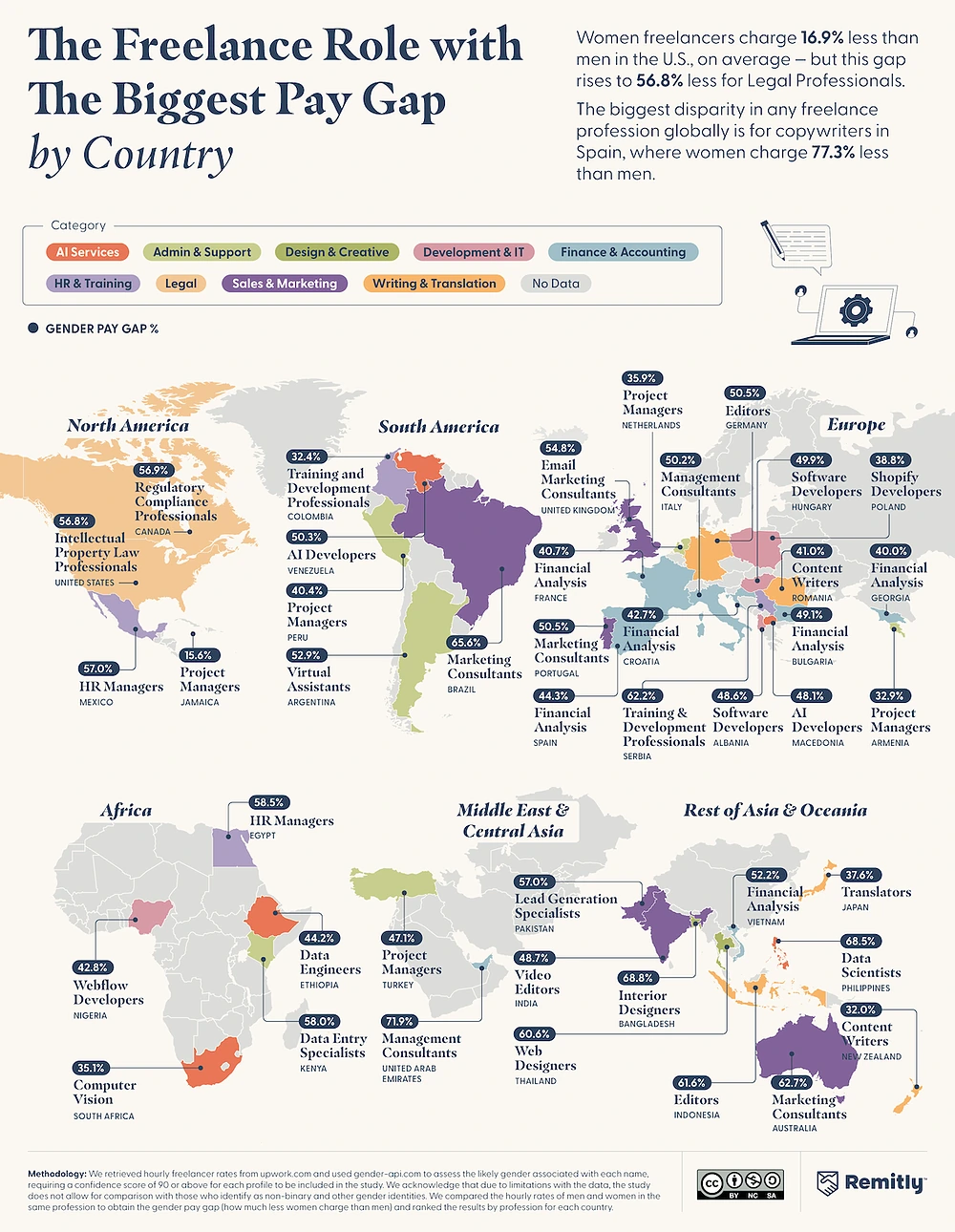
In the U.S., the biggest freelancer pay gap is between Intellectual Property Law Professionals. Men freelancing in this role charge an average of $140.57 USD per hour, while women charge $60.71 USD — a pay gap of 56.8%. One research paper found that women in the law profession may be more likely than men to take on freelance work without quitting their law firm job because “part-time work can be negatively perceived as a lack of commitment to the profession.”7
Women in this position may end up charging less per hour, partly due to the reduced time they have to bid for work assignments and limits on the types of assignments they are able to take. These conditions can hinder the capacity for a woman in this position to build her reputation, client base and payment rates.
Women in this position may end up charging less per hour, partly due to the reduced time they have to bid for work assignments and limits on the types of assignments they are able to take. These conditions can hinder the capacity for a woman in this position to build her reputation, client base and payment rates.
Multiple freelance roles in AI have a gender pay gap of over 20%
We also broke down the major job categories by specialism to see which featured roles have the largest freelancer pay disparities out of our analyzed dataset.
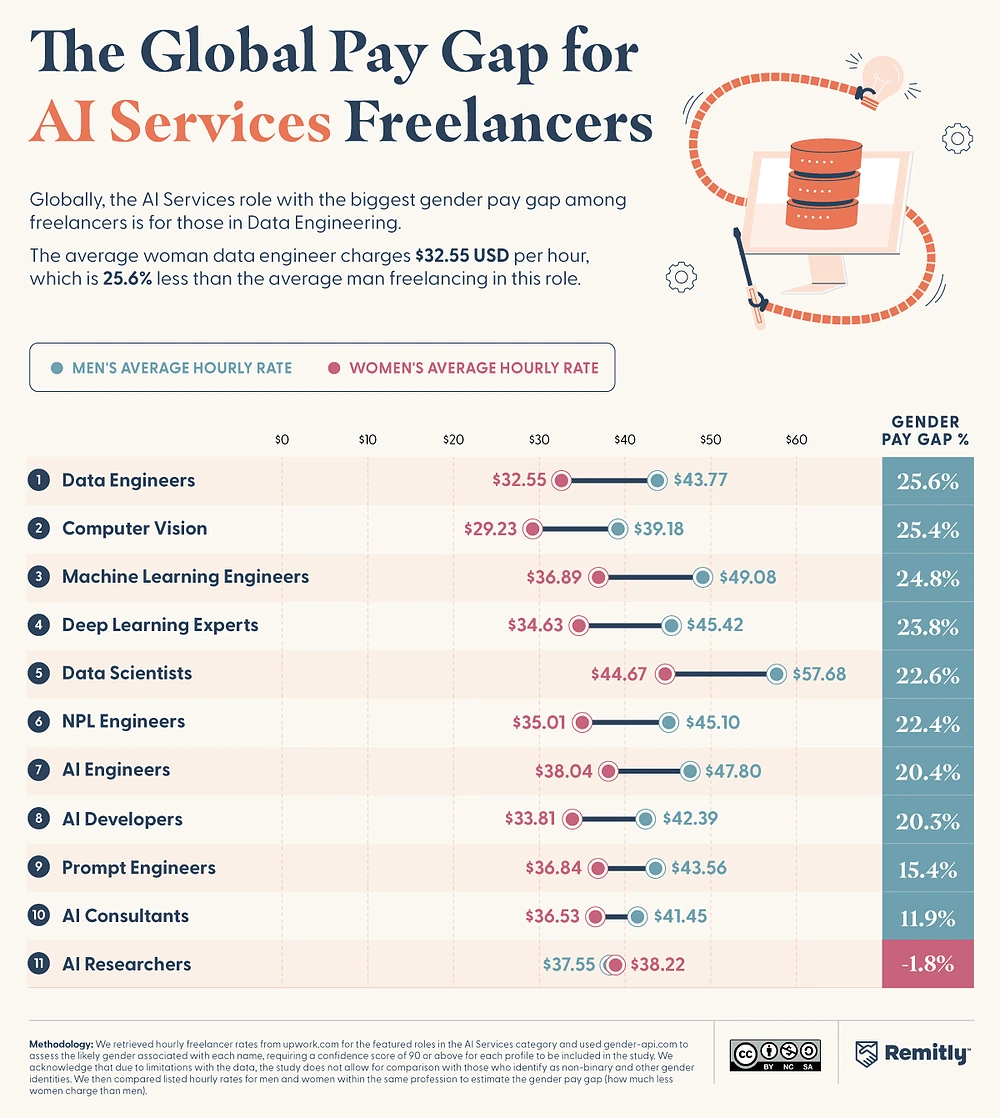
In AI services, the pay gap consistently exceeds 20% across the seven worst-affected roles, with Data Engineers (25.6%) and Computer Vision freelancers (25.4%) experiencing the most profound disparity. Conversely, AI Researchers who are women actually charge an average of 1.8% more than men, based on a sample of 495 freelancers in that role.
In AI services, the pay gap consistently exceeds 20% across the seven worst-affected roles, with Data Engineers (25.6%) and Computer Vision freelancers (25.4%) experiencing the most profound disparity. Conversely, AI Researchers who are women actually charge an average of 1.8% more than men, based on a sample of 495 freelancers in that role.
Blockchain Developers achieve near-parity — but not the case for most freelance IT roles
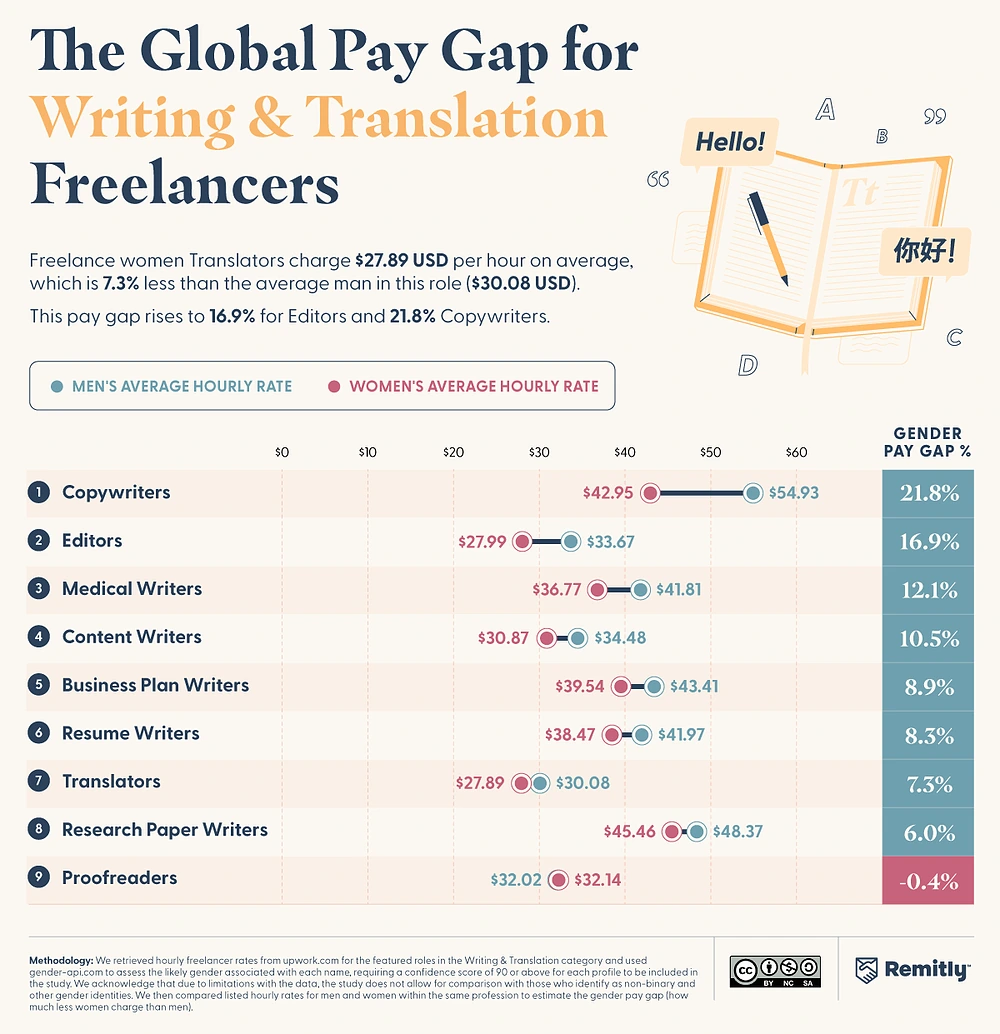
Women who freelance as Blockchain Developers charge an average of $38.49 USD per hour — just $0.31 or 0.8% less than men ($38.80 USD). However, all other featured roles in Development and IT show a pay gap of 9.5% or more, ranging up to Python Developers (17.3%) and AI Engineers (20.4%).
The role with the biggest freelance pay gap is Accounts Payable Manager
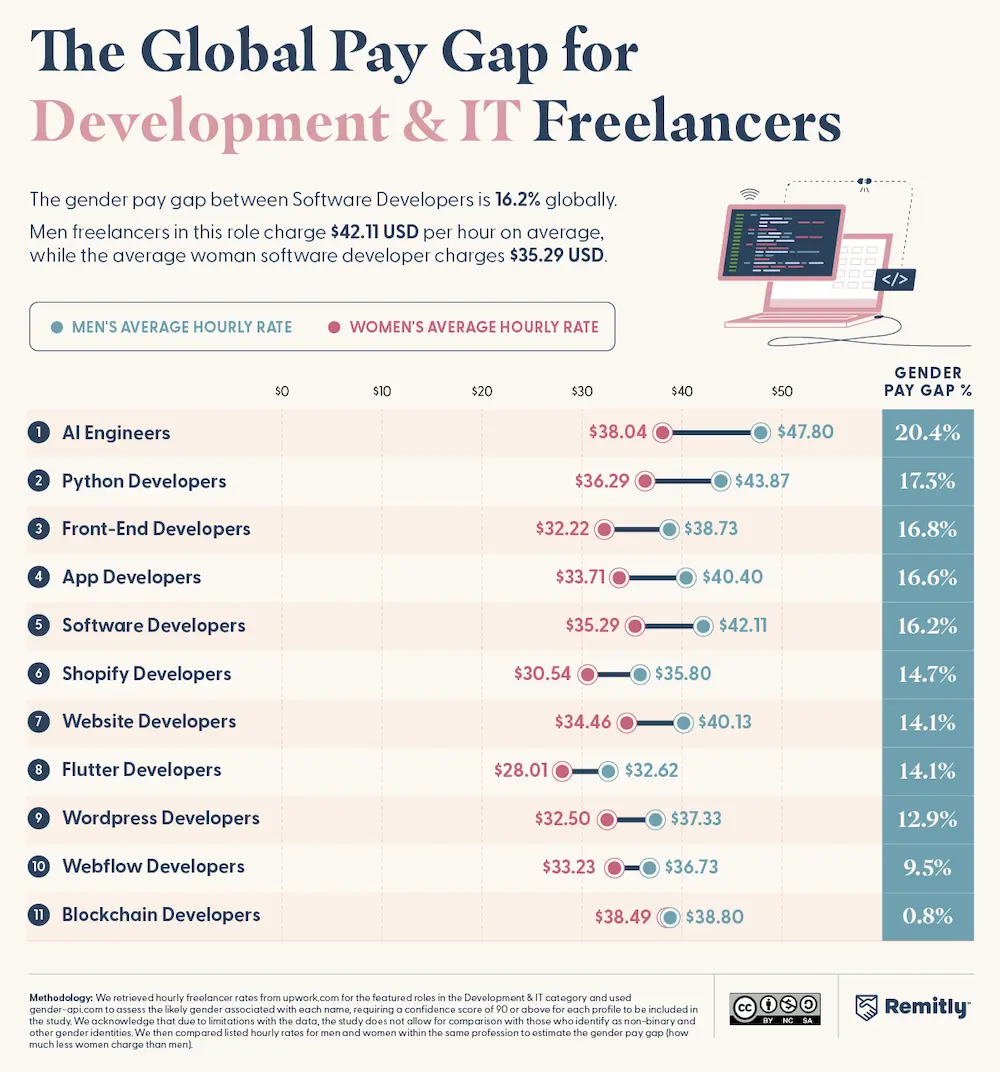
In the Finance and Accounting category, freelance Accounts Payable Managers face a gender pay gap of 35.3%. That's one of the biggest pay gaps for any featured role in the major categories covered by our study. Bookkeepers (24.4%) and Management Consultants (22.8%) are also among those experiencing the most significant pay gaps.
However, in the role with the highest rates, Fundraising Consultants, women charge a fraction (0.4%) more than men: $61.59 USD versus $61.36 USD.
However, in the role with the highest rates, Fundraising Consultants, women charge a fraction (0.4%) more than men: $61.59 USD versus $61.36 USD.
YouTube Editors are the Design and Creative professionals with the biggest gender pay disparity
The history of moving image editing is one of gender disparity. Film editors were primarily women in the early years of cinema, partly due to the preconception that editing was “a job that women did the way women did sewing,” according to filmmaker Su Friedrich8. However, as the process became more industrialized, “men decided editing both sound and film would be too complex for women to handle,” says researcher Alea Stokes9.
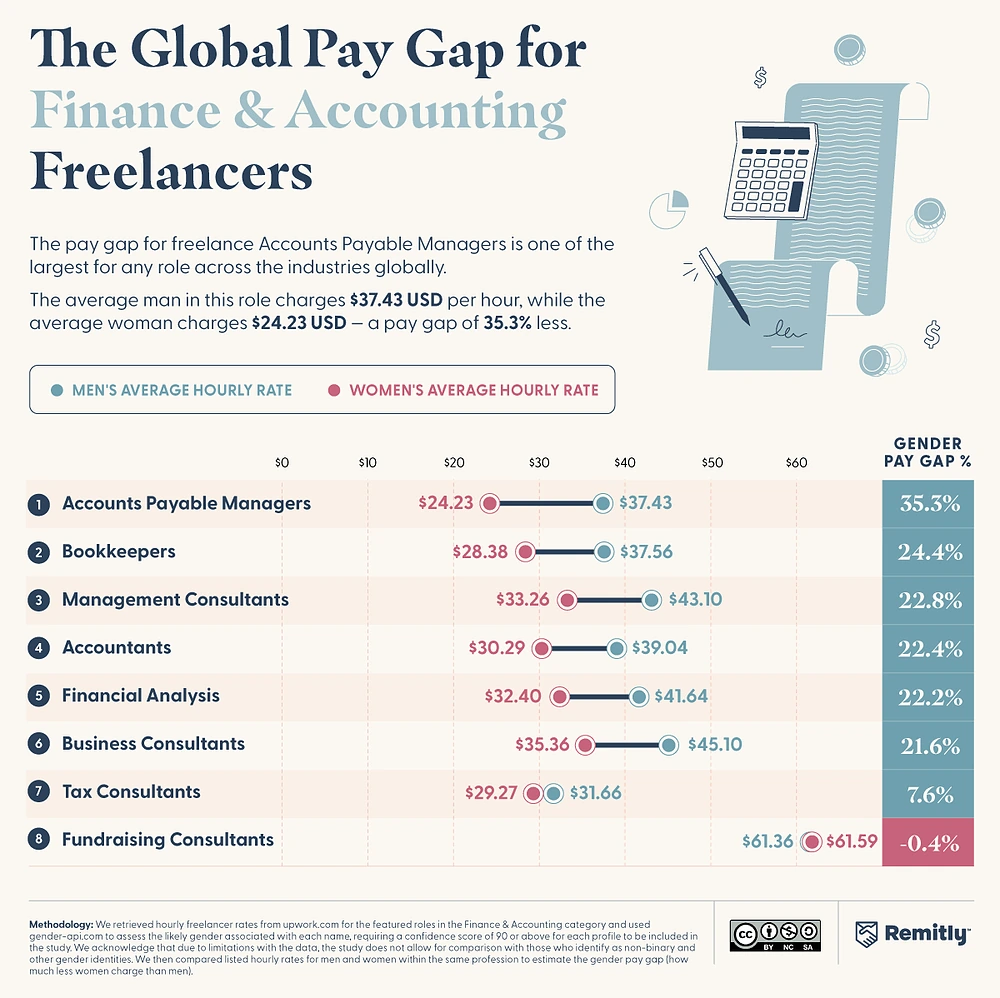
This value imbalance appears to endure in newer incarnations of the profession a century on. Despite being a relatively young role, the job of YouTube Video Editor comes with a gender pay gap of 23.4% — the largest disparity in the Design and Creative category.
This value imbalance appears to endure in newer incarnations of the profession a century on. Despite being a relatively young role, the job of YouTube Video Editor comes with a gender pay gap of 23.4% — the largest disparity in the Design and Creative category.
Copywriting freelancer pay gap is 21.8%
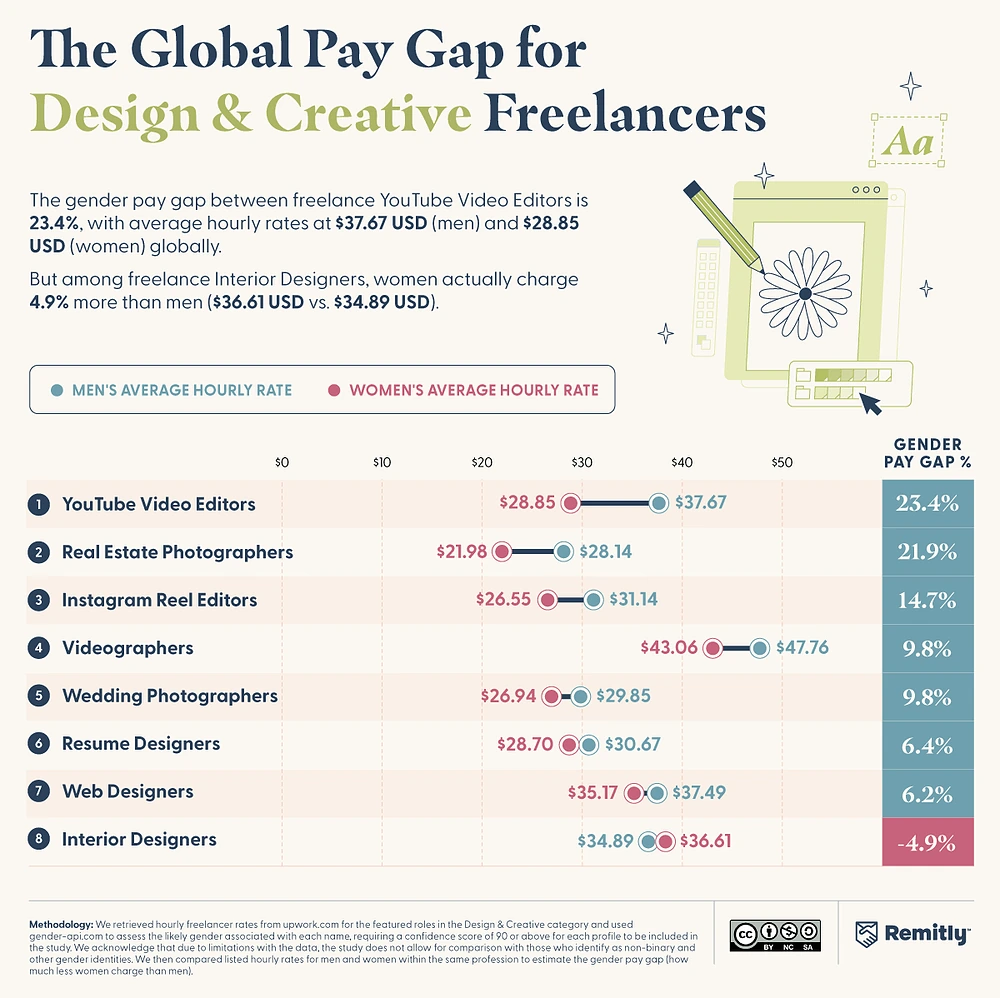
Copywriters experience the biggest gender pay gap among freelancers in the Writing and Translation category, with women charging an average of $42.95 USD, which is 21.8% less than men ($54.93 USD). This is a disparity of nearly five percentage points more than the next worst pay gap in this category, Editors (16.9%).
Women who freelance as Google Ads Experts charge 22.0% less than men
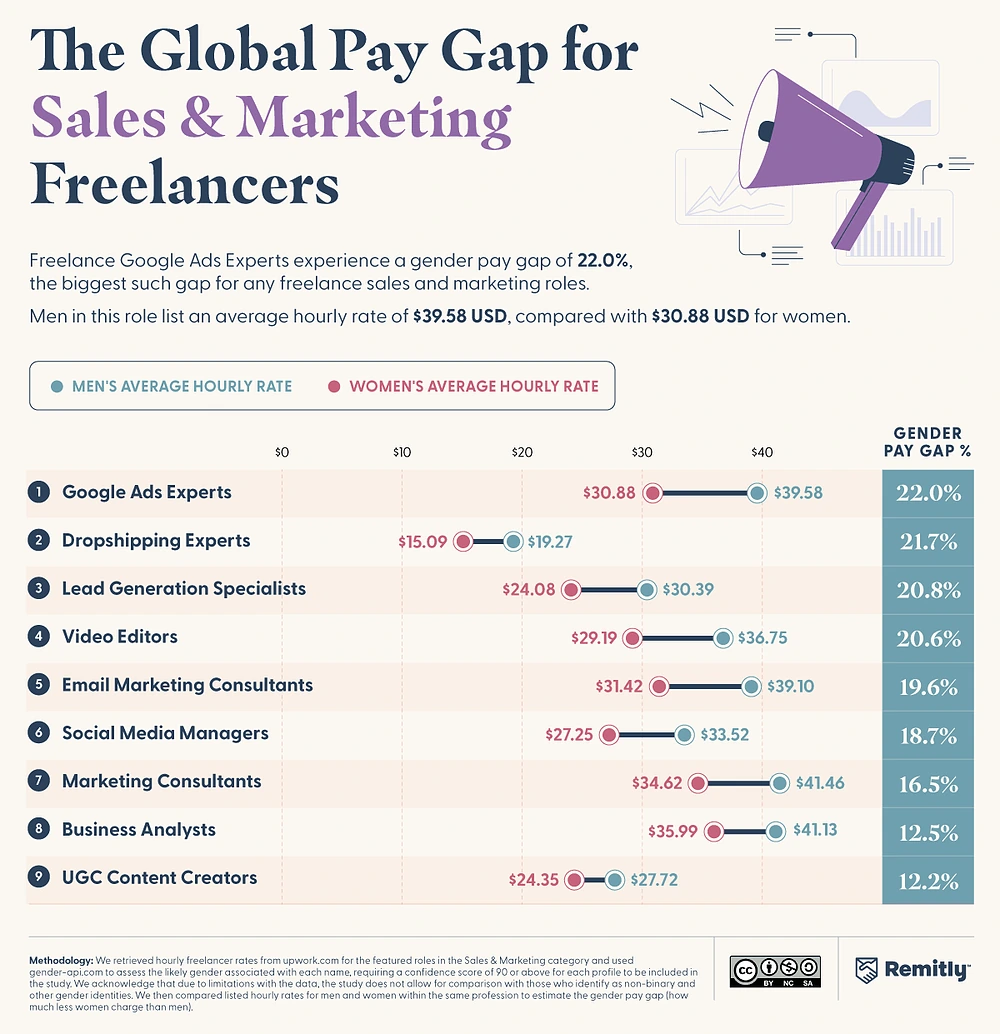
One U.S. study found that women employed in advertising earn 5% less than men, rising to 8% less for women who are mothers, and that the average woman in advertising suffers a relative income shortfall of $270,000 USD across her career10. For freelancers, however, we found that the most prevalent roles in advertising or marketing carry a pay gap of 12.2% or more. The widest gaps across the Sales and Marketing category are for Google Ads Experts (a pay gap of 22.0%) and Dropshipping Experts (21.7%).
How to set freelance rates you won’t regret later
Setting freelance rates that help you thrive without pricing out potential clients is a delicate business. But an estimated 163 million11 global freelancers or more navigate this issue on platforms like Upwork, PeoplePerHour, or Twine, and there are tried and tested ways to find, calculate and maintain the right prices for you.
- Figure out your base rate. This is the minimum rate you need to cover essential costs. Calculate your monthly business and personal expenses, divide this figure by the number of monthly billable hours (opens in new window) you can work, and don’t dip beneath this rate.
- Allow for time off. Working at your base rate may work as you build a client base, but you’ll need to factor in higher rates to start building a cushion for vacation or sick leave.
- Check out the competition. Study the freelance platforms and join forums and groups to get a clearer idea of what people are charging. Don’t forget to adjust your figures to account for your experience levels and local cost of living.
- Be cautious with your international rates. Working internationally (opens in new window) broadens your potential client base but can come with extra costs, including currency conversion (opens in new window) rates and transfer fees. Factor this in when quoting for international clients, and be clear who will pay fees where relevant.
- Be transparent and include details. Make it clear the nature and extent of the work you will do for the stated fee, and consider whether you need to charge more for assignments where there is a tight turnaround or where there are likely to be multiple rounds of revision.
- Don’t undersell yourself. Consider your experience, achievements and qualifications when setting freelancer rates, and share them proudly in your marketing. Gather professional testimonials and recommendations to back up your personal statement.
- Know your parameters. There may be conditions in which you want to offer a lower or higher rate to your regular figures. You will be in a stronger negotiating position if you know your limits and your reasoning and can express your value with confidence.
- Find the right payments tool for you. A tool like Remitly for Freelancers (opens in new window)* can be a simple way to make global payments (opens in new window) for those working with international clients and multiple currencies.
Methodology
We retrieved freelancer rates across the globe on upwork.com to calculate the extent of the gender pay gap overall and in different regions, industries and roles.
First, we curated a list of countries to focus on and a list of roles to explore. We chose Upwork’s featured roles for each major work category, then used their search function to identify freelancers in each occupation across the selected countries. To improve consistency in the dataset, we only included profiles with listed hourly rates and required at least 100 billed hours for a freelancer’s rate to be considered.
Having collected these freelancer rates, we used gender-api.com to assess the likely gender associated with each freelancer’s name. GenderAPI compares names against its regularly updated database of over six million names from 191 countries, compiled from publicly available data, governmental data and manual additions/corrections, adjusted for regional name variations. The app uses these statistics to determine the probability that a name belongs to a man or a woman. We required a confidence score of 90 or above for each name determination to include its associated data in our study. As such, each gender determination indicates the “most likely” gender for each freelancer profile rather than each individual’s official or personal gender identification. We acknowledge that due to limitations with the data, the study does not allow for comparison with those who identify as non-binary and other gender identities.
Finally, we compared the hourly rates of men and women (as inferred by GenderAPI) in the same profession to obtain the gender pay gap in both absolute terms and as a percentage (the pay gap percentage represents how much less women charge than men rather than how much more men charge than women). We required data for at least five men and five women in each role for it to be considered in the final report. For aggregated role figures, we required at least 100 freelancers globally.
We aggregated the hourly rates of both men and women at country level by weighting the number of freelancers in a role/category against the total number of freelancers for the country. In case of the roles and categories, we weighted the number of freelancers in each country for that role/category against the total freelancers in said role/category.
Data is correct as of May 2026. Upwork is a trademark of Upwork Inc. This report is not affiliated with or endorsed by Upwork.
References
1 International Labour Office (1951). C100 - Equal Remuneration Convention, 1951 (No. 100). https://normlex.ilo.org/dyn/nrmlx_en/f?p=NORMLEXPUB:12100:0::NO::P12100_INSTRUMENT_ID:312245 (opens in new window)
2 United Nations (2025). International Equal Pay Day 18 September. https://www.un.org/en/observances/equal-pay-day (opens in new window)
3 World Inequality Lab (2026). Highlights from the World Inequality Report 2026 (WIR 2026). https://wir2026.wid.world/insight/executive-summary/ (opens in new window)
4 Council of the EU and the European Council (2026). The EU's gender pay gap: facts and figures. https://www.consilium.europa.eu/en/policies/the-eu-s-gender-pay-gap-facts-and-figures/ (opens in new window)
5 IPSE (2020). Women in self-employment: Understanding the female self-employed community. https://ipse.imgix.net/downloads/TEMPLATES/Women-in-Self-Employment-IPSE.pdf (opens in new window)
6 Business Insider (2026). The pivot-to-freelance paradox. https://www.businessinsider.com/return-to-office-ai-women-out-of-work-moms-2026-3 (opens in new window)
7 International Labour Review (2025). Platforms as inequality regimes: Researching legal services. https://en.ilr-rit.org/article/pubid/18854/ (opens in new window)
8 National Public Radio (2025). The pioneering women behind the invisible art of film editing. https://www.npr.org/2024/03/09/1236786943/oscars-movies-film-editing-women (opens in new window)
9 Boston Public Library (2022). On the Cutting Room Floor: The Little-Known Careers of Female Film Editors. https://www.bpl.org/blogs/post/on-the-cutting-room-floor-the-little-known-careers-of-female-film-editors (opens in new window)
10 DNA&STONE (2025). The Making of an Advertising Gender Pay Gap. https://www.dnaandstone.com/news/genderpaygap (opens in new window)
11 Open Research Europe (2021). How many online workers are there in the world? A data-driven assessment. https://open-research-europe.ec.europa.eu/articles/1-53 (opens in new window)
First, we curated a list of countries to focus on and a list of roles to explore. We chose Upwork’s featured roles for each major work category, then used their search function to identify freelancers in each occupation across the selected countries. To improve consistency in the dataset, we only included profiles with listed hourly rates and required at least 100 billed hours for a freelancer’s rate to be considered.
Having collected these freelancer rates, we used gender-api.com to assess the likely gender associated with each freelancer’s name. GenderAPI compares names against its regularly updated database of over six million names from 191 countries, compiled from publicly available data, governmental data and manual additions/corrections, adjusted for regional name variations. The app uses these statistics to determine the probability that a name belongs to a man or a woman. We required a confidence score of 90 or above for each name determination to include its associated data in our study. As such, each gender determination indicates the “most likely” gender for each freelancer profile rather than each individual’s official or personal gender identification. We acknowledge that due to limitations with the data, the study does not allow for comparison with those who identify as non-binary and other gender identities.
Finally, we compared the hourly rates of men and women (as inferred by GenderAPI) in the same profession to obtain the gender pay gap in both absolute terms and as a percentage (the pay gap percentage represents how much less women charge than men rather than how much more men charge than women). We required data for at least five men and five women in each role for it to be considered in the final report. For aggregated role figures, we required at least 100 freelancers globally.
We aggregated the hourly rates of both men and women at country level by weighting the number of freelancers in a role/category against the total number of freelancers for the country. In case of the roles and categories, we weighted the number of freelancers in each country for that role/category against the total freelancers in said role/category.
Data is correct as of May 2026. Upwork is a trademark of Upwork Inc. This report is not affiliated with or endorsed by Upwork.
References
1 International Labour Office (1951). C100 - Equal Remuneration Convention, 1951 (No. 100). https://normlex.ilo.org/dyn/nrmlx_en/f?p=NORMLEXPUB:12100:0::NO::P12100_INSTRUMENT_ID:312245 (opens in new window)
2 United Nations (2025). International Equal Pay Day 18 September. https://www.un.org/en/observances/equal-pay-day (opens in new window)
3 World Inequality Lab (2026). Highlights from the World Inequality Report 2026 (WIR 2026). https://wir2026.wid.world/insight/executive-summary/ (opens in new window)
4 Council of the EU and the European Council (2026). The EU's gender pay gap: facts and figures. https://www.consilium.europa.eu/en/policies/the-eu-s-gender-pay-gap-facts-and-figures/ (opens in new window)
5 IPSE (2020). Women in self-employment: Understanding the female self-employed community. https://ipse.imgix.net/downloads/TEMPLATES/Women-in-Self-Employment-IPSE.pdf (opens in new window)
6 Business Insider (2026). The pivot-to-freelance paradox. https://www.businessinsider.com/return-to-office-ai-women-out-of-work-moms-2026-3 (opens in new window)
7 International Labour Review (2025). Platforms as inequality regimes: Researching legal services. https://en.ilr-rit.org/article/pubid/18854/ (opens in new window)
8 National Public Radio (2025). The pioneering women behind the invisible art of film editing. https://www.npr.org/2024/03/09/1236786943/oscars-movies-film-editing-women (opens in new window)
9 Boston Public Library (2022). On the Cutting Room Floor: The Little-Known Careers of Female Film Editors. https://www.bpl.org/blogs/post/on-the-cutting-room-floor-the-little-known-careers-of-female-film-editors (opens in new window)
10 DNA&STONE (2025). The Making of an Advertising Gender Pay Gap. https://www.dnaandstone.com/news/genderpaygap (opens in new window)
11 Open Research Europe (2021). How many online workers are there in the world? A data-driven assessment. https://open-research-europe.ec.europa.eu/articles/1-53 (opens in new window)
Beyond Borders: The Official Remitly Blog
What Freelancers Should Know Before Taking On International Clients
Read more (opens in new window)
Managing Cash Flow as a Global Freelancer: A Practical Guide
Read more (opens in new window)
Self-employment views around the world
Read more (opens in new window)This publication is provided for general information purposes only and is not intended to cover all aspects of the topics discussed herein. This publication is not a substitute for seeking advice from an applicable specialist or professional. The content in this publication does not constitute legal, tax, or other professional advice from Remitly or any of its affiliates and should not be relied upon as such. While we strive to keep our posts up to date and accurate, we cannot represent, warrant or otherwise guarantee that the content is accurate, complete or up to date.