

Quick answer: The “Eurotunnel” that Americans often ask about is actually the Channel Tunnel, a 31-mile rail tunnel connecting England and France beneath the English Channel. Passengers don’t drive through it directly. Foot travelers use Eurostar trains between city centers, while drivers use LeShuttle to transport their vehicles. Both services run through the same tunnel, just in different ways.
Britain and continental Europe sit on opposite sides of a body of water, yet trains cross between them every single day, disappearing beneath the seabed and reappearing in another country roughly 35 minutes later. There’s no glass tunnel, no view of fish swimming overhead, and no moment where the London-to-Paris trip feels like a submarine ride. It’s simply a train tunnel, engineered with startling precision, that happens to run under one of the busiest shipping channels on Earth.
For Americans planning a first trip to the UK or France, the terminology can get confusing fast. “Eurotunnel,” “Eurostar,” and “Chunnel” get used almost interchangeably, even though they refer to different things. This guide clears that up and walks through what the experience actually feels like, how to use it, and how it was built.

What Exactly Is the Channel Tunnel?
The Channel Tunnel is a rail tunnel running beneath the English Channel, connecting Folkestone, England, to Coquelles, near Calais, France. It stretches roughly 31 miles (50 km), with about 24 miles (38 km) of that running under the seabed. It opened in 1994 after roughly six years of construction, and it remains one of the longest undersea tunnels in the world.
The tunnel was built to solve a straightforward problem: Britain is an island, and travel to mainland Europe historically meant a ferry or a flight. A fixed rail link made high-speed travel possible without weather delays or airport transfers. “Chunnel” caught on early as a nickname, blending “Channel” and “tunnel” into something easier to say than “Channel Tunnel” — and it stuck in popular use, even though transportation companies use the formal name.
Is the Channel Tunnel actually under the ocean?
The Channel Tunnel runs beneath the seabed of the English Channel, not through open water. Trains travel through a bored tunnel surrounded by rock and chalk marl, not through a structure submerged in visible seawater. There’s no window into the ocean at any point.
How deep is the Channel Tunnel?
The tunnel sits as deep as 250 feet (75 meters) below the seabed at its lowest point. That depth was chosen deliberately, placing the tunnel within a layer of chalk marl stable enough to bore through without significant water infiltration.

Eurostar vs. LeShuttle: The Difference Americans Need to Know
This is where most confusion starts. Eurostar and LeShuttle both use the Channel Tunnel, but they serve completely different travelers.
| Eurostar | LeShuttle | |
| Who uses it | Foot passengers | Travelers with vehicles |
| Where you board | City rail stations (London, Paris, Brussels) | Vehicle terminals near Folkestone and Calais |
| Can you bring a car | No | Yes |
| Uses the Channel Tunnel | Yes | Yes |
| Typical use case | London–Paris or London–Brussels trip | Driving between Britain and mainland Europe |
Most Americans searching for “Eurotunnel tickets from London to Paris” actually want Eurostar. Eurostar is the passenger train service that runs directly between city-center stations, and it’s the option relevant to nearly every American doing a London-Paris trip without a car. LeShuttle only matters if you’re driving your own vehicle across the Channel, which is a less common scenario for U.S. visitors renting cars for a UK-only or France-only itinerary.

What Does Traveling Through the Channel Tunnel Actually Feel Like?
What do you see inside the tunnel?
Passengers see darkness outside the train windows, similar to any nighttime train ride. There’s no illumination showing rock walls or water, and definitely no marine life visible from your seat.
Can you feel that you’re underneath the English Channel?
The ride feels much like any other high-speed train journey. There’s no dramatic pressure change, no unusual noise, and no sense of descending underwater. Many passengers report barely noticing the moment the train enters or exits the tunnel section.
How long are you actually underwater?
The undersea portion takes about 20 minutes to cross by train. The full Eurostar journey between London and Paris takes roughly 2 hours and 15 minutes, meaning the vast majority of the trip happens above ground, not beneath the Channel.
Is going through the Channel Tunnel scary?
For most travelers, no. The tunnel is a fixed, permanent rail structure with rigorous safety systems, including a dedicated service tunnel for emergency access. Claustrophobia concerns are understandable given the concept, but the actual experience resembles a standard train ride more than an unsettling underground passage.

How Do Americans Actually Use the Channel Tunnel?
London to Paris without a car
Eurostar passengers board at St Pancras International in London and arrive at Gare du Nord in Paris. Passport checks happen before boarding, not mid-journey, so there’s no stopping partway through the tunnel for border control. Luggage stays with you, much like a domestic train. There’s no separate “Eurotunnel station” where tourists transfer between trains — the entire route runs on one continuous Eurostar service.
England to France with a car
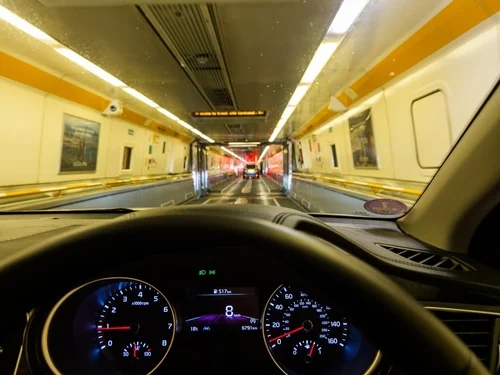
LeShuttle drivers check in at a terminal, drive their vehicle onto a train car, and remain in the vehicle (or step out into a passenger carriage, depending on the service) for the roughly 35-minute crossing before driving off in France. It’s an unusual sensation: sitting in your own car while it travels through an underwater railway tunnel on a train.
Can Americans rent a car and drive through the Channel Tunnel?
No one drives through the tunnel itself. Vehicles are loaded onto LeShuttle trains and transported across, not driven under the Channel independently. Americans planning to rent a car in the UK or France should also plan for driving on the left in Britain and the right in mainland Europe — a detail worth remembering before crossing.

How Was the Channel Tunnel Built?
Proposals to connect Britain and France by tunnel date back to the early 1800s, long before the technology existed to make it feasible. Construction on the current tunnel began in 1988, with crews boring from both the English and French coasts simultaneously using massive tunnel boring machines.
The project ultimately created three parallel tunnels: two rail tunnels and one central service tunnel used for maintenance and emergency access. Engineering teams from both countries met underground in 1990, and the milestone became a defining moment in the project’s history.
How did engineers keep the English Channel from flooding the tunnel?
Engineers selected a tunneling route through a layer of chalk marl, a rock type stable enough to bore through while resisting water infiltration. The tunnel walls were reinforced with concrete lining, and drainage systems were built in to manage any seepage, keeping the structure dry and structurally sound.
How accurate did the engineers have to be?
Extremely. Teams boring from Britain and France had to align their tunnels underground with only a small margin of error, using laser-guided surveying to stay on course. When the two sides finally met beneath the Channel, the alignment was accurate to within centimeters — a remarkable feat for a project without GPS as we know it today.

The Numbers That Make the Channel Tunnel Incredible
- Total length: approximately 31 miles (50 km)
- Undersea section: approximately 24 miles (38 km)
- Maximum depth below seabed: 250 feet (75 meters)
- Opened: 1994
- Construction period: 1988–1994
- Number of tunnels: three (two rail, one service)
- Typical crossing time under the Channel: approximately 35 minutes
Note: Prices, schedules, and operational details change over time, so always confirm current information directly with Eurostar or LeShuttle before booking.

Channel Tunnel Facts That Surprise Americans
- You can’t drive your own car through the tunnel independently — it travels aboard a train.
- Eurostar and LeShuttle are separate services, even though both use the same tunnel.
- The tunnel doesn’t run directly beneath London or Paris — most of the rail journey happens above ground.
- There are three tunnels running in parallel, not one.
- Engineers proposed a Channel tunnel more than a century before construction actually began.
- British and French crews met underground with centimeter-level accuracy.
- The lived experience is far less dramatic than most people imagine before trying it.
Is the Channel Tunnel Worth Experiencing on a European Vacation?
For Americans combining London and Paris, Eurostar is often the most practical choice — it’s faster than flying once airport time is factored in, and it drops travelers directly into city centers. For travelers doing a road trip across Britain and mainland Europe, LeShuttle makes more sense, since it keeps your rental car with you the entire way.
Compared with flying, the train avoids airport security lines and offers a smoother check-in process. Compared with a ferry, it’s considerably faster and less affected by weather. Neither option is universally “better” — it depends on whether your trip centers on a car or a city-to-city itinerary.

Frequently Asked Questions About the Channel Tunnel
Does the Channel Tunnel go underwater?
The tunnel runs beneath the seabed of the English Channel, not through open water. It’s surrounded by rock, not submerged in visible ocean.
Can you see the ocean from inside the tunnel?
No. Passengers see darkness outside the windows, with no view of water or marine life at any point.
How long are you underwater on Eurostar?
The undersea portion of the journey takes about 20 minutes, out of a total London-to-Paris trip of roughly 2 hours and 15 minutes.
How deep is the Channel Tunnel?
It reaches up to 250 feet (75 meters) below the seabed at its deepest point.
Can you drive a car through the Channel Tunnel?
No. Vehicles are loaded onto LeShuttle trains and transported across; drivers don’t operate their cars inside the tunnel.
What’s the difference between Eurostar and the Channel Tunnel?
The Channel Tunnel is the physical rail tunnel under the English Channel. Eurostar is the passenger train company that uses that tunnel for foot travelers between cities like London and Paris.
Does the Channel Tunnel connect London directly to Paris?
Not directly. The tunnel connects Folkestone, England, to Coquelles, France. Eurostar trains then continue above ground to reach city-center stations like St Pancras and Gare du Nord.

One of Europe’s Strangest Journeys Is Surprisingly Ordinary
The engineering behind the Channel Tunnel is extraordinary: two countries boring toward each other beneath the seabed and meeting within centimeters of accuracy. Yet the experience of actually traveling through it feels almost routine. An American traveler can have breakfast in London, board a train, pass beneath the English Channel, and arrive in Paris in time for lunch — without ever setting foot in an airport.



