

Key Highlights
Thinking of driving in India? Here is what you should know.
-
Foreign drivers can drive on Indian roads with their driving license from their home country, but it must be in English.
-
An International Driving Permit (IDP) is needed by most rental companies, so it is good to have it even if you have your home country’s license.
-
You will need your driving license, IDP, passport, and a valid visa while driving in India.
-
Indian roads can be tough and busy, so you must know and follow local traffic rules.
-
If you want to stay in India for a long time, getting an Indian driving license is a good idea.
Introduction
Are you planning to visit India and want to go on a road trip? Driving in India can be a great way to see the country’s different places. But you may ask, “Is it okay for me to drive on Indian roads?” Yes, you can drive, but there are some rules. You must have the right documents with you to drive. This means you need your driving license and, in many cases, an International Driving Permit (IDP). These will help you drive on busy and exciting Indian roads. Here is what you need to know before you get ready for your trip.
Understanding Driving in India as a Foreigner
If you are from another country, driving in India might seem scary at first. But with some good planning, you can do it. The rules for driving are there to make sure all international travelers stay safe when they drive motor vehicles on Indian roads.
It is important to know these rules before you get here. This will help things go much better for you. If you are visiting India for a short time or planning to stay longer, you need to know what foreign drivers must do by law. This will help you have a good time driving in India.
Overview of Indian Driving Laws for Visitors
India’s driving rules come from the Motor Vehicles Act. This act sets the laws for all drivers, including those visiting from other countries. For foreigners, the main thing to remember is that India does accept an international driving license. If your driving license is written in English, you can usually use it.
But when you drive in India, it may not feel the same as what you know at home. There are clear traffic rules, but most people also follow local driving habits. The way people drive can be very different, so be ready for things to change quickly and for the road to be hard to predict.
It’s important to understand these things before you go out on the road. The traffic police in India make sure people are following the motor vehicles act. You should always have your driving license and all papers with you. This will help you stay out of trouble. If the police do stop you, the best thing you can do is stay calm, be nice, and work with them.
Who Qualifies as a Foreign Driver in India
Any visitor to India who is not an Indian citizen is called a foreign national. This includes the people who come as tourists, people on work, and the ones who move to India for some time. If you are one of them and want to drive, you have to follow some special rules.
International travelers who have a valid driving license from their home country can usually drive in India. You can do this for some time. Your valid driving license from your home country is your main proof that you are allowed to drive.
Your driving license and your passport also work as an important form of identification. The name on your license should match the name on your other papers. This is to make sure that you can be seen as a good driver when you travel in India.
Validity of Foreign Driver’s Licenses in India
You can use your foreign license to drive in India, but there are some rules. The main thing you need to know is that your home license must be in English. If it is not, you have to give an official translation or an International Driving Permit (IDP) with it.
Even when your license is in English, it is a good idea to get an IDP. The international driving permit is a well-known paper that explains your driving license details in many languages. Car rental companies and the police often ask for one. We will talk more about the IDP and what you need to do later on.
Using Your Home Country License in India
You can use your valid driving license from your home country to drive in India for up to one year. Your license must be in English. This lets you drive the same type of vehicle here as you do at home. For example, if you drive a car at home, you can drive a car in India too.
This rule is good for many tourists and people who visit for a short time. You do not have to go get a new license in India if your stay is not long. You must carry your original foreign license with you every time you are on the road.
Remember, even with a valid driving license, you will need to get used to how people drive in India. Most Indian road signs are in English. But, the way people drive, how busy the traffic gets, and the road rules may not be the same as in your home country.
When an International Driving Permit (IDP) Is Required
An International Driving Permit, or IDP, is a paper that helps show your driving license from your home country in many languages. The United Nations gives permission for the IDP, and people accept it around the world. You may not always need one by law in India if your driving license is in English. Still, it is a good idea for all foreign drivers to have it.
There can be times when an IDP is very important. Car rental businesses often ask for it because it is a part of their rules. Traffic police see the IDP as a form of identification that they can read quickly, so it can help make things go well if you are stopped.
You should get an IDP if:
-
Your home country’s driving license is not in English.
-
You plan to rent a car, as most companies will want to see it.
-
You want a paper that people know all over, so you can avoid problems if someone does not understand your license.
Try to get your IDP from the motor vehicle office in your own country before you go to India.
Essential Documents Needed to Drive Legally
To drive in India, you need to have some important papers with you. Think of these as tools you must have before you get in the car. The main things you will need are your passport, a valid visa, and your driving license.
If you get stopped by the police, having all the necessary documents will make things easy for you. It shows you know what to do and you follow the rules in India. Let’s look at what you should keep with you.
Passport, Visa, and Entry Requirements
You need your passport when you travel to another country, and this is the same in India. It will be the main form of identification you will use. You have to keep your original passport with you. Do not keep just a copy, especially if you drive in India.
You will also need to have a valid visa with you when you are in India. This visa shows that you are in the country for a legal reason. The type of visa you get will depend on why you visit, but any valid visa will be good for driving.
Make sure you always have these papers together. Keep them in a safe place. When you are going out on the roads, you must be ready to show:
-
Your original passport.
-
Proof that you have a valid visa for India.
-
Another form of identification, which can be your home country’s driver’s license.
Required Permits and Proof of Insurance
Besides bringing your own ID, you need some papers to show you can drive and that your car is allowed on the road. The International Driving Permit (IDP) is very important if you are a foreign visitor and your license is not in English.
You must have third-party liability insurance if you drive on Indian roads. When you rent a car, the rental company will give you proof of this insurance. Be sure to keep this in the car all the time. This paper shows that you have insurance that helps if you hurt someone or damage something while driving.
Here is a simple checklist of permits and insurance papers you need with you:
-
Your International Driving Permit (IDP). This is needed if your license is not in English.
-
Proof that you have valid third-party liability insurance for the car.
-
The registration certificate for the vehicle.
Beginner’s Guide: How Foreigners Can Start Driving in India
Are you ready to drive in India? If you are one of the foreign visitors or international travelers, the process can be easy when you know what to do. You only have to make sure that your driving license can be used in India and that you have the right paperwork.
This guide will help you with all you need to do before you drive. It will go over how you can check your driving license and what local rules you need to know about. We will show you all the steps, so you drive in India in a safe and legal way.
What You’ll Need Before Getting Behind the Wheel
Before you rent a car or ride a friend’s motorcycle, make sure you get your necessary documents ready. This step is very important. The main idea is to be able to show that you are a legal and qualified driver.
Having all your paperwork and necessary documents in order helps you follow the law. It also gives you peace of mind. If you get stopped, you can quickly show your paperwork and be on your way without trouble.
Here is a quick checklist of what you need:
-
A valid driving license from your home country that is in English.
-
An International Driving Permit (IDP), which is highly suggested.
-
Your original passport with a valid Indian visa.
Step-by-Step Process for Foreigners to Drive in India
Driving in India as a foreigner may look hard at first, but it’s really just a few easy steps. You don’t have to go to a Regional Transport Office (RTO) unless you want to get a local license. Most tourists just need to get the right documents ready.
You need to focus on your paperwork and checking your documents. Make sure the papers you have from home will work in India. If you follow these, you can avoid problems and have a smooth start when you drive. If you are not sure about something, ask the rental car company for help.
Here’s what short-term visitors should do:
-
Check if your home license can be used in India.
-
Get your International Driving Permit (IDP) before you take your trip.
-
Collect all the important personal and vehicle paperwork.
-
Rent your car from a company you can trust.
-
Read up on local traffic rules so you know what to expect when you drive.
Step 1: Verify License and Obtain an IDP
The first thing you need to do is check your driving license. If your home license is printed in English, you can use it in India for up to one year. But, if it’s not in English, you will need to have an International Driving Permit, or IDP, along with it.
Even when your license is in English, it’s smart to get an IDP. The IDP gives you an official translation and the people who check papers or rent cars in India like to see it. Having the IDP can make things go well and help you avoid problems.
You have to get your International Driving Permit in your home country before you visit India. You usually do this through the same office that gave you your home license. Make sure to apply early because it may take a bit to get your IDP.
Step 2: Gather All Mandatory Documents
After you have your license and IDP ready, your next job is to get all the other documents you need. It’s best to make a travel folder. This way, you can keep everything in one place. The most important things to carry are your original passport and a valid Indian visa. These show who you are and that you are in the country the right way.
You will also need proof that the car you drive is insured. If you rent a car, the company gives you this paper. Always check that the insurance is in the car before you go. If you plan to stay a long time and want to get an Indian license, you may have to get a medical certificate too.
You need to keep these papers with you every time you drive. You should know that a photocopy may not work all the time. Carry the originals in a place that is easy to get to, but still safe. Being ready with these will help you get through any check with the police fast, with no problems.
Step 3: Renting or Buying a Vehicle as a Foreigner
With all your paperwork ready, you can now get a car or a motorcycle. For most people who visit, renting is the easiest way. There are many places in big cities like Delhi, Mumbai, and Goa where you can rent. These companies often work with visitors from other places.
When you pick a rental company, make sure to go with the one that people say is good. Avis is popular, but there are also local companies that give good service. You will need all the things we talked about before. This means your license, IDP, passport, and visa. The paperwork for renting is usually simple.
Buying a vehicle takes a lot more time and can be hard. It only makes sense if you want to stay here for a long time. There are a lot of rules and forms about ownership. This can be tough if you are new here. That’s why renting is the best choice for most people.
Safety and Road Conditions for Foreign Drivers
Driving on Indian roads is not like other places. It can be tough for people not used to it. Road conditions in India can be very different from one place to the next. You see modern highways, and you see narrow city streets that are packed and slow. Traffic flow can be all over the place. You must stay sharp and keep your mental presence at all times.
Your safety should always be your focus. It is important to know what makes indian roads so tricky and find ways to be ready. You need good driving skills. You should also have the right insurance, such as a collision damage waiver, when you rent a car.
Common Challenges Faced by Foreigners on Indian Roads
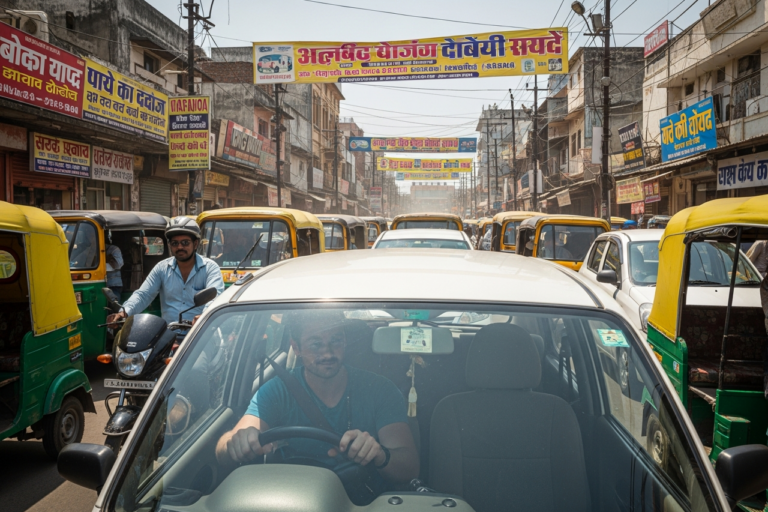
Foreign drivers can find Indian roads to be a lot for the senses. The amount of cars, bikes, auto-rickshaws, buses, and animals can feel too much. Heavy traffic is usual in most big cities, and lanes are not really followed. Many people just drive wherever there is space.
It is hard to get around without good road signs. Big highways are marked well, but small roads may not be. You will also be sharing the road with public transport that stops a lot and not always at the same place.
Here are some common things you need to be ready for:
-
Traffic flow is not predictable, and most do not stay in their lane.
-
There are animals, people walking, and all kinds of vehicles on indian roads.
-
Some roads are not in good shape and road signs can be hard to see or missing.
Tips for Staying Safe While Driving in India
If you want to be safe when you drive in India, you need to use care, feel sure about driving, and be able to change the way you drive when you have to. The most important thing is to stay alert all the time. You really have to keep your mental presence strong because things can change very fast when you are on the road in India.
It is good to use a defensive driving way of thinking. You should be ready for other drivers to not follow the rules. Always make sure that you leave enough space with the car in front. Honking your horn is common here. The use of a horn is not usually a mean sign—it just says, “I am here!” So don’t be surprised when you hear it a lot or have to use it yourself.
To help you have a safer trip, keep these tips in mind:
-
Always drive with a defensive plan and pay close attention to the road.
-
Try not to drive at night, if you can choose, especially in the village or country places in India.
-
Try to avoid driving when there are peak hours and lots of traffic in big cities.
-
When you want to pass someone or if you are on a road with turns that you can’t see around, use your horn to let others know you are coming.
-
If you don’t feel good about driving, you can hire a driver just for the first days so you can get used to the way people drive in India.
This way, you can get around well
Renting Cars and Self-Drive Options for Foreigners
Renting a car for your own drive is very common among foreigners when they visit India. It lets you move around and see things in your own way, at your own time. The main rental companies can be found in big cities and at airports. They often work with people from other countries, so they know what to expect.
To get a car to drive on your own, you will need your driving license from your home country, an International Driving Permit (IDP), your passport, and a valid visa. We will talk more about what is needed, and some rules or limits you may face.
Car Rental Requirements for International Tourists
When you go to rent a car in India, the company will ask to see some documents. They do this to check if you can drive in India and to keep their car safe. If you bring these papers with you, getting your rental car will be fast and simple.
Most rental spots need you to be at least 21 or 23 years old. You will also need to have had your driving license for about one or two years. Rules may be slightly different with each company, so you should read their terms and conditions online before you book.
Here is what you need to rent a car:
-
A valid driving license from your home country (it has to be in English).
-
An International Driving Permit (IDP) is almost always needed.
-
Your original passport and a valid Indian visa.
Restrictions and Insurance Considerations
While renting a car is generally straightforward, some restrictions may apply. Some rental companies may have age limits, and others might restrict taking the vehicle across state borders without prior permission. Always clarify these details before finalizing your rental.
Insurance is a critical consideration. All rental cars come with mandatory third-party liability insurance. However, this only covers damage to others. It is highly recommended that you opt for a Collision Damage Waiver (CDW). This will limit your financial liability if the rental car gets damaged.
Understanding the insurance options is key to a worry-free rental experience. Below is a simple breakdown of common insurance types.
|
Insurance Type |
What It Covers |
|---|---|
|
Third-Party Liability |
(Mandatory) Covers damage to other people’s property or injury to others. |
|
Collision Damage Waiver (CDW) |
(Optional but recommended) Reduces your liability for damage to the rental car. |
Adjusting to Indian Traffic: What Foreigners Should Know
The biggest change for foreign drivers in India is the traffic. The traffic flow is not as organized as it is in many western countries. You will be on the road with cars, motorcycles, rickshaws, and even animals. The traffic rules are there, but people follow their own ways and the road feels like it is full of organized chaos.
To fit in, you need to be patient and watch what others do. You have to pick up the unwritten rules of the road, like knowing how to merge and the right time to use your horn. We will go over some main differences in road culture to help you get ready.
Differences in Road Culture and Etiquette
The road culture in India may surprise people who come from western countries. Here, cars and bikes travel much closer together. The traffic flow is not very strict and does not always follow lanes. Drivers often make their own lanes and fit into any small gap they find.
Honking is also very different here. In many western countries, it can seem rude. In India, honking is needed to talk with others on the road. People give a quick honk to show they will pass, when going around a corner, or to tell others they are near. It is more like saying “hello” than “move out of my way.”
Key cultural differences are:
-
Constant Honking: It is mostly used for talking, not being angry.
-
Lane Discipline: Lanes are like a guide. They are not strong rules.
-
Giving Way: Bigger cars or the bold driver goes first, not by the traffic rules.
This way of driving is common in India, and is new to many who come from western countries. It also shows how the traffic flow changes here.
How Long It Takes to Get Comfortable Driving in India
The time it takes for international travelers to feel okay with Indian traffic is different for everyone. Some people may get used to driving after a few days on less busy roads. Others may need a week or more. A few might never feel fully at ease.
Start slow. Try to drive on quieter roads, or go out during times when there are fewer cars. This helps you get used to the traffic flow. Google Maps can be handy for this, but it may not always be right when it tells you how long a trip will take. The traffic in India can change fast, so be ready for that.
Your comfort will come from your driving experience, how easy you can adapt, and your patience. Do not push yourself into road trips right away. Just take your time. If you find it tough, remember you can hire a driver in India. It is easy and does not cost much.
Long-Term Stays: Obtaining an Indian Driving License
If you plan to stay in India for a long time, it may not be good to use your foreign license and IDP. These are usually valid for only one year. Getting an Indian driving license is a better choice. To do this, you need to apply at the local Regional Transport Office (RTO).
You will have to fill out an application for an indian driving license. The RTO will ask you for different documents. You might also need to take a written and driving test. The next parts will show who can get a driving license in India and what steps you have to take if you are not from India.
Eligibility Criteria and Application Process
To get an Indian driving license as a foreigner, you must have a long-term visa. This can be a resident permit, an employment visa, or a student visa. You cannot use a short-term tourist visa to apply. The first thing you need to do is find the right application form at the RTO in the city where you live.
You have to give the completed application form and some other documents. Most places ask for copies of your passport and visa, proof of your address in India, and passport-size photos. Some RTOs might ask for a medical certificate, too.
The main rules for getting a driving license are:
-
You must have a valid long-term visa and live in India.
-
You need to be old enough to drive by law.
-
You must have all the things the RTO wants to see.
Once you send your application, you have to take the learner’s license test first. After that, there will be a permanent driving test.
Using an Indian License as a Foreigner
When you get an Indian driving license, you can drive anywhere in India. It is the same as what anyone in India can do. For foreign citizens staying a long time, the indian driving license makes things easier. You do not have to carry your foreign license or IDP.
The indian driving license is also good for showing who you are. The photo on it can be used as local identification. It tells people in charge that you followed the steps and know traffic rules in India, since you passed the needed tests.
Keep in mind, you are expected to follow traffic rules and laws with your Indian driving license. It is your permit to drive in India. You should carry the license every time you drive.
Conclusion
Driving in India as a foreigner can feel different, but it is good to be ready. You need to know the local laws. Make sure you have the right papers with you. The road conditions can change, so stay alert. You can use your home country license or get an international driving permit. Being prepared helps keep your journey safe. India’s roads are busy and full of life. When you drive, focus on safety and follow local ways of driving. If you want to learn more or need help with your plans to drive in India, get in touch.
Frequently Asked Questions
Can foreigners drive in India with their home country license?
Yes, international travelers can drive in India with their home license for up to one year if it is in English. If your license is not in English, you need to have an International Driving Permit, or IDP. You should always carry your original driving license with you on the Indian roads.
Do foreign tourists need an international driving permit to drive in India?
All foreign tourists should get an International Driving Permit (IDP) when they come to India. If your driving license is not in English, you must have an IDP. Even if your license is in English, it is good to have one. The IDP helps when you have to talk with the police or with car rental companies in India. It makes things easy for you.
Are foreigners allowed to rent cars for self-driving in India?
Yes, people from other countries can rent cars to drive themselves in India. You have to show your foreign license in English, an international driving permit (IDP), your passport, and a valid Indian visa. You should ask the rental company if they have any age rules or other limits.
Is it safe for foreigners to drive in India as visitors?
Safety for foreign visitors in India depends on how ready they are. Indian roads can be hectic. Road conditions change from place to place. You should drive carefully, stay off the roads at night, and keep your eyes open all the time. If dealing with tough traffic is not for you, get a driver. Many people in India do this because it is safe and common.



