

Key Highlights
-
Vietnam has changed the way it gives out visas. Now, citizens of all countries can get a 90-day e-visa.
-
You can do the whole vietnam visa application process online. Just use the official e-visa portal.
-
Knowing the visa requirements is very important. This will help your trip go well.
-
People coming to Vietnam can go for different visa types, like a tourist visa or a business visa.
-
There is a visa exemption for citizens of some countries. This is for short trips.
-
With the e-visa, you can come in or go out of Vietnam through 42 international border gates. These include big airports.
Introduction
Thinking about going to Vietnam? Getting a Vietnam visa might seem hard, but it can be easy. You need the right visa before you start your trip. This guide will help you learn about the visa requirements. It explains the different types of visas and the steps in the application process. You will get everything you need to speak to the immigration department. Then, your travel will be smooth and simple. Get ready for your time in Vietnam!
Vietnam’s Visa Policy and Latest Updates
Vietnam’s visa policies are handled by the immigration department. It is important to know the newest rules. There have been big changes to help both tourists and business people visit more easily.
For the latest and correct information, you should check with the nearest vietnamese embassy or consulate. The ministry of foreign affairs gives advice, so you can get the right details before you go.
Overview of Entry Requirements for U.S. Citizens
If you are a citizen of the United States and want to visit Vietnam, you must follow some entry rules. The main rule is to have a valid passport. Your passport should be good for at least six more months from when you plan to go in and must have one blank page for the visa stamp.
In 2024, things are easier for U.S. citizens. You must get a visa before you travel. You can use the e-visa system to do this online. Make sure you fill out the application form the right way so you do not have problems or delays.
When you arrive, you will show your passport and visa to the immigration authorities. They will check your papers and then let you in. Always make sure to look over the latest visa requirements before you leave, since rules can change.
Recent Changes in Vietnam’s Visa Regulations (2024)
The Vietnamese government has made big changes to its visa rules in 2024. These changes make it easier to visit Vietnam. One of the main updates is that you can now get an e-visa for up to 90 days instead of just 30 days. This means tourists and business travelers can stay longer.
These updates come from the ministry of public security and the immigration department. The new e-visa lets you enter Vietnam many times. So, it’s easier if you want to visit other places and then come back.
To use these new rules, make sure you follow the official instructions on the government’s e-visa portal. This helps your application go smoothly so you get the visa without any problems.
Types of Vietnam Visas
Vietnam has different types of visas that fit many travel needs. If you want to go on holiday, work, or visit family, you will find a Vietnam visa for your plan. The most common kinds are tourist visas and business visas. But there are visas for investors, students, and family members of Vietnamese citizens, too.
It is important to know the differences between these visa types. Each has its own rules, time limits, and ways to apply. We will go over some of the main visa categories here.
Tourist Visa: Eligibility, Uses, and Validity
The tourist visa is the top choice for people who want to see Vietnam’s great places and enjoy its busy culture. To get this visa, you need a valid passport. You must also plan to travel just for fun. The application process is simple. You fill out the visa application form and send in the required documents.
Now, the tourist e-visa can be used for up to 90 days. You may pick a single-entry or a multiple-entry visa. This lets you be flexible when you visit Vietnam or other places nearby.
After your application is approved, you will get an electronic visa or a visa stamp in your passport. This depends on how you applied. Be sure to have all needed documents, such as your passport copy and a digital photo, ready when you do the application form.
Business, Work, and Investor Visas Explained
If you are going to Vietnam for work, you can choose from a few visa types. A business visa is good for short trips, like meetings, conferences, or signing papers. It does not let you get a job in Vietnam.
If you want to work for a company in Vietnam, you must get a work visa. You will also need a work permit from the Ministry of Labor. Most of the time, your employer will help you with the work visa.
Foreign nationals who invest money in a business in Vietnam can get an investor visa. Each visa type has different steps you must follow. Most of the time, you need help from a Vietnamese group or company. Some people who travel for work may get an APEC business travel card. This business travel card helps you get into Vietnam more easily.
Family and Dependent Visas
If you are a foreigner and you marry a Vietnamese citizen, or you have family in Vietnam, a family visa can be a good fit for you. This visa category lets you stay in Vietnam longer so you can be with your loved ones.
The dependent visa is made for family members, like spouses and children, of foreigners who work or invest in Vietnam. It lets the family live together in the country. Most of the time, the primary visa holder’s sponsor or boss helps with the application process for their dependents.
To get these visas, you usually need to show proof of your relationship, like a birth or marriage certificate. You should also have an approval letter from the vietnamese immigration authorities. The process helps make sure families get to be together while they live in Vietnam.
Visa Exemptions and Special Programs
Did you know that you may not need a visa to go to Vietnam? The country has a visa exemption program that lets people from some nations visit without a visa. You can stay for a short time, usually for fun or travel, and you do not have to get a visa first.
The goal of these programs is to bring in more travelers and to help build good ties with other nations. The Ministry of Foreign Affairs picks which countries are part of the visa exemption list and how long you can stay. Let’s see which countries get this, and look at other special ways you may be able to visit Vietnam without a visa.
Countries with Visa-Free Entry to Vietnam
Yes, citizens of several countries can enter Vietnam without a visa for a limited period. This visa exemption simplifies travel for many tourists. For example, travelers from South Korea, Japan, and several European countries like the United Kingdom, Germany, France, Italy, and Spain can enjoy visa-free stays.
The duration of the visa-free stay varies by country. While citizens of all countries can now apply for an e-visa, this exemption allows for even easier access for short trips. You simply need to present your valid passport at one of Vietnam’s international airports or land borders.
Here is a list of some countries with visa exemption agreements with Vietnam and the allowed duration of stay. Remember to check the latest rules before you travel as these can change.
|
Country |
Maximum Stay |
|---|---|
|
Chile |
90 days |
|
Cambodia, Indonesia, Kyrgyzstan, Laos, Malaysia, Singapore, Thailand |
30 days |
|
South Korea, Japan, Russia, Denmark, Finland, Norway, Sweden |
15 days |
|
United Kingdom, France, Germany, Spain, Italy, Belarus |
15 days |
Vietnam’s Phu Quoc Island Visa-Free Policy
Are you hoping for a tropical trip? Phu Quoc Island in Vietnam is a great choice. There is a visa exemption in place. Visitors from other countries can go to Phu Quoc for up to 30 days. You do not need an entry visa, no matter where you are from.
The visa exemption works if you fly straight to Phu Quoc from outside the country. It also applies when you travel through one of Vietnam’s international border gates and stay in the transit area. This makes Phu Quoc very easy to reach for your beach time.
If you want to leave Phu Quoc to visit another spot in Vietnam, you will need a visa. If you stay only on the island, you can enter simply and without trouble. The Vietnamese immigration authorities confirm this policy.
Applying for a Vietnam e-Visa
The easiest way to get your visa for Vietnam is the electronic visa system. Citizens of all countries and territories can use this option. The application process is simple and done completely online. You do not have to go to an embassy. Just use your computer at home.
All you need is the internet. You can go to the official Vietnam electronic visa portal to start. The system is made to help you at every step. It guides you through the application process.
Step-by-Step Application Process
Applying for a Vietnam e-visa is a simple process. You can do it in just a few steps. First, you need to get your documents ready. Then, go to the official e-visa website.
On the site, you will fill in the online application form. Put in your personal details and where you want to go. After you send in the form, you pay the e-visa fee. Next, wait for the Vietnam Immigration Department to check your request. When it gets approved, you will get an approval letter by email.
Here is a plain list of each step:
-
Visit the official Vietnam e-visa portal.
-
Upload a picture of yourself and a scanned page from your valid passport.
-
Fill out the application form with correct information.
-
Pay the e-visa fee with one of the payment choices.
-
Get your registration code and wait for the Immigration Department to finish your application process.
-
Download and print your e-visa after you get the approval letter.
Required Documents for Vietnam e-Visa
To apply for a Vietnam e-visa, you have to get some required documents ready. Getting these before you fill out the visa application form will help all passport holders finish the process quickly.
The main documents you will need are a digital copy of your valid passport and a recent photo. The photo should be clear and taken with a white background. You have to show your whole face in the picture, and it should not have glasses. The passport must be valid for at least six months from the date you plan to enter.
Here is the list of essential documents:
-
A scanned copy of the biographical data page from your passport.
-
A digital portrait photo (4×6 cm) on a white background.
-
A valid passport that has at least one blank visa page.
-
A working email address so you get updates and your e-visa.
-
A credit or debit card for paying online.
Vietnam Visa Extensions and Multiple Entry Options
What if you come to Vietnam and like it so much that you want to stay longer? You can ask for a visa extension. You have to be careful with the steps. Go to an immigration office in Vietnam and apply for the extension before your visa runs out.
Vietnam also has multiple entry e-visas now. These are great if you plan to visit nearby countries and then return to Vietnam. This gives you more choices for your travel plans. Here is what you can do to handle both options.
How to Extend Your Visa While in Vietnam
Yes, you can make your visa last longer while you are in Vietnam. It is important to start the process before your current visa runs out. This helps you keep your legal status in the country. If you stay past your visa date, you might have to pay money or face other problems. The immigration authorities in Vietnam are the ones who handle visa extensions.
You will need to go to the immigration office in the city you are staying in. This could be Hanoi, Da Nang, or Ho Chi Minh City. Some people get help from visa agents to do this, but you can also do it by yourself. You must take your passport and fill out some forms. Do not forget to register your temporary residence with the local police. This is something the authorities often ask for.
Here’s what you need to do:
-
Find the immigration office closest to you.
-
Bring your real passport with you.
-
Fill out the application form (Form NA5).
-
Pay the fee for the extension.
Obtaining a Multiple-Entry Vietnam Visa
It is now possible to get a multiple-entry visa for Vietnam. This is a good way to go if you travel often. The updated e-visa system offers a multiple-entry option. You can use this for up to 90 days. You will be able to leave and come back to Vietnam as many times as you want during the visa validity period.
When you fill out your e-visa application, you can pick from single-entry or multiple-entry visas. Just choose the one that matches your travel plans. The fee for a multiple-entry visa is higher than that for a single-entry. But this extra cost is worth it for most people because of the flexibility.
If you already have a single-entry visa and you change your mind, you can’t upgrade to a multiple-entry visa. You must apply for a new visa. So, think about what you may need when you start the application process for any new visa applications.
Vietnam Visa on Arrival vs. e-Visa
Travelers going to Vietnam often ask what is the best way to get a visa. Many people pick either Visa on Arrival (VOA) or e-visa. These are both good, but they have different steps.
The e-visa is done fully online. You complete the process before you come to Vietnam. You get an electronic visa, then you print it out and take it with you.
For Visa on Arrival, you first get an approval letter online before you travel. When you reach the airport, you use that letter to get a visa stamp in your passport. Now, the immigration department is pushing the e-visa more. They made this way smoother and faster for travelers.
Key Differences & Benefits
The main thing that sets a Visa on Arrival apart from an e-visa is how you get it and how easy it is. You do everything for an e-visa online before you go. You print the e-visa, bring it, and this lets you get into Vietnam much faster.
A Visa on Arrival works a bit different. You first need to get an approval letter online from a visa agent. When you land in Vietnam, you have to wait in a line at the Visa on Arrival counter. There, you pay the stamping fee and get a visa stamp in your passport. This can take a lot of time if there are many people, especially when lots of travelers come. Also, the new 90-day validity period is only for the e-visa.
Key points to keep in mind:
-
e-Visa: Apply online and pay there, get your visa before you fly, be able to enter from 42 ports.
-
Visa on Arrival: Get an approval letter online, pay to get your visa stamped when you arrive.
-
Convenience: With e-visa, you can skip the lines at the airport.
-
Validity: Only the e-visa gives you up to 90 days and you can enter and leave many times.
Application Procedures Compared
The application process for an e-visa is done on the official government portal. You fill out a visa application form. You upload your documents and pay the fee online. The whole thing is digital. After your visa is approved, you print it out. You do not have to visit a Vietnamese embassy or consulate general.
If you want a Visa on Arrival, the application process has two steps. First, you apply online through a third-party agency. You get an approval letter. Next, you show this letter, your passport, photos, and pay with cash for the stamping fee at your port of entry in Vietnam.
So, there is one important step to finish when you arrive. You do not have this step with an e-visa. With an e-visa, you go right to the immigration counter. The Visa on Arrival service is found at some international airports only. The e-visa is accepted at more air, land, and sea ports than Visa on Arrival.
Entering and Exiting Vietnam at Major Airports
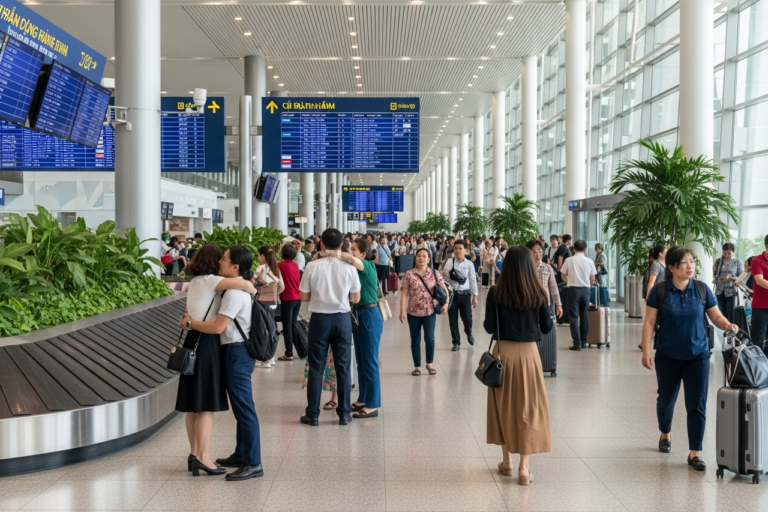
When you come to Vietnam, you will most likely land at one of the big international airports like Noi Bai in Hanoi, Tan Son Nhat in Ho Chi Minh City, or Da Nang. These airports do a good job with people who come from other countries. They have clear steps for getting through immigration.
It helps to know what to expect at the airport. If you have your passport, visa, and all other required documents ready, you will get through the process faster. This way, you can start your stay in Vietnam without any hold-ups.
Immigration Procedures and Customs
When you get to a Vietnamese airport, all passport holders have to go through the immigration department. You will give your passport and visa to the officer. This might be an e-visa printout or a visa stamp. The officer from the Vietnamese immigration department will check your papers. They may also ask some questions about your stay.
Once you finish with immigration, go to pick up your bags. After that, you will go through customs. If you have anything that is not allowed, or anything over the duty-free limit, you must tell the officer. Most tourists find the customs process to be simple.
Here are some things you should keep in mind for a good airport visit:
-
Have your passport and visa ready for the officer to see.
-
Fill out the arrival or departure card if it is needed.
-
Be ready to answer questions about why you are coming to Vietnam.
-
Share information about any goods you should declare at customs.
-
All visitors have to register their temporary residence with the local police. Most hotels will do this for you.
What to Expect at Entry/Exit Points
At entry and exit points in Vietnam, things can be busy, but most of the time, it is orderly. When you get there, you will wait in a line for the immigration authorities. Show your passport and entry visa. The officer will check your papers, stamp your passport, and let you in.
When you leave Vietnam, the steps are about the same but happen in reverse. There, you go through exit immigration. An officer from the Vietnam Immigration Department will look at your passport, check the visa, and put a stamp for exit. Most tourists do not need a special exit visa.
How fast things go changes based on the hour and gate you pick. Big airports tend to be quicker, but it is smart to get there early so you have enough time before your flight leaves.
Conclusion
To sum up, it is important to understand how visas work in Vietnam. This helps travelers, people working abroad, and businesses move around the country with ease. There are many types of visas and rules you need to know. Staying updated makes your trip better. If you plan to visit for fun, work, or to invest, learning about the process will help you get ready. If you have questions or need help with your visa, you can ask for a free consultation. Safe travels!
Frequently Asked Questions
What should I do if my Vietnam visa application is rejected?
If the immigration department rejects your application, you need to check the reason they give. This is often because some information is wrong or the photos do not meet what is needed. You can send your application again, but be sure that all the details are right this time. If you still have trouble, you can get in touch with the vietnamese embassy or get help from a visa agent for your next visa applications.
How long does it take to get a Vietnam visa and how much does it cost?
The processing time for an e-visa is usually 3 to 5 business days. A single-entry e-visa is $25. If you want a multiple-entry e-visa, it costs $50. The total cost and time may be different, so make sure you check the official government portal when you fill out the visa application form.
Can I change or upgrade my Vietnam visa after arriving?
Changing your visa category, like going from a tourist visa to a work visa, can be hard. Most times, it is not allowed. You often have to apply for a new visa, and you may need to leave the country to do this. If you want to change to a work visa, you need a work permit first. It is best to contact the Vietnamese Immigration Department for advice. The immigration department will help you understand what you need to do about your new visa and visa category.



