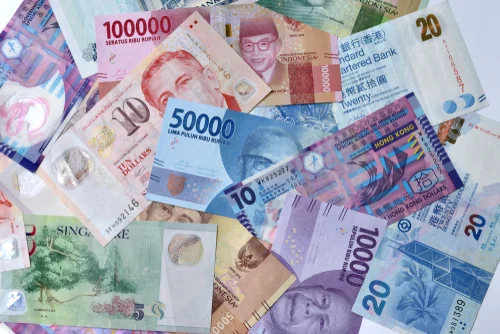
Asia uses dozens of different currencies with no single currency accepted continent-wide. Major currencies include the Japanese Yen, Indian Rupee, Chinese Yuan, Thai Baht, and Singapore Dollar. British pounds are not widely accepted — UK travellers should carry local currency or use a travel-friendly card. Cash remains essential in many Asian countries.
What Is the Currency in Asia? A Quick Overview
Asia doesn’t use one single currency — the continent’s 40-plus countries each issue their own, from the Japanese Yen to the Indian Rupee. Major currencies include the Japanese Yen, Indian Rupee, Chinese Yuan, Thai Baht and Singapore Dollar.
British pounds aren’t widely accepted, so if you’re travelling or sending money to Asia, you’ll need local currency, a travel-friendly card, or a money transfer service that pays out in the right currency. Cash remains essential in many Asian countries, even as digital payments grow fast in others.
Whether you’re planning a trip or sending money home to family, knowing what to expect from currency in Asia makes a real difference. From a Remitly perspective, that means looking at Asian currencies from both sides: what UK travellers need when spending abroad, and what UK senders need when transferring money to friends and family in Asia.
This guide walks through the currencies you’re most likely to come across, whether cash or card will serve you better, and what to know if you’re sending money to Asia from the UK.

Major Currencies in Asia: What UK Travellers Need to Know
Below are the currencies most relevant to UK travellers and senders, with practical, character-based guidance rather than exchange rates — numbers that go out of date the moment they’re published.
Indian Rupee (INR)

The Indian Rupee (₹), issued by the Reserve Bank of India, is subject to strict rules on being taken in or out of the country, so UK travellers are generally better off getting rupees after they arrive. Cash remains vital in many rural areas, though UPI — India’s real-time payment system — has changed how a huge number of people pay for everyday things.
According to the National Payments Corporation of India (NPCI), UPI processed 24.5 billion transactions in August 2026 alone, up from around 20 billion in August 2025.
For the UK’s large British-Indian community sending money home, it helps to know that UPI is now central to everyday payments in India, alongside traditional bank accounts and cash. For UK senders, that makes it worth checking how a recipient prefers to receive and access their money, while UK travellers should still carry some cash, particularly when heading outside major cities.
Thai Baht (THB)

The Thai Baht (฿) is regulated by the Bank of Thailand. Outside Bangkok’s main tourist areas, cash still does most of the work — many smaller shops, street stalls and rural guesthouses don’t take cards at all. Foreign cards often face a flat local withdrawal fee at Thai ATMs, typically ฿220 per withdrawal in 2026, on top of your UK bank’s own charges, so check your card’s terms before you go. Even where card machines exist, some merchants still prefer cash.
Chinese Yuan / Renminbi (CNY)

China’s currency causes genuine confusion for UK visitors: Renminbi (RMB), issued by the People’s Bank of China, is the currency’s official name, while the Yuan is its basic unit — similar to ‘sterling’ and ‘the pound’.
WeChat Pay and Alipay dominate everyday spending, though foreign card support on these apps has changed over time, so check current access before you travel. Carry some cash as a backup, since taking Yuan out of China is restricted.
UAE Dirham (AED)

The UAE Dirham (د.إ), issued by the Central Bank of the UAE, is pegged to the US dollar, which keeps it relatively stable. In Dubai’s hotels, malls, and restaurants, cards are widely accepted, but you’ll still want cash for souks, taxis, and smaller vendors.
The UAE is also a major corridor for money sent from the UK, particularly for South Asian workers supporting family back home, so understanding how AED is spent matters for senders too.
Japanese Yen (JPY)

Japan’s Yen (¥), issued by the Bank of Japan, remains one of the world’s most heavily traded currencies — yet Japan itself is still surprisingly cash-dominant. Many restaurants, shrines, and small hotels take cash only.
The reliable workaround: 7-Eleven convenience stores are everywhere, and their Seven Bank ATMs accept most UK-issued Visa and Mastercard cards, as well as several other international card networks.
Cashless payments are growing, especially in bigger cities — Japan’s Ministry of Economy, Trade and Industry (METI) reported that cashless payments accounted for 58.0% of consumer payments in 2025 — but carry yen for smaller or more traditional places.
Singapore Dollar (SGD)

The Singapore Dollar (S$), managed by the Monetary Authority of Singapore, is the most card- and app-friendly currency on this list. Contactless payments, PayNow and GrabPay are used everywhere, and UK cards generally work without issue.
That makes Singapore a straightforward stop for UK business travellers and expats, though it’s still worth carrying a little cash for hawker centres and smaller stalls that may prefer it.
Hong Kong Dollar (HKD)

Hong Kong Dollar (HK$), issued by the Hong Kong Monetary Authority, is pegged to the US dollar. The Octopus Card is the backbone of daily life here, covering trains, buses, convenience stores and vending machines.
UK cards tend to work well in hotels and shopping malls, but cash — or a topped-up Octopus Card — is more useful at wet markets and smaller local restaurants.
South Korean Won (KRW)

The Won (₩), issued by the Bank of Korea, matters to the UK’s growing wave of K-pop, K-drama and food-tourism visitors. South Korea is highly card-friendly, and mobile wallets like Kakao Pay and Samsung Pay are used for almost everything.
Even so, traditional markets and some smaller vendors still favour cash, so keep a modest amount of won on hand alongside your card.
Philippine Peso (PHP)

The Philippine Peso (₱), issued by the Bangko Sentral ng Pilipinas, matters to both travellers and the UK’s Filipino community sending money home. Cash dominates outside Manila, and card infrastructure can be limited in rural areas.
Mobile apps GCash and Maya are widely used by recipients, so if you’re sending money from the UK, it’s worth checking whether your transfer service can pay directly into one.
Indonesian Rupiah (IDR)

Indonesia’s Rupiah comes in famously high denominations — don’t be alarmed if your dinner bill runs into the hundreds of thousands. Cash still matters outside Bali and Jakarta, but QRIS, Indonesia’s standardised QR payment system introduced by Bank Indonesia, has expanded quickly in tourist and business hubs, where UK cards linked to Google Pay or Apple Pay now work in many cafés and shops.
Malaysian Ringgit (MYR)

The Malaysian Ringgit (RM), overseen by Bank Negara Malaysia, is relatively stable, and digital payments are growing through apps like DuitNow QR and Touch ‘n Go eWallet. The catch for UK visitors is that these local e-wallets are hard to set up without a Malaysian bank account, so you’ll mostly rely on cards or cash. Cards work well in Kuala Lumpur and Penang; cash suits smaller towns.
Vietnamese Dong (VND)

The Dong, issued by the State Bank of Vietnam, is one of the world’s lowest-valued currencies by unit, so expect to deal in tens or hundreds of thousands for everyday purchases. Cash remains essential outside the big cities, though card acceptance is growing in Ho Chi Minh City and Hanoi. Keep smaller notes handy for markets, street food and taxis.
Sri Lankan Rupee (LKR)

The Sri Lankan Rupee, issued by the Central Bank of Sri Lanka, has been recovering gradually since the country’s 2022 economic crisis, and while infrastructure is improving, cash still matters outside Colombo.
The IMF reported in September 2026 that Sri Lanka’s economy grew 4.2% year-on-year in Q2 2026 and official reserves had reached US$6.9 billion by the end of August, although economic risks remain.
The LKR is significant for the UK’s British-Sri Lankan community, many of whom send money home regularly, so keeping an eye on the country’s economic situation is worthwhile for travellers and senders alike.
Nepalese Rupee (NPR)

The Nepalese Rupee, issued by Nepal Rastra Bank, is pegged to the Indian Rupee, which keeps it relatively predictable. Nepal’s economy is heavily cash-based, particularly on trekking routes through the Himalayas, where card machines and even ATMs are rare.
In Kathmandu and Pokhara, ATMs are more common but can still be unreliable, so carry more cash than you think you’ll need.
Cambodian Riel (KHR)

Cambodia runs an unusual dual-currency system, overseen by the National Bank of Cambodia: the US Dollar covers most tourist transactions and larger purchases, while the Riel handles smaller, everyday spending like street food and market stalls.
This makes Cambodia relatively straightforward for UK travellers, since carrying some US dollars in cash covers most situations.
Laotian Kip (LAK)

Laos, whose currency is overseen by the Bank of the Lao PDR, also runs a multi-currency system in practice — Thai Baht and US Dollars are widely accepted in tourist areas alongside the Kip.
The country is predominantly cash-based, and ATMs are limited outside Vientiane and Luang Prabang, so plan ahead and carry more cash than you would elsewhere in the region.
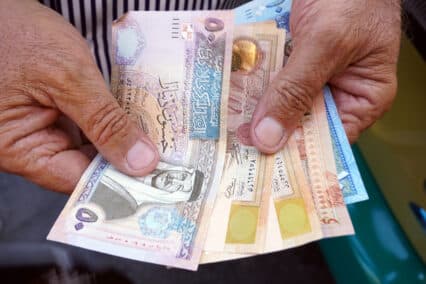
Jordanian Dinar (JOD)

The Jordanian Dinar, issued by the Central Bank of Jordan, is pegged to the US dollar, giving it relative stability. Cards are widely accepted in Amman and at major tourist sites like Petra and Wadi Rum, but smaller towns and local markets still run largely on cash, so carry dinars alongside a card when you travel.
Cash or Card in Asia? What UK Travellers Should Know in 2026
It depends where you’re going. Some countries lean heavily cash-based; others are increasingly card- and app-friendly — though the split isn’t perfectly clean, since even the most digital destinations have pockets where cash is king.
Mostly cash-based: Japan, Vietnam, Cambodia, Laos and Nepal. In each of these, smaller businesses, rural areas and traditional markets often don’t take cards at all, so carrying enough local cash (or USD, in Cambodia and Laos) is essential.
Mostly card-friendly: Singapore, South Korea, Hong Kong and the UAE. In these destinations, contactless payments and mobile wallets cover most everyday spending, though a little local cash still helps for markets, small vendors and tipping.
Whatever your destination, it’s worth carrying some local currency in cash regardless — card machines can go down, and cash-only stalls are common even in card-friendly cities.
A multi-currency travel card from a provider like Wise or Revolut can also help for topping up in local currency as you go, though it’s worth checking your specific destination and currency are supported before you rely on one for a whole trip.

Sending Money to Asia from the UK: What You Need to Know
The UK is home to significant communities with family across Asia, and understanding a country’s currency and payment habits matters as much for sending money as it does for travelling there. India alone was the most common country of birth outside the UK among residents of England and Wales in the 2021 Census, with 920,000 Indian-born residents, according to the Office for National Statistics (ONS).
India, the Philippines, Sri Lanka, Nepal and Bangladesh are all important remittance destinations, although the role remittances play differs considerably between them. World Bank data shows that personal remittances were equivalent to 26.2% of Nepal’s GDP, 6.8% of Sri Lanka’s, 6.1% of Bangladesh’s and 3.5% of India’s in 2024.
If you’re sending money to India, the Philippines, Sri Lanka, Nepal or Bangladesh, how easily your recipient can access the funds often comes down to local payment infrastructure — a transfer that lands in a UPI-linked account in India, for example, can be spent or withdrawn almost immediately, while a recipient in a more cash-based area may need to visit a specific bank branch or agent location.
With Remitly, you can send money to many destinations across Asia, including recipients using the Bangladeshi Taka, with options that let recipients receive funds into a bank account, a mobile wallet, or for cash pickup. If you’re weighing up your options for sending money home, it’s worth comparing the best ways to send money from the UK to find the method that suits your recipient’s situation, whether that’s speed, cost, or how the money arrives.
Practical Money Tips for UK Travellers in Asia
- Order some local currency before you go, if you can. A small amount for your first day covers taxis, snacks and tips before you find an ATM.
- Tell your bank you’re travelling. A quick note on your account, or in your banking app, can stop your card being blocked for ‘unusual activity’ the moment you land.
- Check your card’s foreign transaction and ATM withdrawal fees. Some cards charge nothing abroad; others add a percentage on every purchase, which adds up fast on a longer trip.
- Keep cash spread across a few places. Your bag, a money belt, a hotel safe — rather than carrying everything in one wallet.
- Carry some US dollars as a backup for Cambodia, Laos or Vietnam. USD is widely accepted alongside the local currency in all three.
- Compare a multi-currency travel card against your regular debit card before you leave. Providers like Wise and Revolut can offer better exchange rates for some currencies, though coverage varies by country, so check if yours is supported.
- Exchange a little currency through your UK bank or a reputable provider before you fly. Airport exchange desks typically offer the worst rates, so use them only as a last resort.
Frequently Asked Questions
What currency does Asia use?
Asia doesn’t have one single currency. Each of its 40-plus countries issues its own, from the Japanese Yen and Indian Rupee to the Thai Baht and UAE Dirham. British pounds aren’t accepted almost anywhere on the continent, so travellers and senders need to work with local currency, a travel card, or a money transfer service.
Will my UK card work in Asia?
It depends on the country. Cards work reliably in Singapore, South Korea, Hong Kong and the UAE, and increasingly well in bigger cities elsewhere. In more cash-based destinations like Japan, Vietnam, Cambodia, Laos and Nepal, you’ll need cash for many everyday purchases, especially outside major cities and tourist areas.
What is the strongest currency in Asia?
Strength depends on how you measure it. By unit value, currencies like the Singapore Dollar and Japanese Yen are considered strong and stable. A currency’s unit value doesn’t affect how far your money goes day to day, though — what matters more is the local cost of living.
Should I use cash or card in Asia?
Both. Card-friendly destinations like Singapore and South Korea cover most spending digitally, but even there, some markets and small vendors are cash-only. In more cash-based countries, carrying enough local currency (or USD in Cambodia, Laos and Vietnam) matters more than which card you bring.
Should I exchange money before I travel to Asia?
Exchanging a small amount through your UK bank or a reputable provider before you fly is generally better than waiting for the airport, where rates tend to be worse. You can then top up with a local ATM withdrawal or a multi-currency card once you’ve landed.
What’s the best way to send money to Asia from the UK?
The best method depends on your recipient’s situation — how they’ll receive the funds, how quickly they need it, and the cost involved. Comparing providers on speed, fees and how the money arrives (bank account, mobile wallet or cash pickup) helps you find the option that suits your recipient best.
Which Asian countries use US dollars alongside their own currency?
Cambodia, Laos and, to some extent, Nepal all see US dollars used alongside their local currency, particularly in tourist areas and for larger transactions. Riel, Kip and Nepalese Rupees still handle smaller, everyday spending, so carrying both is useful in these destinations.
Key Takeaways
However you’re using this guide — packing for a trip or sending money home — we hope it helps you feel a little more prepared for the currencies you’ll come across in Asia.
- Asia has no single currency — each of its 40-plus countries issues its own, and British pounds aren’t widely accepted anywhere on the continent.
- Cash is still essential in Japan, Vietnam, Cambodia, Laos and Nepal, even as digital payments grow quickly elsewhere.
- Singapore, South Korea, Hong Kong and the UAE are the most card- and app-friendly destinations for UK travellers.
- If you’re sending money to family in Asia, understanding your recipient’s local payment options (bank account, mobile wallet or cash pickup) helps you choose the right method.
- Currencies and payment infrastructure change quickly — check current advice, including FCDO travel guidance, before you travel or send money in 2026.
Last reviewed: September 2026.