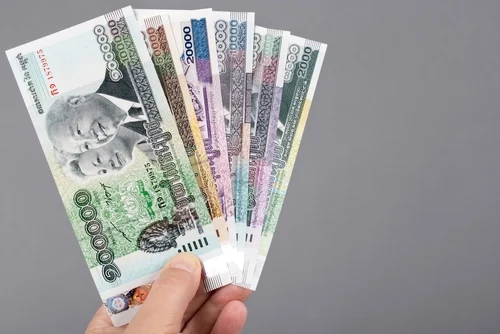
The Cambodian riel (KHR) is Cambodia’s official currency, marked with the symbol ៛, and it circulates alongside the US dollar in a dual-currency economy. For UK travellers, understanding how riel and dollars work together, and knowing when to use each, makes managing money in Cambodia far more straightforward.
This guide covers everything you should know before your trip, from Cambodia’s banknotes and history to practical tips on cash, cards, and exchanging pounds. If you’re sending money to family or friends in Cambodia, Remitly can help you transfer funds from the UK.

All the facts in a glance
- Cambodia runs a dual-currency economy: riel and US dollars are both used daily, sometimes within the same transaction.
- US dollars dominate in Phnom Penh, Siem Reap, and other tourist areas; riel is more common for small purchases, transport, and rural areas.
- Most ATMs dispense US dollars, so it’s worth checking your UK bank’s foreign transaction fees before you travel.
- Riel banknotes range from 50 to 50,000 riel and feature landmarks such as Angkor Wat and Bakong Temple.

What is the Cambodian riel?
The Cambodian riel is abbreviated as KHR and represented by the symbol ៛. It’s subdivided into smaller units called sen (one-hundredth of a riel) and kak (one-tenth of a riel), though these are rarely referenced in everyday transactions. Cambodia is one of several countries across the region with its own distinct approach to currency. You can read more in our guide to currency in Asia.
Current riel banknotes in circulation include:
- 50 riel
- 100 riel
- 500 riel
- 1,000 riel
- 2,000 riel
- 5,000 riel
- 10,000 riel
- 15,000 riel
- 20,000 riel
- 50,000 riel
Coins also exist in denominations of 50, 100, 200, and 500 riel, but decades of economic disruption mean they’re rarely used today. In practice, you’ll handle riel almost entirely as banknotes.

Cambodia’s dual-currency economy: what UK travellers need to know
Cambodia is unusual in that two currencies operate side by side, officially and openly. The US dollar and the Cambodian riel are both accepted for everyday purchases, and it’s common to pay in one currency and receive change in the other. This kind of Cambodia dual currency setup is rare, and it shapes almost every transaction you’ll make while travelling.
In practice, this split tends to follow a pattern. US dollars are the default in Phnom Penh, Siem Reap, and other tourist hubs, where hotels, restaurants, and larger shops usually quote prices in dollars. Riel takes over for smaller amounts and in rural areas, where dollar notes and coins for tiny sums simply aren’t practical. A common example: if you pay in US dollars for a small purchase, such as a bottle of water or a tuk-tuk ride, you’ll often get your change back in riel, since businesses use riel to make up amounts smaller than a dollar. Getting comfortable using money in Cambodia this way takes a day or two, but it quickly becomes second nature.
For UK travellers, this has a few practical implications. If you’re withdrawing cash from an ATM, most machines in Cambodia dispense US dollars rather than riel, so you may need to get smaller riel notes from a shop, market, or currency exchange instead. It’s also worth checking your UK bank’s foreign transaction fees and any ATM withdrawal charges before you travel, as these can add up if you’re withdrawing cash frequently. As a UK traveller, understanding these basics of Cambodian money before you land makes the whole trip easier to budget for.

The history of the Cambodian riel
A look back at Cambodian riel history shows just how closely the currency tracks Cambodia’s turbulent twentieth century. The first riel was introduced in 1953, following Cambodia’s independence from France, and it functioned as the country’s national currency for the next two decades.
During the Khmer Rouge regime, from 1975 to 1979, Cambodia’s monetary system was abolished entirely as part of an effort to eliminate private property and market exchange. Banks were shut down, currency was destroyed, and the country relied on bartering for several years.
The modern riel was reintroduced in 1980 as Cambodia began rebuilding its economy, according to the National Bank of Cambodia. Confidence in the new currency took time to establish, and the US dollar became widely used from the early 1990s onwards, a trend that accelerated during the United Nations Transitional Authority in Cambodia’s presence in the country. That dual-currency habit has persisted ever since, and it’s still the system UK travellers encounter today. Neighbouring Laos followed its own path with the Lao kip, though Cambodia’s relationship with the US dollar remains more deeply embedded in everyday spending.

What do Cambodian riel banknotes look like?
Riel banknotes are colourful and distinctive, each featuring a different cultural landmark, historical scene, or member of the Cambodian royal family. Familiarising yourself with a few key notes can make handling cash much easier during your trip.
- The 20,000 riel note features Angkor Wat, Cambodia’s most famous temple complex.
- The 50,000 riel note honours King Norodom Sihanouk alongside Bakong Temple, a significant historical site.
Because riel notes come in a wide range of denominations, it’s worth taking a moment to look through a few examples early in your trip. Even the higher-value notes represent a fairly modest sum in pounds, so there’s no need to be cautious about handling large-looking numbers. If banknote design interests you, our roundup of the world’s most beautiful banknotes is worth a look.

Practical tips for using money in Cambodia as a UK traveller
Should you use riel or US dollars?
In practice, most UK travellers end up using both. US dollars work well for hotels, restaurants, tours, and larger purchases in cities, particularly in Phnom Penh and Siem Reap. Riel is genuinely useful, not just a curiosity, for smaller purchases such as street food, market stalls, tuk-tuk fares, and tips, and it’s the more practical option once you’re outside the main tourist areas. Carrying a mix of both currencies gives you the most flexibility, and it’s a good habit to build early if you’re new to using money in Cambodia.
Getting cash in Cambodia
Most ATMs across Cambodia dispense US dollars rather than riel, and international UK cards are generally accepted, though it’s worth checking with your bank beforehand about foreign transaction fees, as these vary between providers. A virtual card can also be a handy way to manage spending abroad without carrying multiple physical cards. It also helps to carry some small US dollar notes, ones and fives in particular, since Cambodian vendors don’t always have change for larger bills. This is one of the more practical adjustments for Cambodian money for UK travellers, since cash habits work differently there than in the UK.
Currency exchange for UK travellers
You can exchange pounds for US dollars or Cambodian riel at Cambodian airports and at dedicated currency exchange offices in Phnom Penh and Siem Reap. Many UK travellers find it more flexible to convert GBP to US dollars first, then pick up small amounts of riel locally for day-to-day spending. Avoid exchanging money with unofficial street changers, as rates and reliability can vary considerably.

FAQs
What is the currency code for Cambodian money?
The KHR currency code represents the Cambodian riel, and its symbol is ៛. The riel is Cambodia’s official currency, subdivided into 100 sen, though sen are rarely used in everyday transactions. You’ll see KHR currency listed on receipts, exchange boards, and pricing aimed at local markets.
Should I use US dollars or Cambodian riel in Cambodia?
Both currencies work well depending on where you are. US dollars are widely used in cities, hotels, and for larger purchases, while riel is handy for small transactions, tuk-tuks, markets, and rural areas. Carrying a mix of both currencies gives UK travellers the most flexibility throughout a trip.
Can I use my UK debit or credit card in Cambodia?
Yes, in most cities and tourist areas. Hotels, restaurants, and larger shops in Phnom Penh and Siem Reap widely accept Visa and Mastercard, though smaller businesses, markets, and rural areas are usually cash-only. Check with your UK bank about foreign transaction fees before you travel, since these vary by provider, and card networks typically convert at close to the mid-market rate. Contactless payments are increasingly common in the main cities, but it’s still worth carrying cash as a backup.
Where can I exchange pounds for Cambodian riel or US dollars?
You can exchange pounds at Cambodian airports and licensed exchange offices in Phnom Penh and Siem Reap. Many UK travellers convert GBP to US dollars first, since dollars are more widely accepted, then use small amounts of riel for local purchases. Unofficial street changers are best avoided, as rates and legitimacy vary.
Why does Cambodia use two currencies?
Cambodia’s dual-currency economy developed after the Khmer Rouge era, when the country’s monetary system had to be rebuilt almost from scratch. The riel was reintroduced in 1980, and US dollars became widespread through the 1990s during the UN’s presence in the country, a habit that has persisted ever since.
Are Cambodian riel coins still used?
Riel coins exist in several denominations, but they’re rarely seen in everyday transactions. Decades of economic disruption limited coin use, and banknotes remain the practical standard for cash payments. UK travellers are unlikely to receive or need coins during a typical visit to Cambodia.

What denominations of Cambodian riel banknotes should I know?
Cambodian riel banknotes range from 50 riel up to 50,000 riel, with each note featuring a different design. Higher denominations, such as the 20,000 and 50,000 riel notes, depict landmarks like Angkor Wat and Bakong Temple. Familiarising yourself with these designs makes handling cash easier during your trip.
Key takeaways
- Cambodia operates a dual-currency economy, with the riel and US dollar both circulating officially and used interchangeably for everyday purchases.
- US dollars are the practical choice for hotels, restaurants, and larger purchases in Phnom Penh and Siem Reap, while riel is useful for small change, transport, and rural transactions.
- Most ATMs in Cambodia dispense US dollars, so it’s worth checking your UK bank’s foreign transaction fees before you travel.
- Cambodian riel banknotes range from 50 to 50,000 riel and feature cultural landmarks, including Angkor Wat and Bakong Temple.
- Exchanging GBP to US dollars first, rather than directly to riel, generally gives UK travellers more flexibility during their trip.
Preparing for Cambodia’s dual-currency system
With a little preparation, navigating Cambodia’s dual-currency system becomes straightforward. Carrying a mix of US dollars and riel, knowing where each is accepted, and checking your card’s foreign fees ahead of time will help you spend confidently throughout your trip.
If you’re planning to send money to family or friends in Cambodia, Remitly can help you transfer funds from the UK. For more on managing money abroad, explore our guide on ways to send money from the UK.
Sources
This article was reviewed for accuracy against currently available guidance in August 2026.