Key Highlights
-
The official currency of New Zealand is the New Zealand dollar (NZD).
-
The currency code is NZD, and the symbol is $.
-
New Zealand money has both colourful polymer banknotes and many coins.
-
You can exchange foreign currency at banks, airports, and Bureau de Change counters.
-
Cash is handy, but you will see card and mobile payments used everywhere in New Zealand.
-
There is no limit to how much money you can bring in, but you need to declare cash if it is over NZ$10,000.
Introduction
Thinking about going to New Zealand to see the beautiful scenery? It’s a good idea to plan how you will pay for things while you are there. The New Zealand dollar is the official currency in the country. This guide will tell you all you need to know about the New Zealand currency. You will learn what the notes and coins look like and how you can pay for places to stay and other activities. When you get to know the New Zealand dollar, you will find it easier to handle your money and enjoy your trip more.
Understanding the New Zealand Dollar (NZD)
The New Zealand dollar, or NZD, is the official currency of New Zealand. You will see that people use this dollar as money in the Cook Islands, Niue, Tokelau, and the Pitcairn Islands too. It is good to know the local currency when you travel.
When you plan to go, it is a good idea to look at the exchange rate for the New Zealand dollar with your home money. This can help you see how far your money will go. It also helps you sort your budget for the trip in a clear way. Let us look into its official status of the currency of New Zealand and also see how it matches up with other money from other places.
Official Status, Currency Code, and Symbol
The New Zealand dollar (NZD) is looked after by the Reserve Bank of New Zealand. This group gives out the country’s banknotes and coins. The New Zealand dollar became the official currency in 1967. This was when it took over from the New Zealand pound.
In global exchange markets, the official code for the New Zealand dollar is NZD. The dollar sign ($) is used as the currency symbol in shops or on menus. You may also see it written as NZ$ so people know it’s not the US dollar or the Australian dollar.
If you understand this, you can use the correct details when you need a currency converter or book something online. The NZD is steady and well-known. This makes it simple for travellers to sort out their money while they visit or stay in New Zealand.
How NZD Differs from Other Currencies
The New Zealand dollar is often called the ‘Kiwi dollar’. It has some things that make it stand out. For one, new zealand’s banknotes are not made from paper. Instead, they use a polymer. This helps make the banknotes last longer and also keeps them safe to use.
The NZD has a value that can go up or down compared to other big currencies. The exchange rate for the new zealand dollar will move, so it’s a good idea to use a currency converter if you want to know the latest rate. This dollar uses a ‘floating’ system, so the price is set by people trading in the foreign exchange market.
Here are some other things the NZD does:
-
The new zealand dollar is the only legal tender in the country. That means money like the USD or the AUD will not be taken to pay for most things.
-
The NZD is one of the most traded kinds of money in the world. This is even though new zealand has a smaller economy than some big countries.
-
The pictures on the banknotes and coins show off the cultural heritage and native animals that belong to new zealand.
So if you go to New Zealand, remember to pay with the kiwi dollar. It helps to know what makes the NZD different and how to check the exchange rate with a good currency converter. This way, you can enjoy what zealand has to offer without any money mix-ups.
New Zealand Dollar Denominations
When you use the New Zealand dollar, the money comes as both banknotes and coins. This means you can pay for something small like a coffee, or something bigger like a souvenir, with ease. The denominations are made to fit everyday needs.
The new zealand dollar gets split into dollars and cents. There are 100 cents in one dollar. You use coins for lower amounts and banknotes for higher amounts. Let’s look at what these new zealand dollar banknotes and coins are like, and what special features they have.
Banknotes – Designs and Features
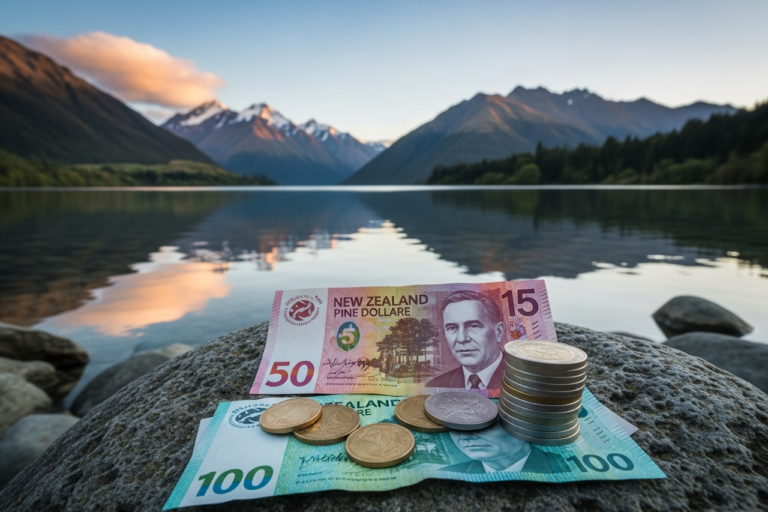
New Zealand’s banknotes are bright and full of detail. You can get them in $5, $10, $20, $50, and $100. Each note shows an important New Zealander on one side. On the other side, there is a bird from New Zealand. This is to show the nation’s cultural heritage. For example, the $5 note has Sir Edmund Hillary on it.
Before she died, Queen Elizabeth II was on the $20 note. This is something you will find in many Commonwealth places. One thing that makes New Zealand’s banknotes stand out is that they are made from a kind of plastic called polymer. Polymer means the banknotes last longer than paper ones. It also means they can have new security features like a clear window you can see through.
The Bank of New Zealand looks after these security features. This helps stop people from making fake money and keeps New Zealand money safe. The bright colours and clear pictures also help you see which note you have without any trouble. It makes it simple to tell the different denominations from each other at a look.
Coins – Sizes and Unique Aspects
The coins you get in New Zealand are easy to know, just like the banknotes. You will need these coins for small buys. Coins come in denominations of 10, 20, and 50 cents, plus $1 and $2. New Zealand no longer uses 1, 2, and 5 cent coins, so every cash deal now gets rounded to the nearest 10 cents.
Each of the coins in Zealand comes with its own design. Most have native animals or Maori patterns. The $1 coin shows a kiwi, which is the country’s main bird. The $2 coin has a kotuku, which is the white heron. On the back side of every coin, there is a picture of the king or queen.
Here are some things about the coins:
-
They are not the same size and colour, with both gold and silver, so you can spot them at a glance.
-
The 20 cent coin is shaped like a “Spanish flower” and has seven lumps around the sides. It shows a carving of Maori Pukaki.
-
The 50 cent coin pictures Captain Cook’s ship, the Endeavour, near Mount Taranaki.
Payment Methods Commonly Used in New Zealand
In New Zealand, people pay for things in a way that is up to date and easy. Card payments are used a lot, with Visa and Mastercard being taken almost everywhere. You can pay with your credit card or a travel money card for many things. This includes hotel costs and even getting a coffee in the morning.
There are many ATMs to use in cities and towns too. This makes it simple to get local currency if you need cash. Along with normal cards, people in New Zealand also use new ways to pay. Many now use technology like mobile payments. It’s good to know about the balance between using cash or cards, and to see how things like card payments and travel money cards are common in New Zealand.
Cash vs Card Payments
While you will get by with just card payments in most cities of New Zealand, it is a good idea to have some cash with you. There are smaller places, local markets, and some tour groups in rural spots that may want you to use cash. Having some New Zealand currency with you means you are all set and ready for anything that could come up on your trip.
Most of the time, people use card payments in New Zealand. You can use a credit card or debit card at hotels, restaurants, supermarkets, and petrol stations, so paying is easy all over the country. ATMs are easy to find, so you can get more travel money when you need it instead of keeping a lot on you.
Keep these ideas in mind when you need to choose how you pay in New Zealand:
-
Card payments are easy and less risky.
-
Cash comes in handy for small things or if there is no card machine.
-
Before you go, ask your bank about any extra costs for using your card overseas so you do not get a surprise.
Mobile and Contactless Payments
New Zealand works well with modern ways to pay. Many people in Zealand use contactless payments every day and they are found almost everywhere. If your credit or debit card has the contactless sign, you just need to tap it on the reader. For most things, there is, a set amount you can spend without putting in your PIN.
You can also use your phone to pay. A lot of shops, mostly in the big cities, take Apple Pay and Google Pay. If you have set these up on your phone, you may not even need your wallet. You just tap your device to pay.
Going cashless in Zealand helps make things easy for travellers. You do not need to deal with cash so often. This also helps you get through the checkout quicker. Using mobile and contactless payments can help your trip in New Zealand to be smooth and easy.
Currency Exchange in New Zealand
When you get to New Zealand with foreign currency, you will need to swap it for New Zealand dollars. The good news is, you have many choices when you want to exchange money. You will see foreign exchange services at international airports, in city centres, inside banks, and sometimes at hotels.
If you want the best exchange rate, it is a good idea to look at a few options first. You can use a currency converter to check the mid-market rate before you decide. This helps you know what the rate is at that time. Let’s talk about where you can go in New Zealand to exchange money and what fees you might pay.
Where to Exchange Money and Typical Fees
You have several choices when you need to exchange money in New Zealand, each with potentially different fees and exchange rates. Banks, dedicated currency exchange kiosks, and some hotels offer this service. While airport kiosks are convenient for when you first land, they often have less competitive exchange rates.
For better rates, consider visiting a Bureau de Change in a city centre or a local bank. It pays to shop around, as rates and commission fees can vary. Avoid exchanging money at hotels if possible, as their rates are typically not as favourable.
Here is a quick comparison of common places to exchange currency:
|
Exchange Location |
Convenience |
Typical Fees & Rates |
|---|---|---|
|
Airport Kiosks |
High |
Less competitive rates and potentially higher fees. |
|
City Centre Kiosks |
Medium |
Generally offer competitive exchange rates. |
|
Banks |
Medium |
Reliable, but rates may be less competitive than kiosks. |
|
Hotels |
High |
Poor exchange rates; best used only as a last resort. |
Using Foreign Currency in New Zealand
Many travellers often ask if they can use their home currency in New Zealand. Some places that get a lot of tourists might take well-known foreign currency like the US dollar or Australian dollars. But this is not done much in this country. The New Zealand dollar is the main legal tender in New Zealand.
You have to pay with the local currency for almost all your day-by-day spending. Using foreign currency often gives poor exchange rates and can be a hassle. We want to talk about if you can use US or Australian dollars and what you need to know about bringing your own currency into New Zealand.
Can You Spend US Dollars or Australian Dollars?
You usually cannot use US dollars or Australian dollars in New Zealand shops, restaurants, or for services. The New Zealand dollar is the one legal tender there, and shops will only take the local currency.
Some places in airports or in busy tourist spots may take AUD or USD, but this is not common. If they do, you might not get a good exchange rate. You could end up paying more than if you just used New Zealand dollars.
To have a smooth trip and get the best value, swap your foreign money for New Zealand dollars when you arrive. Or, you can get NZD from any ATM. This makes it easy to pay for things in new zealand, using the right dollar and not losing money on the exchange rate.
Are There Any Currency Restrictions for Travellers?
When you travel to New Zealand, you will see that there are not many rules about foreign currency. You can bring any amount of New Zealand dollars or other money into the country. There is no limit on how much you carry, so you are free to manage your travel money the way you want.
But there is one thing you need to know. If you have more than NZ$10,000 in cash, or the same amount in foreign currency, you must say so. You will need to fill out a Border Cash Report when you come into or leave new zealand.
This is just a rule to stop money crimes. You do not have to pay tax on the cash for this reason. You only need to report if you bring or take a large amount of money out of or into the country. If you do not tell them, you could face a fine. It is very important to be open about the cash you carry as travellers in zealand.
FAQs (Frequently Asked Questions)
Many people want to know what the local currency is before they go to New Zealand. The official currency of New Zealand is the New Zealand dollar. People often call it NZD or the kiwi dollar. If you need to swap money, currency converters are handy. They show you the latest and most competitive exchange rates, whether you have Australian dollars, US dollars, or some other kind of money. You do not have to carry a lot of cash. Card payments are accepted almost everywhere. You can use a credit card or debit card for most things in New Zealand.
Is it better to exchange currency before travelling or after arriving in New Zealand?
It is often a good idea to exchange just a small amount of money before you go to New Zealand. This will help you with your first needs when you get there. But, the exchange rate you get at home is usually poor. If you want the best value, it’s better to exchange money after you arrive in New Zealand. You can also use an ATM because the exchange rate is usually better. The best way is to use a foreign exchange service in a city in New Zealand.
What is the current exchange rate between NZD and USD?
The NZD exchange rate with the USD can change every day because of the global exchange markets. In early May 2026, 1 NZD is about 0.59 USD. If you want the latest exchange rates, it’s good to check a real-time currency converter online before you do anything with money. This way, you always know what the nzd exchange rate is and can get the most up-to-date info.
Are there limits on bringing New Zealand dollars into the country?
There are no set limits on how much New Zealand dollars or foreign currency you can bring in to the country. But all travellers who bring NZ$10,000 or more, or the same in other money, need to say so by filling in a Border Cash Report when they come to New Zealand.
Conclusion
To sum up, it is important to know about the New Zealand Dollar (NZD) if you want to travel or do business in New Zealand. The NZD comes in different denominations. There are special ways to pay, and there are rules that come with currency exchange. Knowing about these things can help make your time in the country easier. If you know what makes the NZD different from other money, or if you know where to change your cash, you will have an easier time looking after your money in New Zealand.
If you want to use your money well while you visit, you can ask for a free talk to help you with the New Zealand Dollar and other currency questions. Travel here with peace of mind and enjoy all that New Zealand has to offer!