Key Highlights
-
The Feast of Corpus Christi is an important event in the Catholic Church. It honours the real presence of Christ in the Eucharist.
-
This old tradition started in the 13th century. The feast day is a time for prayer and thinking about faith.
-
The main part of the feast is the Eucharistic procession. The blessed sacrament is taken out and carried through the streets for everyone to see.
-
In Britain, people mix old customs with local ways. Both Catholic and Anglican styles be seen in how the feast is kept.
-
In 2026, communities across the UK will join in these long-standing processions and practices for Corpus Christi.
Introduction
Welcome to a closer look at the feast of Corpus Christi, one of the most lively and old celebrations in the Christian year. This day is for honouring the holy eucharist, which is at the heart of the Catholic Church. All over Britain, this feast is marked by people coming together for processions, saying prayers, and keeping special local customs. These have been handed down from one year to the next. Are you ready to find out the meaning, story, and lovely ways people celebrate this big day of worship and being part of a community?
Understanding Corpus Christi: Origins and Meaning
The feast of corpus christi is a very special day for christians, especially for those in the catholic church. The meaning behind this feast is to say that jesus is truly present in the holy eucharist. The words “corpus christi” are latin and mean “body of christ.”
This feast gives christians the chance to talk about their faith in the eucharist, not just inside the church but out in the world too. It is both a joyful and serious time. People stop to remember this big gift. Now, we can see how the feast of corpus christi first started.
The Historic Roots of the Corpus Christi Feast in Britain
The feast of Corpus Christi started in the 13th century. The name, ‘Corpus Christi’, comes from Latin. It means ‘Body of Christ’. This shows the feast’s main focus on the Eucharist. A nun called Juliana of Liège had visions. The movement to set up a special feast day grew stronger because of her.
These events, and a wish to talk again about the teaching on the Eucharist, moved Pope Urban IV to act. As a result, Pope Urban IV made this feast part of the whole Catholic Church. In 1264, he wrote an official letter known as a papal bull called Transiturus de hoc mundo, to start the official Solemnity of the Body of Christ. This was an important time in the Church, making a worldwide day to honour the institution of the Eucharist.
The feast of Corpus Christi was meant to be happy and open. It gave a chance for people to show their faith in a bright and public way. This is different from Holy Week, which is more quiet and serious, as that is when the Last Supper is remembered. The arrival of this feast meant people could take part in a big day made to celebrate and show love to the Blessed Sacrament.
The Significance of the Eucharist in the Christian Tradition
At the heart of the Corpus Christi feast is the deep meaning of the Holy Eucharist. For Catholics, the Eucharist is much more than a symbol. It is the real presence of Christ. This is based on what happened during the Last Supper. At that meal, Jesus took some bread and wine. He said that the bread and wine would be his body and blood.
The name given to this belief is transubstantiation. This is very important for the Catholic faith. It says that during Mass, the bread and wine change into the actual body and blood of Jesus Christ. The feast day is a time to think about this and show thanks for the gift.
St Thomas Aquinas is one of the key people who helped people understand the Holy Eucharist. He even wrote hymns for this feast, and people still sing them now. During the feast, Eucharistic adoration is very important. In this practice, people pray in front of the consecrated Host. This is a main part of how Catholics celebrate the Corpus Christi feast day.
Celebrating Corpus Christi: Dates and Core Rituals
The feast of corpus christi is a key event in the catholic church, and the date changes each year. The reason for this is that the feast is tied to the easter season. This places it during an important time in the church’s year.
This feast day is when people come together to show their faith. The focus is on the blessed sacrament, with certain prayers and rituals that take place. In this text, we will talk more about when people celebrate the feast in the UK and what happens on the day.
When Is Corpus Christi Observed in the United Kingdom?
The feast of Corpus Christi is always celebrated on the Thursday after Trinity Sunday. Trinity Sunday comes right after Pentecost. Pentecost is 50 days after Easter. The church marks these days in a certain way, with big events about Christ’s life, death, and rising again.
So, the feast usually takes place at the end of May or sometimes in June. People keep this day on Thursday because it links to Holy Thursday. It was on Holy Thursday at the Last Supper that Jesus started the Eucharist.
But now in many places, like the United Kingdom, the feast of Corpus Christi is often moved to the next Sunday. Doing it on Sunday means more people from the church can come. They do not have to get time off work. This helps the whole group take part in the Mass and Corpus Christi processions.
Rituals, Prayers, and Processions: What Happens on the Day?
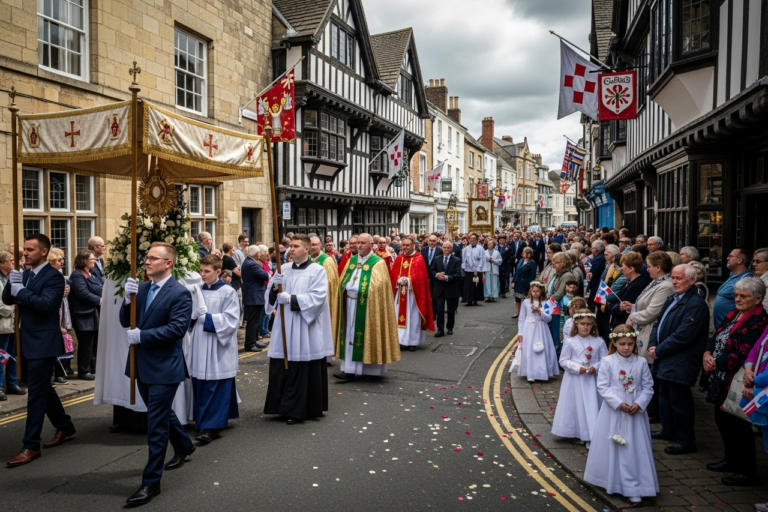
The celebration of Corpus Christi is full of beautiful and serious rituals. One of the main parts of the day is the eucharistic procession. This is a strong way for people to show what they believe. In this procession, the Blessed Sacrament is put in a special vessel called a monstrance, which is made to hold the consecrated host.
A priest or bishop then carries the monstrance through the streets, usually under a canopy. People walk behind, singing hymns and saying prayers. This act of walking with the Blessed Sacrament is a way for people to say that the real presence of Jesus is in the world and is also in their daily lives.
You may notice these important things during a Corpus Christi celebration:
-
A special Mass with readings and prayers about the eucharist.
-
The eucharistic procession, which may pause at outdoor altars for prayers and blessings.
-
Hymns, especially those written by St. Thomas Aquinas, are sung together.
-
Benediction, where there is a blessing given with the Blessed Sacrament at the end of the procession or adoration.
Traditions, Processions, and Regional Variations Across Britain
Across Britain, the traditions of Corpus Christi bring together the main ways of the Catholic Church and the special touch of each place. The key parts of the feast, like the Mass and the procession, are the same, but you can see different twists in each area. These changes show what is special about local towns and cities and show off their history and style.
You will notice these differences in how big the procession is, in which hymns they sing, and how the local groups join in. Looking at all these different ways shows how the feast has grown and been liked all over the country. Both Catholic and Anglican people now take part in Corpus Christi.
Unique Customs in English Towns and Cities
Yes, Corpus Christi is celebrated differently across Britain, with many English towns and cities adding their own unique customs to the feast day. In places with a long Catholic history, these traditions can be particularly rich and elaborate. Cities like Oxford, with its historic colleges including Corpus Christi College, often have a special connection to the feast.
The processions might follow historic routes, and local parishes may have specific traditions that have been passed down for generations. The involvement can vary greatly, from small, parish-led walks to larger, more public events that draw participants from across a diocese.
Here is a look at how customs can vary:
|
Location/Type |
Customary Practice |
|---|---|
|
Major Cities |
Often host large, diocesan-led processions, sometimes drawing thousands of participants. |
|
Historic Towns |
May follow ancient routes through the town centre, linking the procession to local history. |
|
Rural Parishes |
Typically feature smaller, more intimate processions around the church grounds or local streets. |
|
Universities |
Colleges named Corpus Christi, like in Oxford, may have special academic or chapel events. |
Influence of Catholicism and Anglicanism in British Observance
In Britain, the way people keep Corpus Christi comes from the country’s own religious story, bringing together ideas from the Catholic Church and Anglicanism. Today, the feast is still a big event for Catholic churches and is a strong part of the church’s calendar. Dioceses all over the UK hold a special Mass and processions in public, and this shows the belief in the real presence of Christ in the Eucharist.
After the Oxford Movement in the 19th century, some in the Anglican church started to look for and take back old Catholic customs. As a result, there was new interest in loving the Eucharist, and some Anglo-Catholic churches started to keep Corpus Christi with processions and special services that look a lot like those in the Roman Catholic faith.
This is a part of the country’s shared history, even if the churches have different ideas. People from both churches use the same old liturgical texts and hymns, though how they see the Eucharist may not be the same. These ways make Britain’s celebration of the Corpus Christi feast a good example of how Christian traditions keep growing and changing over time.
Conclusion
In conclusion, Corpus Christi is a time full of tradition and history. This feast shows how deep the Christian faith runs in Britain. The customs and joyful processions are found in many regions. These rituals bring people together.
Taking part in Corpus Christi helps people learn more about the meaning of the Eucharist. It also brings all of us closer. The next big celebration is in 2026. This gives us a chance to join with the local community and enjoy these long-standing customs.
If you want to know more about Corpus Christi, the feast, or how the Eucharist is part of it, you can find out. You are welcome to share your story or ask questions at any time!