The British pound (GBP) is the official currency of the United Kingdom, issued by the Bank of England and represented by the symbol £. It’s a fiat currency, meaning its value rests on the UK government’s backing rather than a physical commodity such as gold or silver. Often described as one of the oldest currencies still in active use anywhere in the world, the pound matters to Canadians who are travelling to the UK, have family there, or send money home regularly. This guide from Remitly looks at where the pound comes from, how UK coins and notes have changed, and what Canadians exchanging or sending pounds should know.
TL;DR:
- GBP is the sole official currency of the United Kingdom, issued and regulated by the Bank of England.
- It’s one of the oldest currencies in continuous use, with roots going back to Anglo-Saxon England.
- UK coins and banknotes both feature King Charles III’s portrait, following his accession to the throne in 2022.
- Canadians can exchange Canadian dollars for pounds at banks, currency exchange counters, or through an online transfer service such as Remitly.
Why is the British pound called pound sterling?
The name “pound” comes from the Latin word libra, a unit of weight used across the Roman Empire, which is also why the pound’s symbol, £, is a stylized L. The British pound has its origins in the Roman Empire, which stretched across much of Europe and the British Isles. The “sterling” part is less certain: one commonly cited explanation traces it to the Old English word steorling, a reference to a small star stamped on early Norman silver pennies, though historians don’t fully agree on a single origin. Together, “pound sterling” remains the currency’s full formal name, alongside the shorthand “the pound.”

How old is the British pound?
We know the pound has existed in some form as far back as the year 775 CE, when one pound was equivalent to one pound of silver coins. That history is part of why the pound is often cited as one of the oldest currencies still in active use today, predating the United Kingdom itself by many centuries, since England and Scotland weren’t formally united until 1707.

What countries use the British pound?
The pound is legal tender across the United Kingdom: England, Scotland, Wales, and Northern Ireland. Several British Crown Dependencies and Overseas Territories also issue their own pound-denominated currency, pegged one-to-one with GBP, including:
- Gibraltar
- Jersey
- Guernsey
- The Isle of Man
- The Falkland Islands
- Saint Helena and Ascension Island
These local currencies aren’t generally accepted outside their own territory, so it’s worth exchanging them for standard Bank of England notes before you travel to a different country. Understanding how other European currencies compare can also help if your trip continues beyond the UK.

What coins and notes are in circulation in the UK?
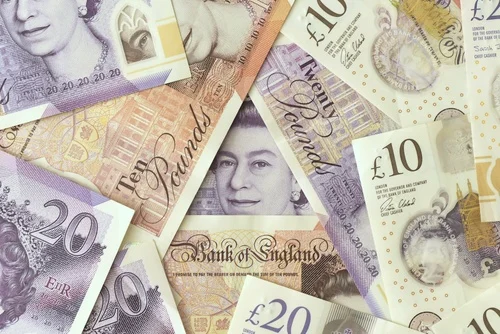
UK coins come in eight denominations: 1p, 2p, 5p, 10p, 20p, and 50p, plus £1 and £2 coins. Bank of England banknotes come in four denominations: £5, £10, £20, and £50.
Since December 2022, new coins have carried King Charles III’s portrait, and Bank of England banknotes have featured him since June 2024. The Bank of England reverses the direction the monarch faces with each new reign, a tradition that has held for centuries. Queen Elizabeth II was the longest-reigning monarch in the U.K.’s history. She took the throne in 1952 and reigned until her passing in 2022. Bank of England banknotes have also been printed on polymer rather than paper since 2016, which makes them more durable and harder to counterfeit than the older paper notes.

Does the UK use the euro?
No. The UK negotiated an opt-out from the euro under the 1992 Maastricht Treaty and kept the pound throughout its time in the EU. When the UK voted to leave the EU in 2016, the pound fell to its lowest level against the US dollar in 31 years, a reminder of how directly political events can move currency values. The UK formally left the EU in 2020, and the pound has remained its only official currency throughout. Most of the nations in the European Union still use the euro, which entered circulation as physical notes and coins in 2002. If you’re curious which countries use the euro, it’s worth checking before you travel, since not every EU member has adopted it.

How to exchange British pounds
Canadians heading to the UK, or sending money to family and friends there, have a few options for exchanging CAD to GBP. Banks and currency exchange counters can convert Canadian dollars to pounds, though rates and fees vary, so it’s worth comparing a couple of providers before you commit.
For sending money rather than carrying cash, an online transfer service from Canada can send pounds directly to a UK bank account, which often works out more conveniently than a wire transfer for smaller, regular amounts.
If you’re planning a longer stay, whether for work, study, or a move to the UK, opening a UK bank account once you arrive can reduce how often you need to exchange currency at all.

FAQs
What is the symbol for the British pound?
The British pound’s symbol is £, and its three-letter currency code is GBP. Both trace back to the Latin word libra, a Roman unit of weight, which is also where the pound gets its name.
Is the British pound the same as the euro?
No. The pound and the euro are separate currencies. The UK never adopted the euro, choosing to keep the pound even while it was part of the European Union, and the pound remains the UK’s only official currency today.
Can I spend British pounds in Canada?
Not directly. Canadian merchants deal in Canadian dollars, so you’ll need to exchange pounds for CAD, or the other way around, through a bank, currency exchange service, or money transfer provider before spending or sending funds.
Why do UK coins sometimes look different for the same value?
The Bank of England updates coin designs with each new monarch, alternating the direction the ruler’s portrait faces. Coins featuring Queen Elizabeth II are still legal tender alongside newer King Charles III coins, so you may see both in circulation for some time.
Is “pound sterling” a different currency from the British pound?
No, they’re the same currency. “Pound sterling” is the formal name, while “pound” and “GBP” are the common short forms used in everyday conversation and on currency exchange boards.
Key takeaways
- GBP is the UK’s official currency, issued by the Bank of England, and among the oldest currencies still in active use, with roots as far back as 775 CE.
- The UK has never used the euro; it opted out under the 1992 Maastricht Treaty and kept the pound after formally leaving the EU in 2020.
- UK coins and banknotes now carry King Charles III’s portrait, and banknotes have been polymer rather than paper since 2016.
- Canadians can exchange Canadian dollars for pounds through banks, currency exchange counters, or an online transfer service like Remitly, depending on whether they need cash in hand or are sending money to someone in the UK.
Last reviewed: November 2026.