The Cost of Having a Baby by Country
When planning a family, the first year of expenses may be one of the steepest learning curves for new parents.
But there are positive aspects to this learning curve. New families soon figure out ways to benefit from discounts and hand-me-downs while also finding which “essentials” are truly indispensable and which are not. In fact, a lot of parenting norms that U.S. and UK families take for granted — such as separate bedrooms or pushing a pram — are considered unusual in other cultures1.
Still, for new parents who travel and work or hope to relocate (opens in new window) ahead of those early months, it can help to see a comparison of basic baby costs from country to country. So, Remitly compiled a list of essentials for a baby’s first year (based on U.S. norms) and manually visited local baby stores, supermarkets and online pharmacies in over 90 countries to collect prices for each one. If you, or your family, have moved overseas and are starting a family, try Remitly to send money internationally (opens in new window).
We then calculated the yearly cost of every item and category in each country and converted the totals to USD for comparison. We also calculated each country’s cost of having a baby as a percentage of the average local income.
But there are positive aspects to this learning curve. New families soon figure out ways to benefit from discounts and hand-me-downs while also finding which “essentials” are truly indispensable and which are not. In fact, a lot of parenting norms that U.S. and UK families take for granted — such as separate bedrooms or pushing a pram — are considered unusual in other cultures1.
Still, for new parents who travel and work or hope to relocate (opens in new window) ahead of those early months, it can help to see a comparison of basic baby costs from country to country. So, Remitly compiled a list of essentials for a baby’s first year (based on U.S. norms) and manually visited local baby stores, supermarkets and online pharmacies in over 90 countries to collect prices for each one. If you, or your family, have moved overseas and are starting a family, try Remitly to send money internationally (opens in new window).
We then calculated the yearly cost of every item and category in each country and converted the totals to USD for comparison. We also calculated each country’s cost of having a baby as a percentage of the average local income.
Key findings
- Our list of baby essentials costs the most in Uzbekistan ($8,879 USD) and the least in Pakistan ($1,720 USD).
- In the U.S., baby essentials cost $5,150 USD (or 6.8% of the average salary), making it the fourth-most affordable country in the world for a baby’s first year.
- Australia ($453 USD), the U.S. ($548 USD), New Zealand ($563 USD) and Canada ($660 USD) are among the 10 countries where a baby’s first year of clothing is cheapest.
- A year’s supply of baby formula costs $759 USD/£569 GBP in the UK — the eighth cheapest in the world.
- Canada, Ireland, and the U.S. are among the five countries where diapers are the most affordable relative to national average income.
The U.S. is the fourth most affordable country for baby essentials, compared to income
First, we calculated the cost of buying our full, cross-category list of baby essentials in every country. These categories include a year’s supply of products for diaper changes (diapers, rash cream, etc.), bottles, baby formula, sleep (beds and bedding), transport and clothing.
In the U.S., these costs add up to $5,150 USD for the first year, which is just 6.8% of the average income ($75,275 USD). There are 49 countries where the cost of having a baby is lower than this, but that 6.8% figure makes the U.S. the fourth most affordable place for a baby’s first year (excluding birth and medical costs, which were not within the scope of this study).
In the U.S., these costs add up to $5,150 USD for the first year, which is just 6.8% of the average income ($75,275 USD). There are 49 countries where the cost of having a baby is lower than this, but that 6.8% figure makes the U.S. the fourth most affordable place for a baby’s first year (excluding birth and medical costs, which were not within the scope of this study).
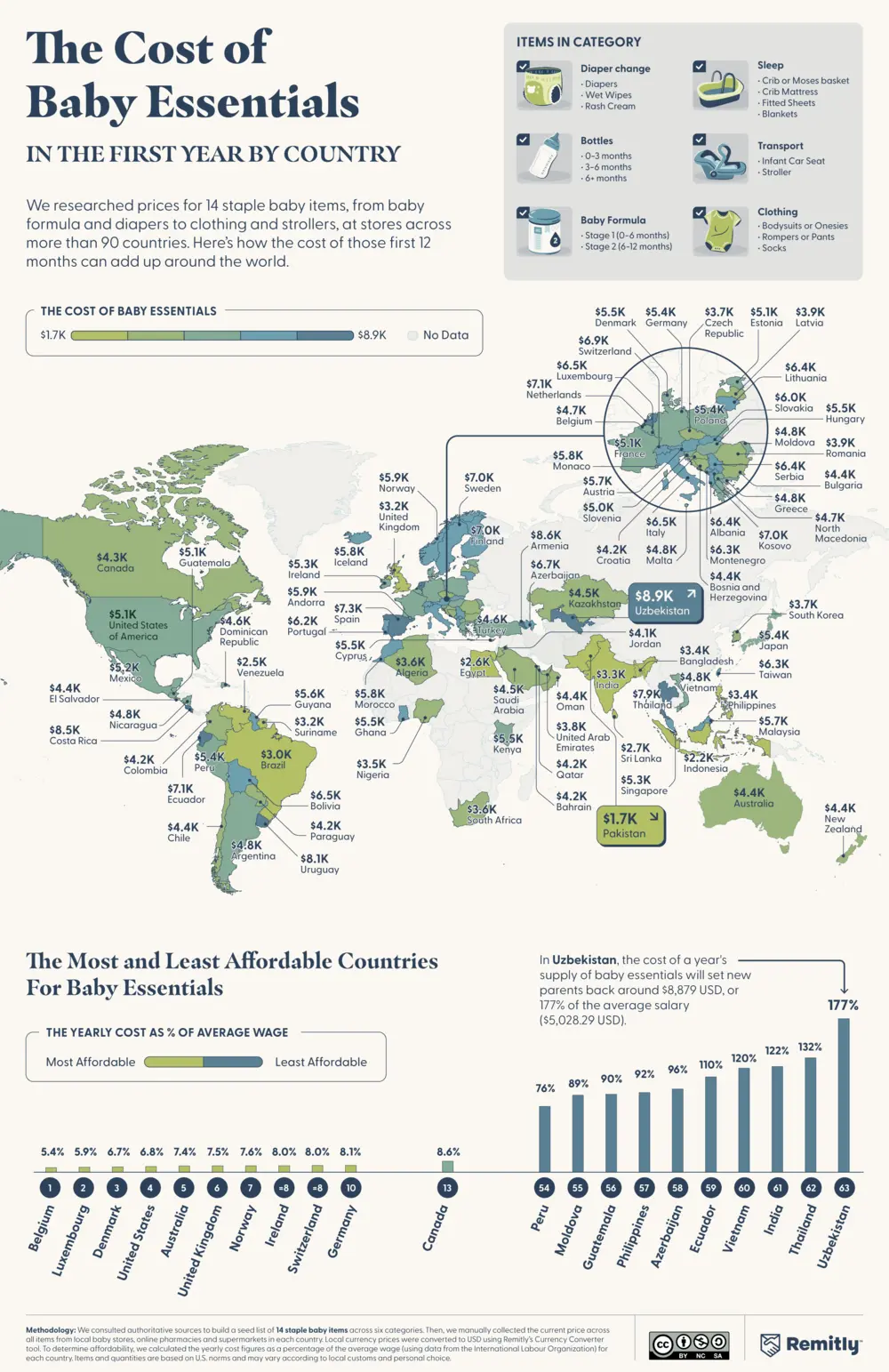
Parents in Uzbekistan face both the steepest costs for a year of baby essentials (based on U.S. norms) and the worst affordability compared to local salaries. The annual cost comes to $8,879 USD, which is 177% (or 1.77 times) the average income of $5,028 USD. Once again, this is based on common U.S. product choices such as a crib; but did you know that in Uzbekistan and other Central Asian countries, babies commonly sleep in a traditional, hand-crafted rocking cradle called the beshik2?
The UK is among the cheapest spots for baby formula
Not every family uses baby formula, but many families with particular needs or choices rely on it to provide essential nutrients for their child3. We based our calculation of the cost of baby formula in every country on six months of Stage 1 (0-6 months) formula and six months of Stage 2.
The UK ($759 USD/£569 GBP) is among 20 countries where the cost of the first year’s baby formula is under $1,000 USD. It is also among the ten countries where baby formula is most affordable, as $759 USD equates to just 1.8% of the national average income. Just under half (47%) of UK parents were using formula, according to 2024 Government figures4, meaning the other half could save an average of £569-£660 in the first year if breastfeeding is an option. If you’re considering a move to the UK, use Remitly to transfer money internationally from the U.S. to the UK (opens in new window).
The UK ($759 USD/£569 GBP) is among 20 countries where the cost of the first year’s baby formula is under $1,000 USD. It is also among the ten countries where baby formula is most affordable, as $759 USD equates to just 1.8% of the national average income. Just under half (47%) of UK parents were using formula, according to 2024 Government figures4, meaning the other half could save an average of £569-£660 in the first year if breastfeeding is an option. If you’re considering a move to the UK, use Remitly to transfer money internationally from the U.S. to the UK (opens in new window).
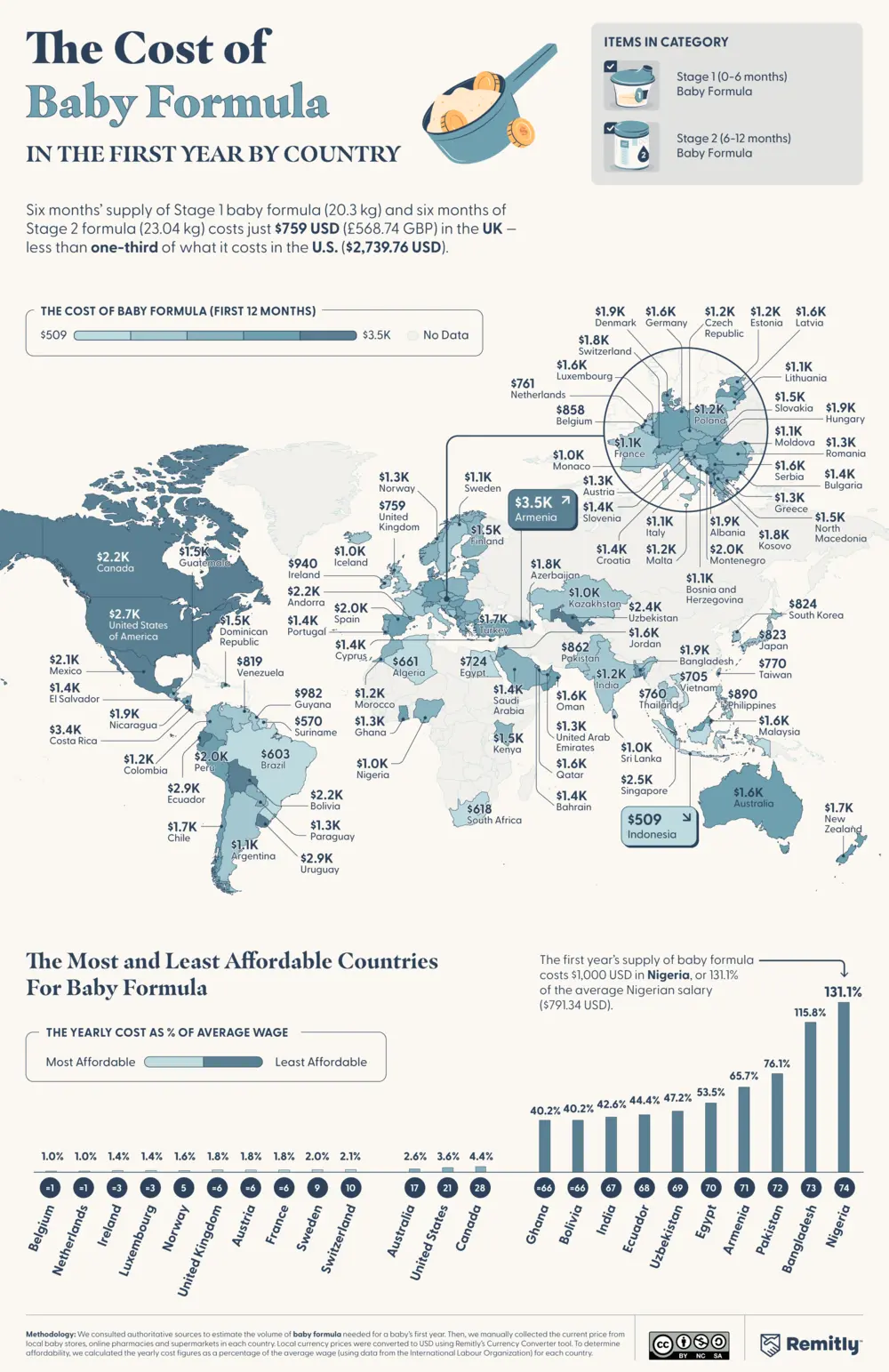
In Nigeria and Bangladesh, a year of baby formula costs more than the average annual income. But formula is most expensive in Armenia ($3,471 USD) and Costa Rica ($3,396 USD). This is 1.2 times as much as in the U.S. ($2,740 USD). Looking to support family overseas? Consider using Remitly to send money to Nigeria (opens in new window) or Bangladesh (opens in new window).
All the same, the U.S. is the fifth most expensive country in the world for baby formula, according to our research and calculations.
All the same, the U.S. is the fifth most expensive country in the world for baby formula, according to our research and calculations.
Finland, Canada and Ireland have the most affordable diapers, compared to salaries
To calculate the cost of the first year of diaper changes, we based our figures on buying 1,110 Size S diapers, 960 Size M and 840 Size L, based on daily use as calculated from pediatrician-reviewed figures. We also factored in the purchase of 7,800 wet wipes and 400ml of rash cream.
In the U.S., this comes to $1,228 USD or around 1.6% of the average salary — making America the joint fifth most affordable place for diapers, even if there are 54 countries where they’re cheaper.
In the U.S., this comes to $1,228 USD or around 1.6% of the average salary — making America the joint fifth most affordable place for diapers, even if there are 54 countries where they’re cheaper.
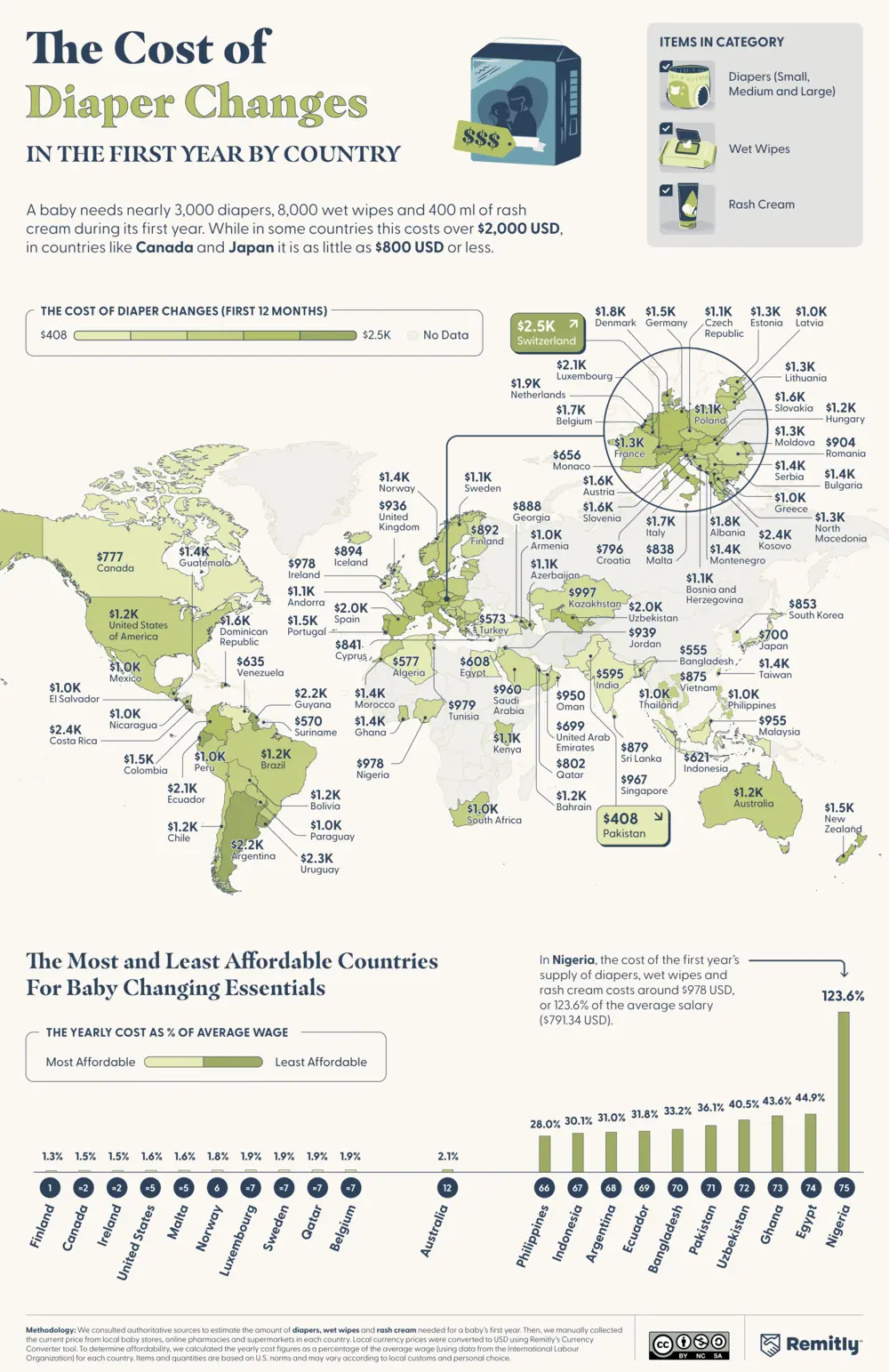
Finland (diapers cost 1.3% of average income) and Canada (opens in new window) (1.5%) have the most affordable diapers. A year's supply in Finland costs just $892 USD. Elsewhere in Europe, Switzerland ($2,534 USD) and Kosovo ($2,448 USD) have the world's most expensive year's supply of diapers.
The cost of diapers accounts for the highest proportion of the average salary in Nigeria (123.6%), Egypt (44.9%) and Ghana (43.6%).
The cost of diapers accounts for the highest proportion of the average salary in Nigeria (123.6%), Egypt (44.9%) and Ghana (43.6%).
Thailand, Sweden and the Netherlands have the most expensive baby clothes
Clothing is the most expensive category that we looked at. A year’s supply of bodysuits or onesies (60 items), rompers or pants (60 items) and socks (24 pairs) costs $1,496 USD as a global average.
This clothing costs the most in Thailand ($3,807 USD), Sweden ($3,649 USD) and the Netherlands ($3,462 USD). In Thailand, this equates to 63.2% of the average annual salary — only in Nigeria (113.7%) is baby clothing less affordable than Thailand.
This clothing costs the most in Thailand ($3,807 USD), Sweden ($3,649 USD) and the Netherlands ($3,462 USD). In Thailand, this equates to 63.2% of the average annual salary — only in Nigeria (113.7%) is baby clothing less affordable than Thailand.
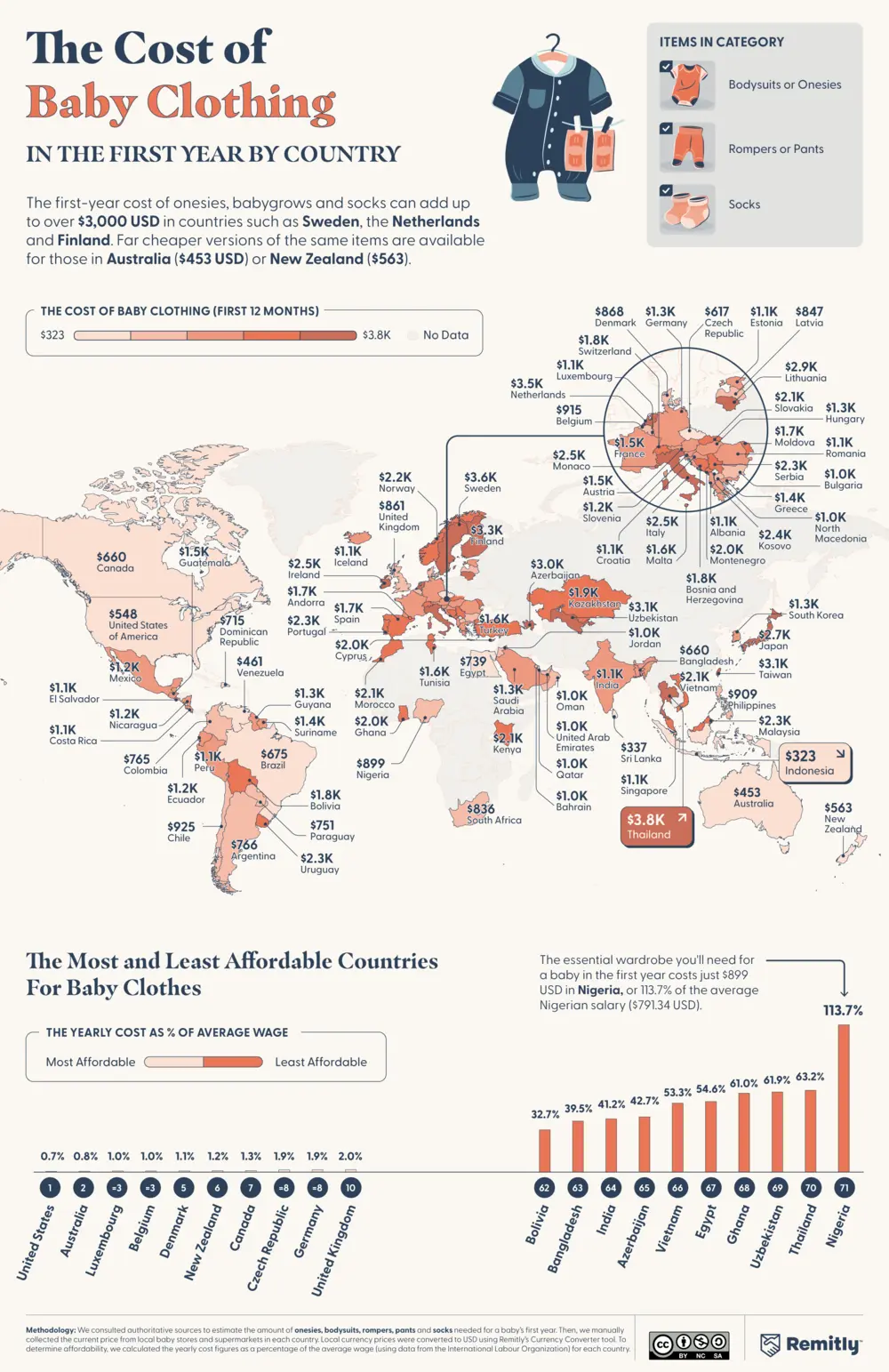
The U.S. is among the countries with the cheapest baby clothing. Our shopping list of first-year essentials costs just $548 USD in the U.S., which is 36.4% less than in the UK ($861 USD/£645 GBP) and 55.2% less than in Mexico ($1,223 USD). For those looking to support family back home, use Remitly to transfer money to Mexico (opens in new window) to help ease those first year expenses.
Baby bedding is cheapest in America compared to average income
For our Sleep Time category, we calculated the cost of a crib or Moses basket, mattress, five fitted sheets and five blankets in every country.
Brazil ($148 USD) and Bosnia and Herzegovina ($163 USD) are the cheapest of all, among six countries where these bedding items total under $200 USD. Iceland ($1,347 USD) is the only country where the bill comes to over $1,000 USD.
Brazil ($148 USD) and Bosnia and Herzegovina ($163 USD) are the cheapest of all, among six countries where these bedding items total under $200 USD. Iceland ($1,347 USD) is the only country where the bill comes to over $1,000 USD.
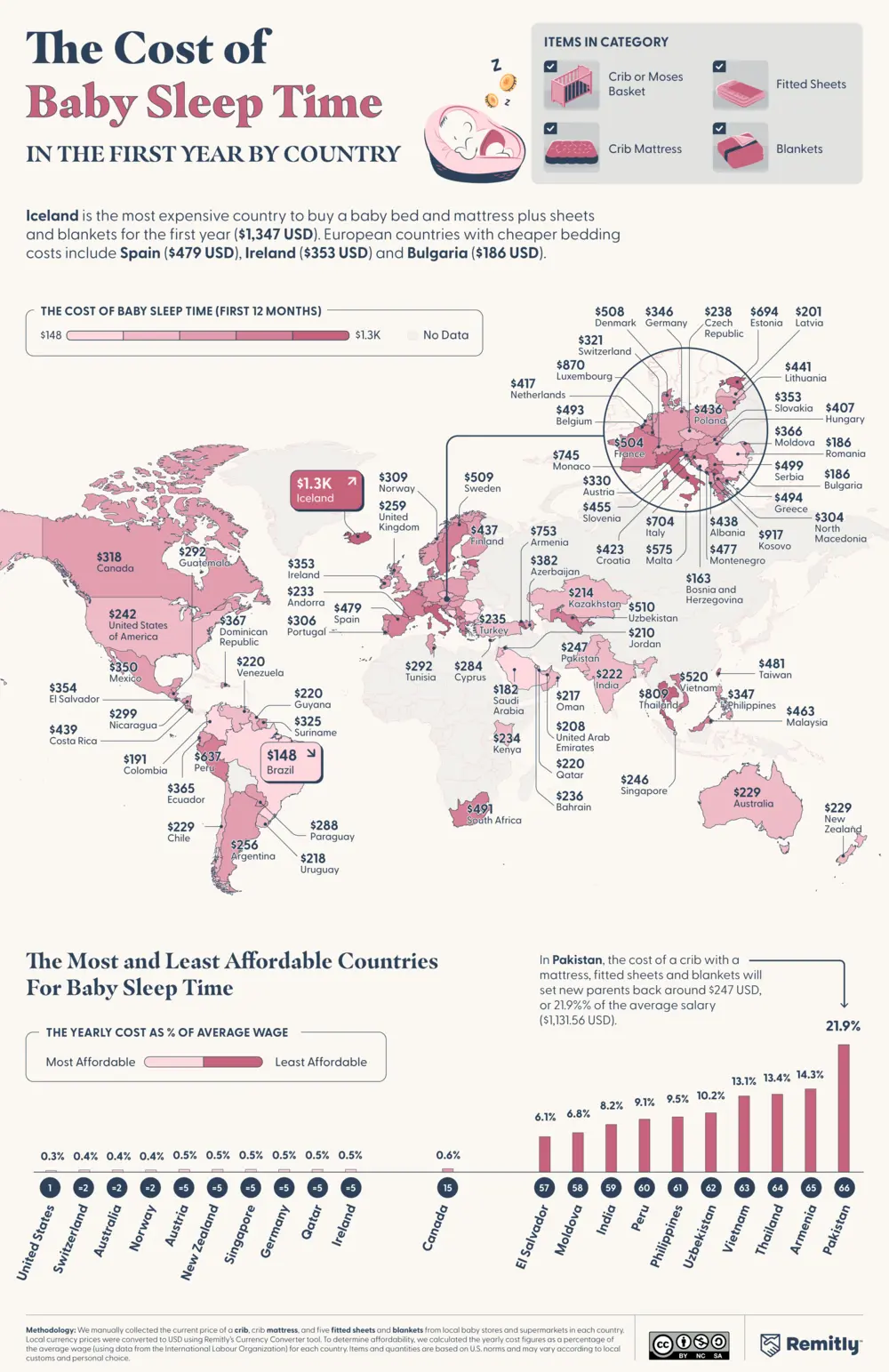
In the U.S., these items cost $242 USD. At just 0.3% of the average annual income in the U.S., this makes America the most affordable place for baby bedding. Australia (0.4%), New Zealand (0.5%) and Canada (0.6%) are other Anglophone countries among the 15 most affordable in this category. Thinking of moving Down Under to raise a family? Read our guide on parenting expectations in Australia (opens in new window).
In Iceland, setting your baby up with travel essentials costs over $1,000 USD
Finally, we looked at the cost of buying an infant car seat and a stroller in every country.
The Philippines (opens in new window) ($71 USD) and Bangladesh ($79 USD) are the cheapest countries to buy these two items, while Bosnia and Herzegovina ($139 USD) and the UK ($147 USD/£110 GBP) are the cheapest places in Europe. The UK is also the joint second most affordable country in the world for these items, with them costing just 0.3% of the average annual income.
The Philippines (opens in new window) ($71 USD) and Bangladesh ($79 USD) are the cheapest countries to buy these two items, while Bosnia and Herzegovina ($139 USD) and the UK ($147 USD/£110 GBP) are the cheapest places in Europe. The UK is also the joint second most affordable country in the world for these items, with them costing just 0.3% of the average annual income.
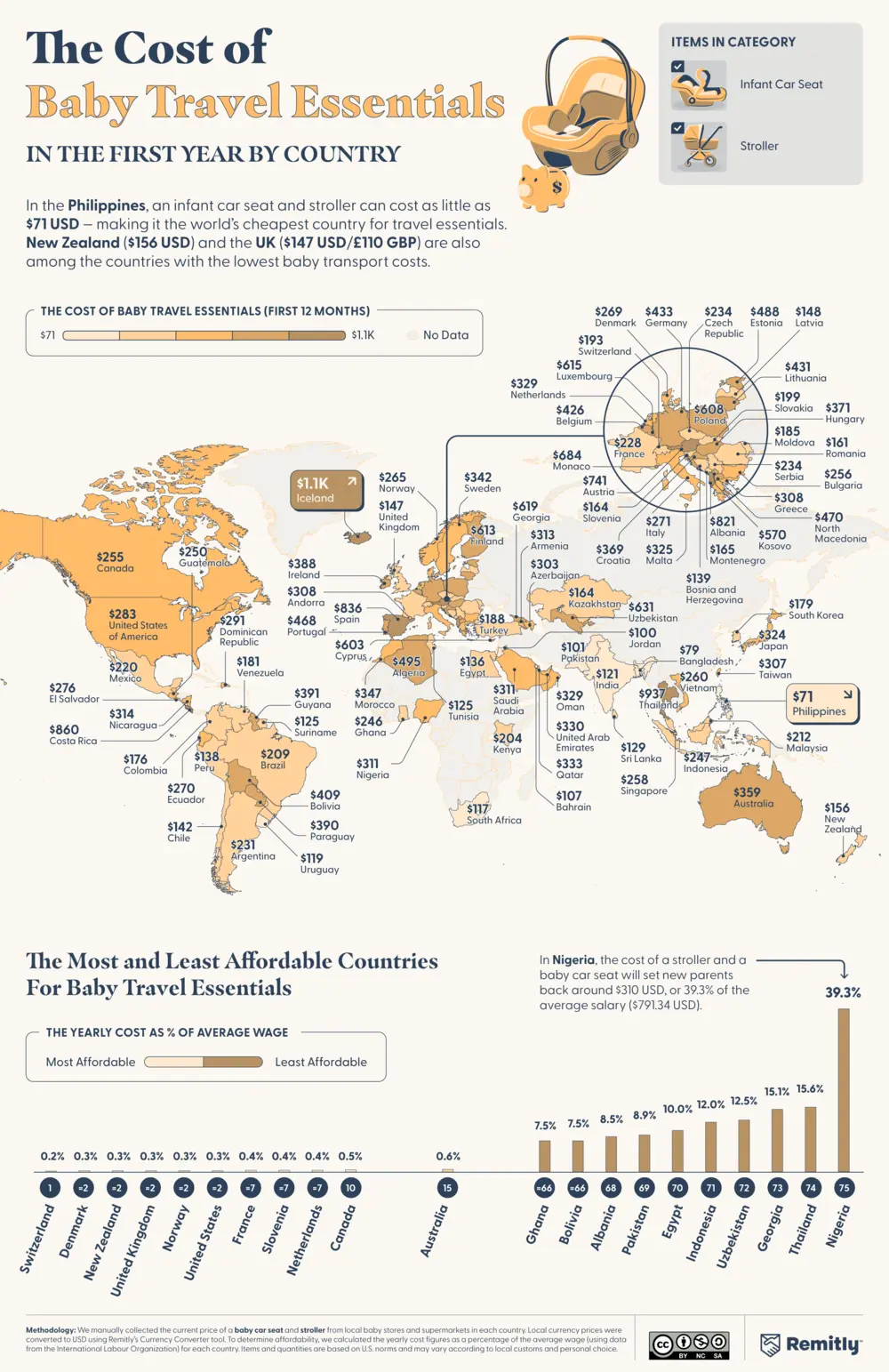
However, there are several European countries among the most expensive in the world. Iceland is the only country where travel essentials cost over $1,000 USD ($1,103 USD), and they cost around $700 or more in Spain, Albania, Austria and Monaco.
How to save money on a baby’s first year essentials when living abroad
Shopping for your first baby’s essentials is already a new experience — and when you imagine doing so in a country that you didn’t grow up in, it may feel even more overwhelming.
So before you spend your hard-earned wages on expensive necessities, consider the following tips for parenting abroad (opens in new window):
So before you spend your hard-earned wages on expensive necessities, consider the following tips for parenting abroad (opens in new window):
- Join local parent groups. Forums and Facebook groups for local expats and new families can be a source of great tips and support. You may even access hand-me-downs on these groups.
- Shop second-hand. Apart from car seats5 and personal hygiene items, many perfectly good baby essentials may be bought pre-used at a lower price. Does the culture that you’ve moved to have thrift stores, flea markets or yard/garage sales?
- Observe local customs and conditions. Generations of wisdom get passed from parent to parent in every culture. Listen and ask questions, and you may find that items you deemed essential are unnecessary. Local parents may also have smart solutions for needs that arise from the local climate and other conditions.
- Research before you travel. While you may find items are cheaper or altogether unnecessary in your new location, note that other essential products may be unavailable or overpriced if they are not commonly used locally.
Methodology
We manually visited local baby stores, and popular everyday supermarkets and online pharmacies in over 90 countries to collect the cost of 14 staple items (plus development stage variations of the same items) across six categories, choosing affordable options (rather than pricey branded versions) from each retailer:
| Category | Item | Yearly Count |
|---|---|---|
| Diaper Changes | Diapers — Size S | 1,110 |
| Diapers — Size M | 960 | |
| Diapers — Size L | 840 | |
| Wet Wipes | 7,800 | |
| Rash Cream | 400ml | |
| Bottles | Bottle with caps — 0-3 months | 8 |
| Bottle with caps — 3-6 months | 8 | |
| Bottle with caps — 6+ months | 6 | |
| Baby Formula | Baby Formula — Stage 1 (0-6 months) | 20.3kg |
| Baby Formula — Stage 2 (6-12 months) | 23.04kg | |
| Sleep | Crib, Carrycot, or Moses basket | 1 |
| Crib Mattress | 1 | |
| Fitted Sheets | 5 | |
| Blankets | 5 | |
| Transport | Infant Car Seat | 1 |
| Stroller | 1 | |
| Clothing | Bodysuits or Onesies | 60 |
| Babygrow or Pants | 60 | |
| Socks | 24 |
We consulted authoritative sources to estimate the volume of each item (e.g., number of diapers and wet wipes, and weight of baby formula) required for a baby’s first year and calculated the yearly cost of each item and category in each country. Local currencies were converted to USD (on June 18th 2026) for comparison purposes using Remitly’s Currency Converter. The sales tax added to U.S. prices was the average across all states (7.53%), and the sales tax added to Canada was the average of cumulative sales taxes by province (11%).
To measure the affordability of select categories, we calculated the yearly cost figure as a percentage of the average wage (using data from the International Labour Organization) for each country.
Items and quantities are based on U.S. norms and may vary according to local customs and personal needs and choices.
Data is correct as of June 2026.
References
[1] BBC (2021). Is the Western way of raising kids weird? https://www.bbc.co.uk/future/article/20210222-the-unusual-ways-western-parents-raise-children (opens in new window)
[2] Elle uzbekistan (2024). Beshik – a traditional cradle. https://elleuzbekistan.com/en/beshik-a-traditional-cradle/ (opens in new window)
[3] USDA Food and Nutrition Administration (2026). Feeding Your Baby. https://www.fna.usda.gov/fs/infant-formula (opens in new window)
[4] Office for Health Improvement & Disparities (2024). Infant feeding survey 2024: full report. https://www.gov.uk/government/statistics/infant-feeding-survey-in-england-2024/infant-feeding-survey-2024-full-report (opens in new window)
[5] Safe Kids Worldwide (2026). Is It Okay To Use A Second-Hand Car Seat? https://www.safekids.org/blog/it-okay-use-second-hand-car-seat (opens in new window)
To measure the affordability of select categories, we calculated the yearly cost figure as a percentage of the average wage (using data from the International Labour Organization) for each country.
Items and quantities are based on U.S. norms and may vary according to local customs and personal needs and choices.
Data is correct as of June 2026.
References
[1] BBC (2021). Is the Western way of raising kids weird? https://www.bbc.co.uk/future/article/20210222-the-unusual-ways-western-parents-raise-children (opens in new window)
[2] Elle uzbekistan (2024). Beshik – a traditional cradle. https://elleuzbekistan.com/en/beshik-a-traditional-cradle/ (opens in new window)
[3] USDA Food and Nutrition Administration (2026). Feeding Your Baby. https://www.fna.usda.gov/fs/infant-formula (opens in new window)
[4] Office for Health Improvement & Disparities (2024). Infant feeding survey 2024: full report. https://www.gov.uk/government/statistics/infant-feeding-survey-in-england-2024/infant-feeding-survey-2024-full-report (opens in new window)
[5] Safe Kids Worldwide (2026). Is It Okay To Use A Second-Hand Car Seat? https://www.safekids.org/blog/it-okay-use-second-hand-car-seat (opens in new window)
Beyond Borders: The Official Remitly Blog
Best Countries to Raise a Family: Safety, Schools, and Stability
Read more (opens in new window)
Maternity Leave in Canada: Everything You Need to Know
Read more (opens in new window)
The Gift of a Quiet Month: How and Why to Send Money Home to Cover Bills
Read more (opens in new window)This publication is provided for general information purposes only and is not intended to cover all aspects of the topics discussed herein. This publication is not a substitute for seeking advice from an applicable specialist or professional. The content in this publication does not constitute legal, tax, or other professional advice from Remitly or any of its affiliates and should not be relied upon as such. While we strive to keep our posts up to date and accurate, we cannot represent, warrant or otherwise guarantee that the content is accurate, complete or up to date.