

Where is it easiest to buy a home in Spain?
House prices in Spain have increased by 12.2% over the past year, reaching an average of around €1,927 per square meter nationwide.1 For many potential buyers, this shift has made it harder to know where buying a home still feels realistic and where competition has already pushed costs beyond their reach.
But buying abroad is never just about price. Accessibility, stability, and opportunity all matter too. For those looking to relocate overseas, the question isn’t just how much a home costs, but how easy it is to actually buy one.
So, which parts of Spain still make ownership within reach in 2025?
To answer that, Remitly analysed official government property data across Spanish provinces, exploring local prices, new housing figures, unsold stock, and the share of international buyers. From this, we’ve found where markets are most open to newcomers and where buyers may face more barriers to entry.
Whether you’re planning a move, investing for the future, or helping loved ones abroad, understanding where it should be easiest to buy can help you prepare and send money to Spain (opens in new window) confidently and securely with Remitly.
But buying abroad is never just about price. Accessibility, stability, and opportunity all matter too. For those looking to relocate overseas, the question isn’t just how much a home costs, but how easy it is to actually buy one.
So, which parts of Spain still make ownership within reach in 2025?
To answer that, Remitly analysed official government property data across Spanish provinces, exploring local prices, new housing figures, unsold stock, and the share of international buyers. From this, we’ve found where markets are most open to newcomers and where buyers may face more barriers to entry.
Whether you’re planning a move, investing for the future, or helping loved ones abroad, understanding where it should be easiest to buy can help you prepare and send money to Spain (opens in new window) confidently and securely with Remitly.
Key findings
- Almería is Spain’s easiest place to buy a home in our national analysis, combining low prices (€1,487.20 per square metre) and high housing availability (18.8 new homes completed and 40.1 building permits per 1,000 residents).
- La Coruña could be a tricky place to purchase a house, with a high year-on-year increase in house prices (21.8%) and a relatively low housing stock (14.5 new homes completed and 28.7 building permits per 1,000 residents).
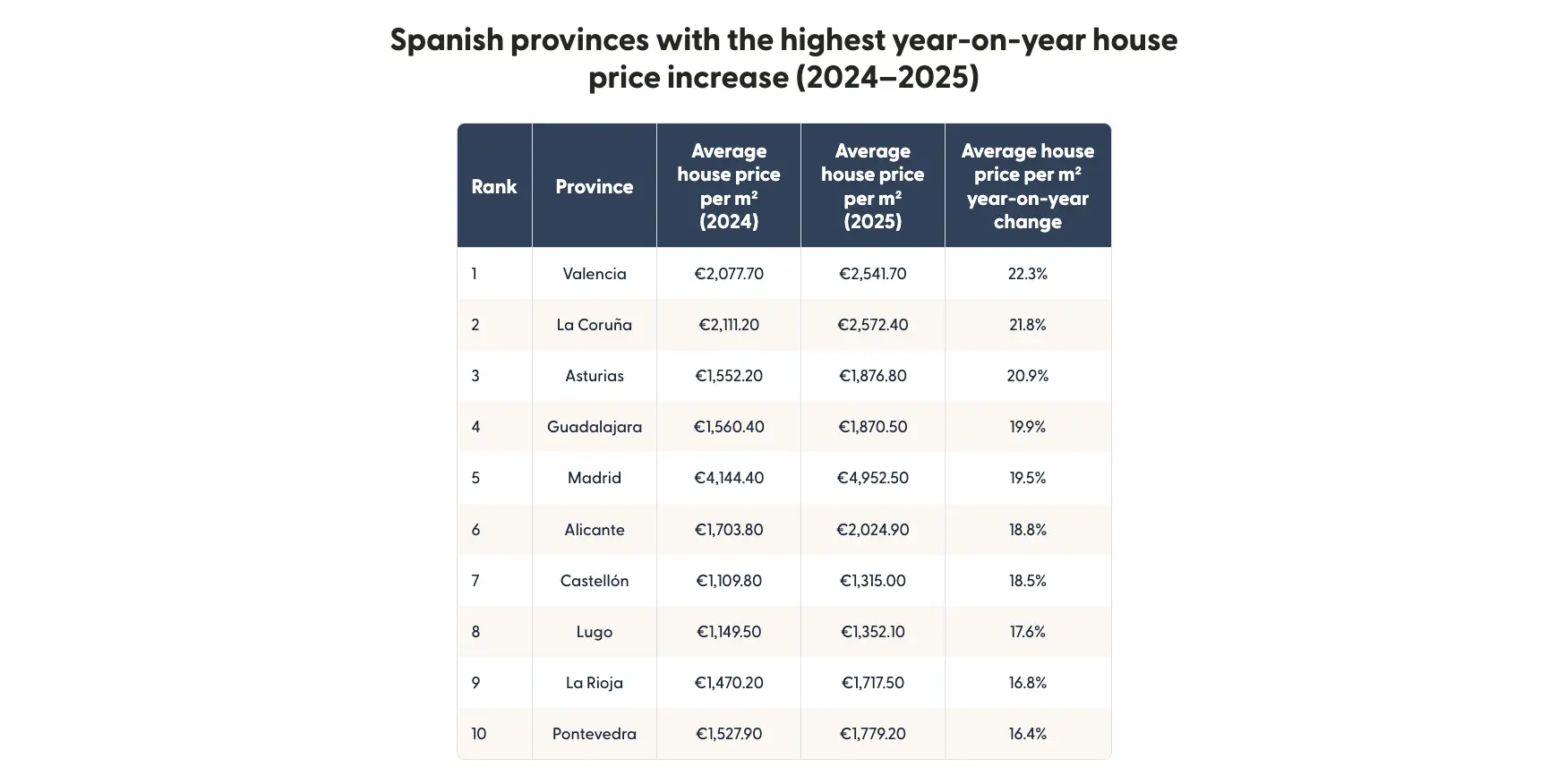
- Valencia records the fastest price growth, with property values increasing by 22.3% year-on-year.
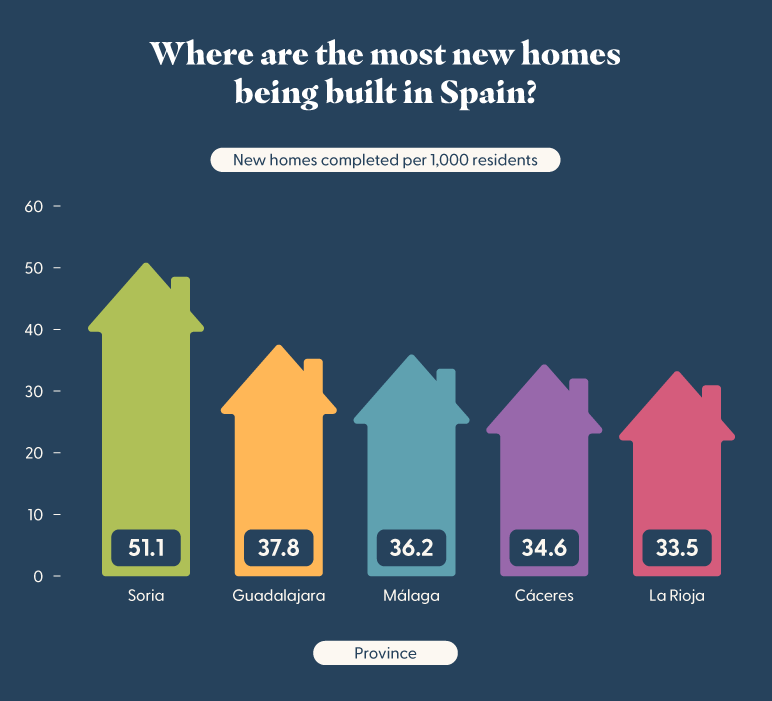
- Soria builds more new homes than any other region in Spain, with 51.1 completions per 1,000 residents.
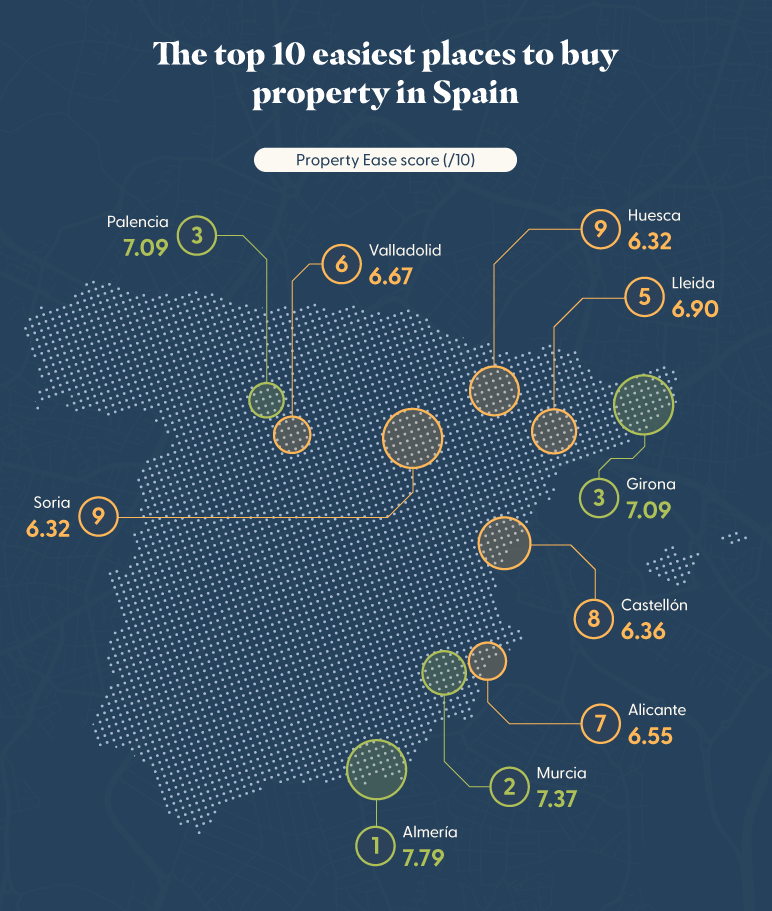
The top 10 easiest places to buy property in Spain
Some areas of Spain are still making it simple for those looking to relocate overseas to take their first step onto the property ladder. The provinces leading the way combine reasonable prices with an active flow of new homes and a market that welcomes international buyers.
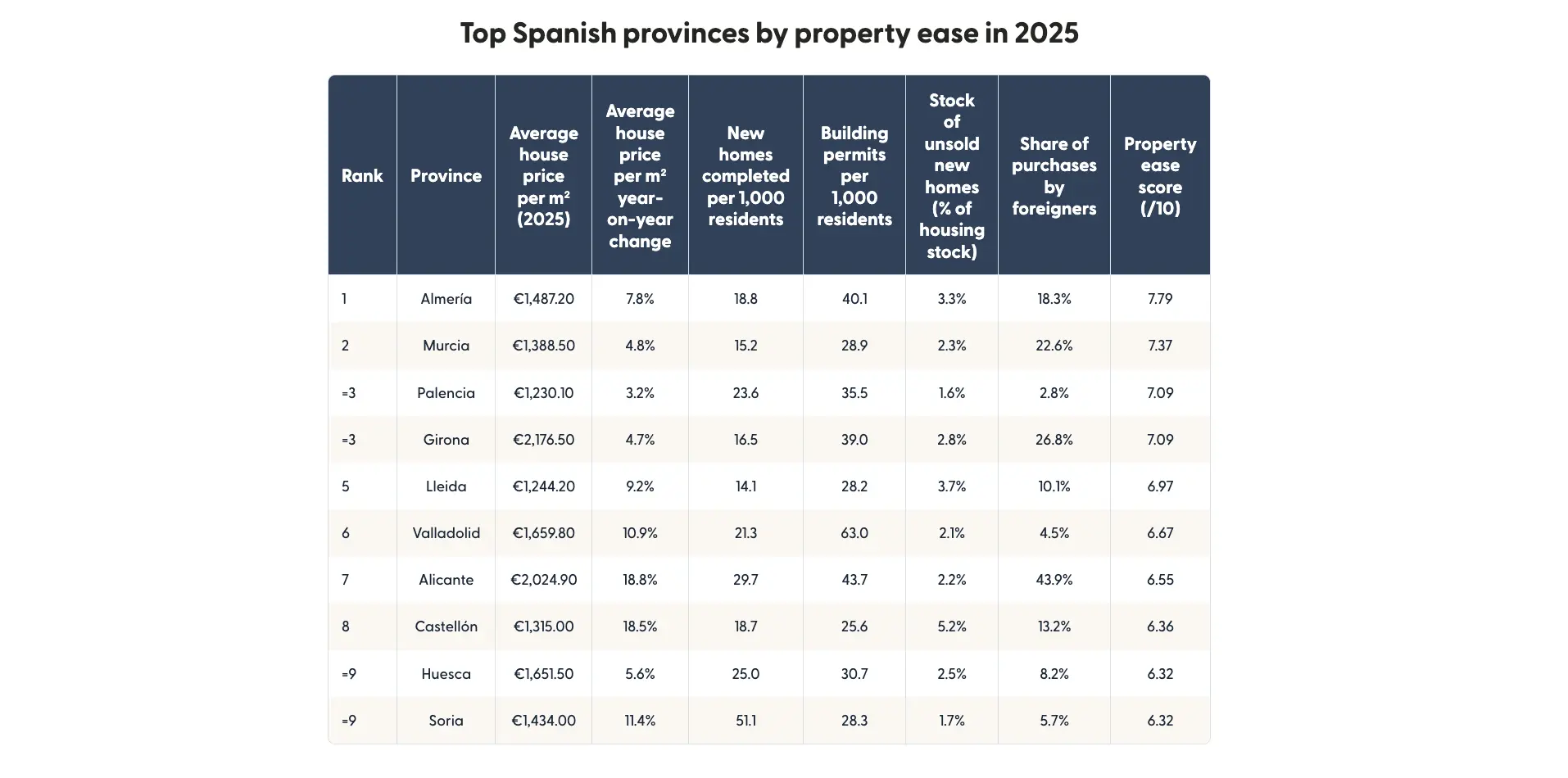
Across the 10 easiest places to buy in our dataset, property costs an average of €1,561.17 per square metre, according to Ministry of Transport and Sustainable Mobility data, which is just under 21% below the national figure.1 Construction is also more prevalent, with 23.4 new homes built per 1,000 residents, compared to just 18.6 in Spain overall.2
Across the 10 easiest places to buy in our dataset, property costs an average of €1,561.17 per square metre, according to Ministry of Transport and Sustainable Mobility data, which is just under 21% below the national figure.1 Construction is also more prevalent, with 23.4 new homes built per 1,000 residents, compared to just 18.6 in Spain overall.2
Where is easiest to buy property in Spain?
- Almería
In Almería, buyers get more space for their money and a wider range of choices when it comes to new developments. Average house prices sit at €1,487.20 per square metre, and despite a 7.8% annual rise, the market remains open to new arrivals. This means a one-bedroom apartment of 45 square metres could cost an average of €66,924.
It is one of a few coastal provinces where affordability and lifestyle still go hand in hand. Ministry of Transport and Sustainable Mobility data shows there have been 18.8 new homes built and 40.1 building permits issued per 1,000 residents. This shows that availability is strong – and nearly one in five property sales are made by foreign buyers, according to Registry Statistics Service findings.
It is one of a few coastal provinces where affordability and lifestyle still go hand in hand. Ministry of Transport and Sustainable Mobility data shows there have been 18.8 new homes built and 40.1 building permits issued per 1,000 residents. This shows that availability is strong – and nearly one in five property sales are made by foreign buyers, according to Registry Statistics Service findings.
- Murcia
Murcia sits just north of Almería but tells a slightly different story. Prices are even lower here, at €1,388.50 per square metre. Compared to nearby Alicante, where average prices have now climbed above €2,000 per square metre, Murcia offers people exploring life abroad a Mediterranean climate and lifestyle for less.
Nearly 23% of homes are purchased by international buyers, indicating that Murcia has a strong appeal abroad while still leaving room for new arrivals. With 15.2 new homes per 1,000 residents and 28.9 permits granted, there is a steady flow of modern housing that could help reduce waiting times and renovation costs.
Nearly 23% of homes are purchased by international buyers, indicating that Murcia has a strong appeal abroad while still leaving room for new arrivals. With 15.2 new homes per 1,000 residents and 28.9 permits granted, there is a steady flow of modern housing that could help reduce waiting times and renovation costs.
- Palencia and Girona
Girona and Palencia both hold third place. In Girona, prices are higher at around €2,176.50 per square metre, yet growth has stayed measured, rising by 4.7% over the past year. That’s far below the increases seen in places like Valencia (22.3%) or La Coruña (21.8%).
With more than one in four homes bought by international buyers, Girona also feels well-connected and open to those looking to start a new life overseas.
Palencia, meanwhile, shows that ease doesn’t have to come at a premium. Homes here cost an average of €1,230.10 per square metre, and construction is active, with 23.6 new homes built for every 1,000 residents. Using this cost per square metre, buyers could expect a two-bedroom 75 square-metre property to be around €92,258.
Low levels of unsold stock (1.6%) also suggest that buyers can move quickly and confidently once they find the right property.
With more than one in four homes bought by international buyers, Girona also feels well-connected and open to those looking to start a new life overseas.
Palencia, meanwhile, shows that ease doesn’t have to come at a premium. Homes here cost an average of €1,230.10 per square metre, and construction is active, with 23.6 new homes built for every 1,000 residents. Using this cost per square metre, buyers could expect a two-bedroom 75 square-metre property to be around €92,258.
Low levels of unsold stock (1.6%) also suggest that buyers can move quickly and confidently once they find the right property.
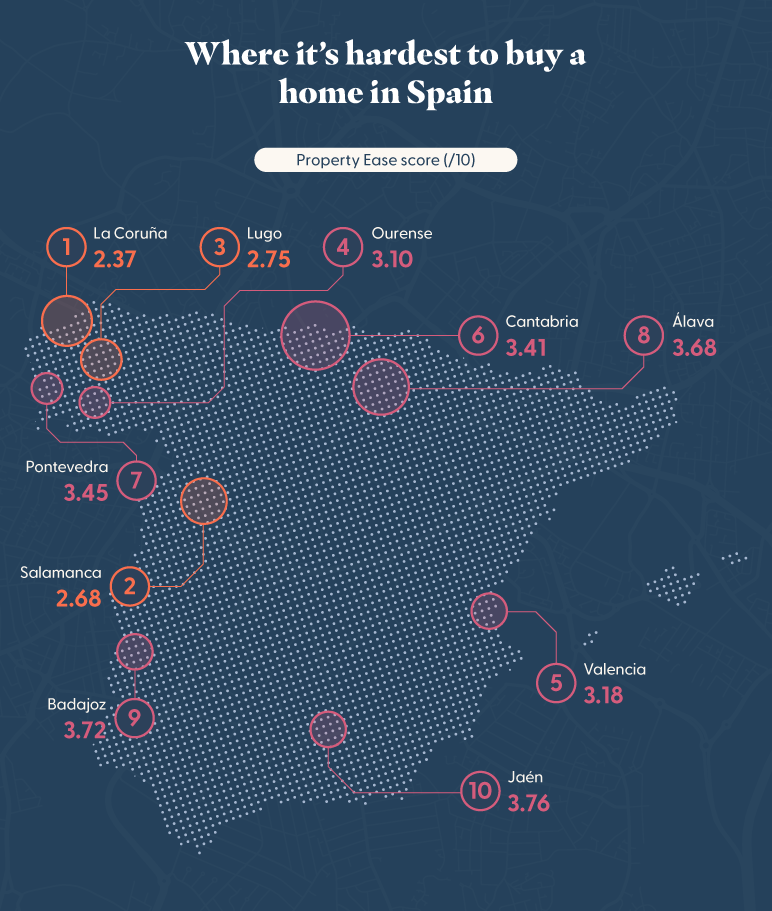
Where is it toughest to buy a home in Spain?
Our study suggests that Spain’s most challenging property markets are those where prices are rising far faster than average and supply remains tight. These are the regions where strong local demand meets limited availability, making it harder for new buyers to get started.
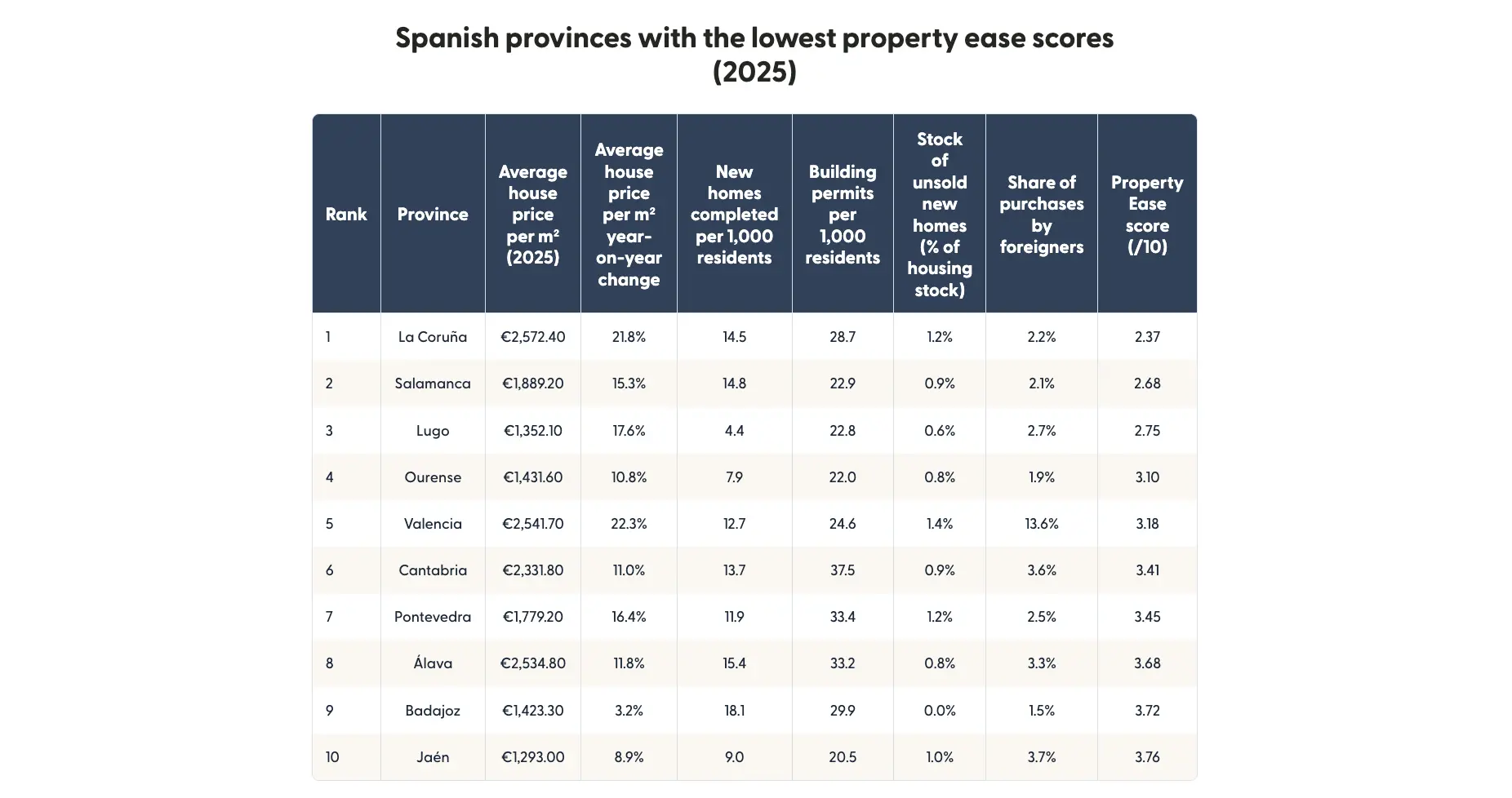
In these 10 provinces, average property values now exceed €1,916 per square metre, and in several cases, price increases have reached more than 22% in a single year. At the same time, housing development is slower, meaning fewer opportunities for buyers to find a home that fits their needs or budget.
It’s also interesting to see which well-known hotspots do not appear in the top spots. Barcelona is often seen as a tough market, yet this year the sharpest price pressures are happening elsewhere. Barcelona has seen a rise in average house prices of 12.3% between Q2 2024 and Q2 2025 while provinces such as La Coruña, Salamanca, and Lugo are seeing increases closer to 15% to 22%.
In these 10 provinces, average property values now exceed €1,916 per square metre, and in several cases, price increases have reached more than 22% in a single year. At the same time, housing development is slower, meaning fewer opportunities for buyers to find a home that fits their needs or budget.
It’s also interesting to see which well-known hotspots do not appear in the top spots. Barcelona is often seen as a tough market, yet this year the sharpest price pressures are happening elsewhere. Barcelona has seen a rise in average house prices of 12.3% between Q2 2024 and Q2 2025 while provinces such as La Coruña, Salamanca, and Lugo are seeing increases closer to 15% to 22%.
- La Coruña
La Coruña has seen some of the sharpest price increases in Spain, with values climbing by 21.8% between Q2 2024 and Q2 2025 to reach an average of €2,572.40 per square metre. At these average price levels, a typical two-bedroom home of around 75 square metres would cost roughly €192,930.
The number of new homes built, 14.5 per 1,000 residents, remains below the national average, which limits availability.
With a foreign buyer share of just 2.2%, the market could be largely driven by local demand. For international buyers, this could translate to higher entry costs and fewer listings compared with southern provinces like Almería, where development is more active.
The number of new homes built, 14.5 per 1,000 residents, remains below the national average, which limits availability.
With a foreign buyer share of just 2.2%, the market could be largely driven by local demand. For international buyers, this could translate to higher entry costs and fewer listings compared with southern provinces like Almería, where development is more active.
- Salamanca
Historic charm meets limited opportunity in Salamanca, with just 2.1% of property sales involving international buyers. Most activity comes from local residents, leaving fewer openings for international movers looking to make this vibrant university city their new home.
Property prices have also increased year-on-year. Homes now average €1,889.20 per square metre, up 15.3% since 2024, while new construction remains modest at 14.8 homes per 1,000 residents. When you translate average prices into real property sizes, a 45 square-metre one-bed in this area could cost around €85,014.
Property prices have also increased year-on-year. Homes now average €1,889.20 per square metre, up 15.3% since 2024, while new construction remains modest at 14.8 homes per 1,000 residents. When you translate average prices into real property sizes, a 45 square-metre one-bed in this area could cost around €85,014.
- Lugo
In Lugo, availability is the biggest obstacle. It records the second-lowest construction rate of any province analysed, with only 4.4 new homes built per 1,000 residents. This scarcity could have contributed to a sharp 17.6% rise in average property values, now at €1,352.10 per square metre. This could see a two-bedroom home, that’s 75 square metres big, on the market for a total of €101,408.
Although prices here remain below the national average, limited development means fewer options for buyers. Registry Statistics Service data shows only 2.7% of purchases are made by foreign residents, suggesting that those searching for a home in Lugo may face a slow-moving market with little new stock coming through.
Although prices here remain below the national average, limited development means fewer options for buyers. Registry Statistics Service data shows only 2.7% of purchases are made by foreign residents, suggesting that those searching for a home in Lugo may face a slow-moving market with little new stock coming through.
Where house prices are rising fastest in Spain
Some parts of Spain are experiencing rapid growth in property values, reshaping how and where buyers can afford to purchase. Ministry of Transport and Sustainable Mobility data shows the national average price increase sits at 12.2%, but in several provinces, prices have climbed at almost twice that pace.
Valencia’s housing market has accelerated faster than anywhere else in Spain, with prices rising by 22.3% between Q2 2024 and Q2 2025. The average home now costs €2,541.70 per square meter, and these price trends mean that a mid-sized two-bed of roughly 75 square metres now averages €190,628.
La Coruña and Asturias have also seen prices jump by more than 20% in a year. With 14.5 and 18.0 new homes built per 1,000 residents, respectively, the new supply could be steady but still not enough to meet demand.
Valencia’s housing market has accelerated faster than anywhere else in Spain, with prices rising by 22.3% between Q2 2024 and Q2 2025. The average home now costs €2,541.70 per square meter, and these price trends mean that a mid-sized two-bed of roughly 75 square metres now averages €190,628.
La Coruña and Asturias have also seen prices jump by more than 20% in a year. With 14.5 and 18.0 new homes built per 1,000 residents, respectively, the new supply could be steady but still not enough to meet demand.
Places where housing stock is on the rise
As property prices climb across much of Spain, the pace of construction is becoming increasingly important for both local and international buyers.
New developments can help ease pressure on affordability by increasing the number of homes available, but building activity varies significantly from one province to another.
New developments can help ease pressure on affordability by increasing the number of homes available, but building activity varies significantly from one province to another.
Where are the most new homes being built in Spain?
Soria currently records the highest rate of new housing in the country, with 51.1 completions for every 1,000 residents. That is almost triple the national average of 18.6.
High construction levels are also seen in Guadalajara (37.8), Málaga (36.2), and Cáceres (34.6), indicating strong regional development across both inland and coastal areas.
These provinces are adding housing faster than most others, which can help moderate price growth and open up more options for first-time or overseas buyers.
High construction levels are also seen in Guadalajara (37.8), Málaga (36.2), and Cáceres (34.6), indicating strong regional development across both inland and coastal areas.
These provinces are adding housing faster than most others, which can help moderate price growth and open up more options for first-time or overseas buyers.
Spanish provinces with the highest number of new homes completed per 1,000 residents
| Rank | Province | New homes completed per 1,000 residents |
|---|---|---|
| 1 | Soria | 51.1 |
| 2 | Guadalajara | 37.8 |
| 3 | Málaga | 36.2 |
| 4 | Cáceres | 34.6 |
| 5 | La Rioja | 33.5 |
| 6 | Alicante | 29.7 |
| 7 | Sevilla | 25.5 |
| 8 | Huesca | 25.0 |
| 9 | Navarra | 23.9 |
| 10 | Palencia | 23.6 |
Where are the most building permits issued in Spain?
Building permits signal future supply, and the data shows that some provinces are preparing for another wave of development. Guadalajara is again in the top three, this time leading the way, issuing 74.0 permits per 1,000 residents.
Sevilla (66.1) and Valladolid (63.0) follow closely. These permit rates could help keep pace with international demand and reduce some of the upward pressure on house prices in these areas.
Sevilla (66.1) and Valladolid (63.0) follow closely. These permit rates could help keep pace with international demand and reduce some of the upward pressure on house prices in these areas.
Spanish provinces with the highest number of building permits per 1,000 residents
| Rank | Province | Building permits per 1,000 residents |
|---|---|---|
| 1 | Guadalajara | 74.0 |
| 2 | Sevilla | 66.1 |
| 3 | Valladolid | 63.0 |
| 4 | Segovia | 52.0 |
| 5 | Asturias | 44.8 |
| 6 | Alicante | 43.7 |
| 7 | Burgos | 40.6 |
| 8 | Navarra | 40.4 |
| 9 | Almería | 40.1 |
| 10 | Girona | 39.0 |
What the findings mean for international buyers
Spain remains one of Europe’s most appealing places to buy property, with over 71,000 purchases involving a foreign buyer in the first half of 2025, but the landscape is changing.3
In provinces where new homes are being built at pace, such as Soria, Murcia, and Málaga, buyers may have more choice, shorter waits and better odds of finding a modern property within budget. In contrast, regions where construction is slower and prices are climbing quickly, like Valencia, often require faster decisions and higher deposits.
Beyond the numbers, lifestyle should also play a role in your decision. Coastal provinces often attract more international buyers, while inland areas can offer more space and quieter surroundings for the same investment.
Wherever you choose to settle, planning ahead financially makes the process easier.
Setting aside funds early for deposits, taxes, and transfer fees can help you to act quickly when the right home appears. When it comes to moving money internationally, Remitly lets you send money to Spain (opens in new window) quickly and securely so you can focus on finding the place that feels like home.
In provinces where new homes are being built at pace, such as Soria, Murcia, and Málaga, buyers may have more choice, shorter waits and better odds of finding a modern property within budget. In contrast, regions where construction is slower and prices are climbing quickly, like Valencia, often require faster decisions and higher deposits.
Beyond the numbers, lifestyle should also play a role in your decision. Coastal provinces often attract more international buyers, while inland areas can offer more space and quieter surroundings for the same investment.
Wherever you choose to settle, planning ahead financially makes the process easier.
Setting aside funds early for deposits, taxes, and transfer fees can help you to act quickly when the right home appears. When it comes to moving money internationally, Remitly lets you send money to Spain (opens in new window) quickly and securely so you can focus on finding the place that feels like home.
Methodology
Remitly (opens in new window) helps people around the world move money confidently with a global footprint in more than 170 countries.
For many of our customers, sending money overseas is part of a bigger journey, one that can include settling in a new country, investing in property, or building a life somewhere new. Buying a home is often a key part of that story, and the ease of doing so can vary dramatically depending on location.
To understand where opportunities remain strongest, we compared each province of Spain on the following factors, normalising the data on a 0-10 scale before combining them into a final ‘property ease score’, with each factor weighted equally:
Note: Any provinces with missing data for any of the index factors were removed from the dataset.
All data was collected in October 2025 and is correct as of then.
For many of our customers, sending money overseas is part of a bigger journey, one that can include settling in a new country, investing in property, or building a life somewhere new. Buying a home is often a key part of that story, and the ease of doing so can vary dramatically depending on location.
To understand where opportunities remain strongest, we compared each province of Spain on the following factors, normalising the data on a 0-10 scale before combining them into a final ‘property ease score’, with each factor weighted equally:
- Average house price per m2 and year-on-year price change (between Q2 2024 and Q2 2025) from the Ministry of Transport and Sustainable Mobility (opens in new window) data.
- New homes completed per 1000 residents from the Ministry of Transport and Sustainable Mobility (opens in new window) data.
- Building permits (number of new dwellings authorised) per 1000 residents from the Ministry of Transport and Sustainable Mobility (opens in new window) data.
- Stock of unsold new homes (% of housing stock) from the Ministry of Transport and Sustainable Mobility (opens in new window) data.
- Share of purchases by foreigners from Registry Statistics Service (opens in new window) data.
Note: Any provinces with missing data for any of the index factors were removed from the dataset.
All data was collected in October 2025 and is correct as of then.
Sources:
View more of our research and data:

How to Settle in Spain as an Immigrant
Read more (opens in new window)This publication is provided for general information purposes only and is not intended to cover all aspects of the topics discussed herein. This publication is not a substitute for seeking advice from an applicable specialist or professional. The content in this publication does not constitute legal, tax, or other professional advice from Remitly or any of its affiliates and should not be relied upon as such. While we strive to keep our posts up to date and accurate, we cannot represent, warrant or otherwise guarantee that the content is accurate, complete or up to date.