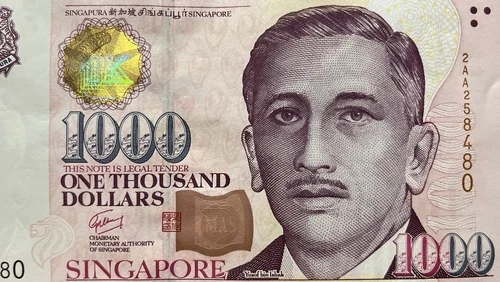
The Singapore dollar (SGD) is the official currency of Singapore, issued by the Monetary Authority of Singapore (MAS). Divided into 100 cents and available in coins and polymer banknotes, it’s considered one of the world’s most stable currencies thanks to Singapore’s AAA credit rating and managed exchange rate policy.
All the facts in a glance
- The Singapore Dollar (SGD) is issued by the Monetary Authority of Singapore (MAS) and divided into 100 cents.
- Singapore holds AAA ratings from S&P, Fitch, and Moody’s; a distinction shared by very few countries.
- The SGD floats within a managed band against an undisclosed basket of trading-partner currencies.
- UK travellers should know that cards are widely accepted, and cash over S$20,000 must be declared on entry.

What Is the Singapore Dollar?
The Singapore dollar uses the currency code SGD to distinguish it from other “dollar” currencies, including the U.S. dollar (USD), Canadian dollar (CAD), and New Zealand dollar (NZD). Like these currencies, it is divided into 100 cents and often represented with the dollar sign ($).
To avoid confusion, the symbol S$ is sometimes used. It is issued by the Monetary Authority of Singapore (MAS) and is widely regarded as one of the most stable currencies in Asia, backed by Singapore’s AAA sovereign credit rating from Fitch Ratings.
SGD Currency Basics: Denominations and Symbols
The Monetary Authority of Singapore (MAS) issues SGD in both coin and banknote forms, with denominations as follows:
- Coins: 1, 5, 10, 20, and 50 cents, as well as $1 coins
- Banknotes: $2, $5, $10, $50, and $100
As of 2026, MAS confirms that both the $1,000 note (discontinued for new issuance as of 1 January 2021) and the $10,000 note (discontinued as of 1 October 2014) remain legal tender but are no longer issued or actively circulated.
Existing notes in these denominations are still considered legal tender, but are rarely seen in everyday exchanges.
The lower-value $2, $5, and $10 notes have also shifted from paper to polymer, which holds up better in Singapore’s humid climate and lasts longer than paper. Security features include a clear window with a portrait watermark, a windowed security thread that shows the denomination when held to light, and Braille dots in the corner for accessibility.

A Brief History of the Singapore Dollar
Colonial era: During its time as a British outpost, Singapore used various currencies, including the Spanish dollar, the Straits Settlements dollar, and the Malaya and British Borneo dollar.
The Straits Settlements dollar was administered under British rule, tying Singapore’s currency history to Britain’s own.
Japanese occupation (1942–1945): The military yen became the local currency, earning the nickname “banana money” due to the banana plant illustration on the $10 note. The currency suffered severe wartime inflation and was rendered almost worthless by the time the occupation ended.
Post-independence currency union: After independence in 1965, Singapore remained in a currency union with Malaysia and Brunei for several years before issuing its own currency.
SGD introduced (1967): The Singapore dollar was officially introduced in 1967, run by the newly established Monetary Authority of Singapore.
Singapore’s AAA Credit Rating
A sovereign credit rating reflects how likely a country is to repay its debts, with AAA being the highest possible score a rating agency can award. Singapore is one of a handful of countries in the world to hold this top rating from all three of the major global agencies: S&P, Fitch, and Moody’s.
As of 2026, Singapore is rated AAA by S&P, AAA by Fitch, and Aaa by Moody’s, reflecting its strong fiscal position.

The SGD’s Managed Float Policy
Singapore’s managed float policy means the SGD’s value is guided by MAS against a basket of currencies, rather than being fixed to one currency or left to trade completely freely. MAS manages the SGD against an undisclosed basket of currencies from Singapore’s major trading partners, allowing it to float within a controlled band.
This keeps imported inflation in check, since a stronger SGD makes imports cheaper, while also protecting Singapore’s exporters from sudden swings that would make their goods too expensive or too cheap compared to competitors abroad.
The SGD–Brunei Dollar Interchangeability Agreement
Under the Currency Interchangeability Agreement signed in 1967, the Singapore dollar and Brunei dollar are interchangeable, one of the few currency arrangements of its kind still active nearly six decades on. This means either currency can be spent as legal tender in both countries, with no need to exchange one for the other.
SGD Backed by Currency Reserves
Every Singapore dollar in circulation is backed one-for-one by foreign reserve assets held in the MAS Currency Fund, not gold or silver specifically, but a broader mix of foreign currencies, bonds, and other reserves. This means Singapore’s currency is fully backed rather than being a pure fiat currency with no reserve requirement.

Practical Tips for UK Travellers and Senders
Singapore is highly cashless-friendly: cards and mobile payments (including UK-issued ones) are accepted almost everywhere, from hawker centres to taxis. For day-to-day spending, a UK debit or credit card will typically work without issue, though it’s worth checking with your bank about foreign transaction fees before you travel.
If you’d rather carry some cash, GBP can be exchanged for SGD at Changi Airport on arrival, at licensed money changers across the city (often offering better rates than banks), or withdrawn directly from ATMs once you land.
UK travellers carrying more than S$20,000 in cash or its equivalent must declare it to Singapore Customs on arrival or departure. This applies regardless of currency, so GBP, USD, or SGD cash all count toward the threshold.
Sending Money to Singapore from the UK
UK residents can send money to Singapore through bank transfers, dedicated money transfer apps, or traditional wire services, each varying in cost, speed, and exchange rate transparency. This works both ways: whether you’re a UK resident supporting family or paying for services in Singapore, or a UK expat living there receiving money from home.
Choosing the right money transfer service is key for secure and affordable transactions. When comparing services, it’s worth checking the exchange rate offered against the mid-market rate, any transfer fees, and how long the money takes to arrive, since these vary significantly between providers.
With Remitly, UK residents can send GBP to Singapore with transparent exchange rates and fast delivery times, whether supporting family, paying for services, or managing cross-border finances.

Frequently Asked Questions About the Singapore Dollar
What is the SGD?
The Singapore dollar (SGD) is the official currency of Singapore, issued by the Monetary Authority of Singapore. It’s divided into 100 cents and is one of the most actively traded currencies in Asia, known for its exceptional stability relative to other regional currencies and its role as a benchmark for Southeast Asian finance.
What denominations does the SGD come in?
Coins come in 1, 5, 10, 20, and 50 cents, plus $1. Banknotes come in $2, $5, $10, $50, and $100. Higher-value $1,000 and $10,000 notes are still legal tender but have not been issued since 2021 and 2014 respectively, and are rarely seen in circulation today.
Is the Singapore dollar stable?
Yes. Singapore holds AAA credit ratings from S&P, Fitch, and Moody’s: one of only a handful of countries worldwide to achieve this from all three agencies. MAS also manages the SGD’s value against a basket of trading-partner currencies, helping to keep it stable against sudden shocks.
Can I use SGD in Brunei?
Yes. Under a 1967 Currency Interchangeability Agreement, the Singapore dollar and Brunei dollar are interchangeable and accepted at par value in both countries, an arrangement that has remained active for nearly six decades.
Do I need to declare SGD entering Singapore?
Yes. If you’re carrying more than S$20,000 in cash or its equivalent in any currency, you must declare it to Singapore Customs on arrival or departure, regardless of whether it’s in SGD, GBP, or another currency.
What security features do SGD notes have?
Polymer banknotes ($2, $5, and $10) include a clear window with a portrait watermark, a windowed security thread visible when held to light, and Braille dots for accessibility, alongside colour-shifting elements to guard against counterfeiting.

Key Takeaways
- The SGD is issued by the Monetary Authority of Singapore and divided into 100 cents.
- Singapore holds AAA ratings from S&P, Fitch, and Moody’s: one of very few countries with top ratings from all three.
- The SGD floats within a managed band against an undisclosed basket of currencies, monitored by MAS.
- The SGD and Brunei dollar have been interchangeable at par since 1967.
- UK travellers can rely on card payments almost everywhere in Singapore, but must declare cash over S$20,000 on entry.
Conclusion
The Singapore dollar is issued by MAS, holds AAA credit ratings from all three major agencies, and is managed against a basket of trading-partner currencies rather than a single fixed rate. For UK travellers, this means cards are accepted almost everywhere, cash above S$20,000 must be declared, and the currency has held its value reliably against GBP over time.
UK residents sending money to family or colleagues in Singapore have several transfer options, with rates and fees varying by provider.
If you’re exploring more of the region, our guide to the Malaysian ringgit covers Singapore’s former currency-union partner. Looking to send money to Singapore? Remitly’s Singapore transfer page offers fast delivery from the UK, and if you’re planning an extended stay, it’s also worth checking the Singapore visa entry requirements before you go.
Last reviewed: August 2026