Key Highlights
Here’s a simple guide on what to know about paying overseas:
-
You should always pay in the local currency, not NZD. This stops you from getting a bad exchange rate for your currency conversion.
-
This also helps you stay away from a thing called dynamic currency conversion (dcc). DCC often means you will get higher fees at the point of sale.
-
Most times, your card provider has a better exchange rate than what you will get at the shop or store.
-
You need to know that some cards charge foreign transaction fees when you use them overseas.
-
It is almost always cheaper for you to pick the local currency when paying, as this helps keep your currency conversion costs down.
Introduction
Heading overseas is a big deal. It can be fun, but dealing with your travel money can also be hard. When you use your card, you may be asked a question. Should you pay in the local currency or in New Zealand Dollars? You may think it is better to see the cost in dollars. But, this choice can mean you pay more than you need to. Knowing more about currency conversion and how it works can help you make the best move with your money. This way, your wallet stays in good shape for the rest of your trip.
When You’re Given the Choice: Paying in Local Currency or NZD
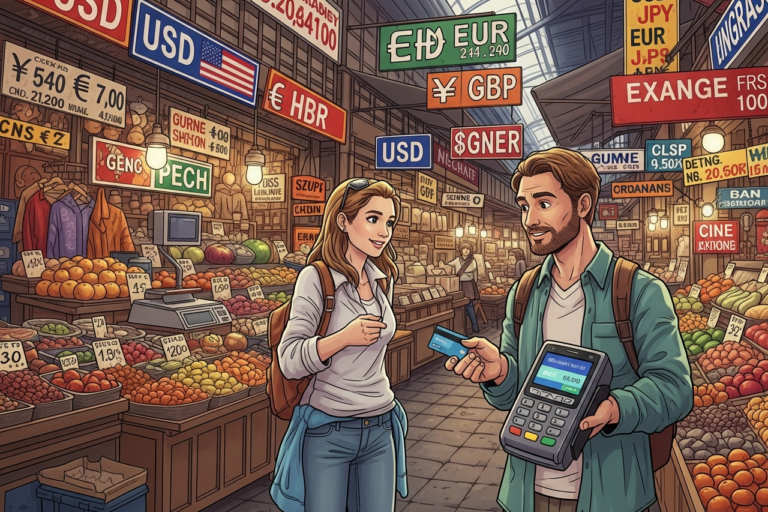
When you are in a shop or at a restaurant overseas, and the payment machine asks if you want to pay in the local currency or your home currency (NZD), you might wonder what to do. This is something many people face, but knowing the best choice can help you save money. Most of the time, it’s better to pick the local currency.
If you choose to pay in NZD at the point of sale, the machine uses dynamic currency conversion (DCC). It will show the amount in dollars, but this easy choice often means you lose out. The exchange rate is likely to be worse, and there can be extra fees added.
So, when you see this option about currency conversion, it’s best to pay in the local currency to get a better deal.
What Is Dynamic Currency Conversion and How Does It Work?
So, what is this thing called dynamic currency conversion, or DCC? This is a service that overseas shops use to change what you pay into your home currency right there and then. Let’s say you are given a choice to pay in NZD instead of Euros or Japanese Yen. If you pick NZD, you are using DCC. It’s the merchant’s bank that sets the conversion rate, not your own card provider.
This is where things can be different. If you decide to pay in the local currency, your card provider, like Mastercard or Visa, will do the currency conversion for you. They usually use an exchange rate that is close to what you see officially on that day. This rate tends to be a good deal for you.
But if you use DCC, the rate is set by the merchant and their bank partner, and it is often not as good for you. They add a margin to the conversion rate, which means you end up paying more for the same thing. You get to see how much you pay in NZD on the spot, but this bit of ease is what you pay for—often more than you think and, at times, you do not even know about the extra cost that comes with it.
Why Merchants Offer Home Currency Payment Options to Kiwis
You might think about why shops and places to eat let you pay in your home currency when it is not a good deal for you. The main reason is that this is a value-added service for them, and they can make money from it. Many shops that use dynamic currency conversion, or DCC, get a commission from the company offering this service.
For shops, this gives them a way to look helpful to tourists. They can say it is easy to use, as you will see the number in NZD right when you pay at the point of sale and know the price that will show on your statement.
The main reasons shops want you to pay in your home currency are:
-
It seems convenient: You can see the price in NZD, and this feels easy to read and understand.
-
Profit sharing: The shop can get a part of the fee made from the currency conversion.
-
Customer familiarity: The shop thinks you will like to see the price in a currency you know, even when it is not the best price.
These options that use dynamic currency conversion might look good, but it is smart to know how they work.
Comparing Fees: Local Currency vs. NZD When Using Your Card Overseas
The cost difference between paying in local currency and NZD can be big. If you pick to pay in your home currency, you will almost always pay more in fees and not get a good exchange rate. This is because DCC will give you the higher rate from the merchant. You may also get a foreign transaction fee from your bank too.
But when you pick the local currency, your card network like Visa or Mastercard does the exchange. These have much better rates. Even if your card has a 2-3% foreign transaction fee, the total cost will often still be less than you would pay with the high DCC exchange rate and extra fees.
Hidden Charges and Exchange Rates Explained
The biggest issue with dynamic currency conversion is the lack of transparency around its hidden charges. When you choose to pay in NZD overseas, the poor exchange rate is where the extra cost is concealed. The rate you’re given is not the market rate; it’s a marked-up conversion rate designed to make a profit for the merchant’s payment processor.
These fees can be substantial. For example, a DCC transaction could inflate your purchase cost by 6% or more, without being clearly itemised as a “fee.” You simply pay a higher total in NZD. In contrast, your own card provider uses a rate that is much closer to the real-time market rate, which is far more favourable for you.
Here’s a simple comparison of how a €100 purchase might look:
|
Payment Method |
Exchange Rate & Fees |
Final Cost in NZD (Approx.) |
|---|---|---|
|
Pay in Local Currency (€) with your card |
Your card provider’s competitive rate (e.g., 1 EUR = 1.76 NZD) + potential 2.5% bank fee |
$180.40 |
|
Pay in NZD (DCC) |
Merchant’s poor rate (e.g., 1 EUR = 1.87 NZD) with fees built-in |
$187.00 |
As you can see, the seemingly convenient option can easily cost you more.
How Credit Card Rewards and Conversion Affect Kiwi Travellers
The way you pick your currency can change how many credit card rewards you get. Most rewards programmes count points based on the last NZD amount your card is charged. The card provider changes the foreign currency payment into NZD before working out how many points you earn.
If you pay in NZD using dynamic currency conversion, the charge on your card goes up. This can sometimes mean you get a few more rewards points for that one buy. But, the poor currency conversion rate will likely cost you more money than the tiny bit you get back in points.
To get the most from your credit card, you should use one of the best credit cards for travel. Go for a card that does not charge foreign transaction fees, and always pay in the local currency. This is a good way to keep your costs down and stick to your travel budget. You will still earn rewards on a better conversion rate. Don’t get tricked by the idea of a few more points if it means you pay more because of a bad conversion rate.
Keywords: currency conversion, local currency, dynamic currency conversion, foreign transaction, conversion rate, card provider, foreign currency, credit card, travel budget, best credit cards, foreign transaction fees
Practical Tips for Paying in Local Currency While Travelling from New Zealand
So, how can you use this knowledge every day? The best thing to do is be prepared. When you get a card machine, always check what currency is on display before you put in your PIN or tap your card. It will help a lot if you always pick the local currency. This way, you can look after your travel money better.
This is not just important in shops. It is the same at ATMs and cash machines. Many overseas cash machines will give you the choice to change what you take out to NZD—this is just another type of DCC. Always say no to this, and pick to pay in the local currency. Let your own card provider do the change for you.
How to Ensure You’re Paying in Local Currency at Shops and ATMs
It’s mostly easy to pay in the local currency, but you need to be on alert when you pay. This goes for both credit card and debit card payments at shops, as well as when you use cash machines. The rule stays the same every time.
When you see a payment terminal, stop and read what is on the screen. There should be two money amounts: one for the local currency and one for NZD. You will see buttons to choose your option. Always pick the button for the local currency like EUR, USD, or JPY. If you are not sure, just ask the cashier to help you choose the local currency.
ATMs work in the same way when you take out money.
-
Always choose “Continue without conversion” or “Charge in [local currency]”.
-
Say no to any offers to charge you in NZD.
-
Watch out for words like “guaranteed rate”; this can be how dcc happens.
-
If the machine picks NZD first, look to see if there’s a way to go back and pick the local currency.
What to Do If a Card Machine Defaults to NZD (or Your Home Currency)
Sometimes, at the point of sale, you may see a payment machine that tries to charge you in NZD by default. This can be annoying. It is set up this way, so you end up using dynamic currency conversion without much choice or getting the best rate.
If this happens, do not rush to pay. The first thing you can do is ask the staff if they can set the payment back to the local currency. In many cases, they can stop the payment and start again in the right way. Just ask with a polite but clear request.
If the staff say it can’t be changed or the machine does not let them, you have a few choices:
-
Ask them to stop the payment. Then, use cash if you have some with you.
-
Let them know politely that your card provider gives you better rates, so you want to pay in the local currency.
-
If the amount is small and you have no other way to pay, you may choose to go ahead. But, for bigger amounts, it’s better to speak up, insist on local currency, or find another way to make your payment.
Keep these tips in mind to help get the most out of your currency conversion when you are shopping.
Conclusion
To sum up, knowing if you should pay in local currency or NZD when you travel can change the way you spend and enjoy your trip. Most of the time, paying in local currency gives you better currency conversion rates and helps you avoid extra charges. This helps you get more out of your travel budget. If you watch out for dynamic currency conversion and hidden costs, you can spend your money in a smart way while away from home. Be sure to use the practical tips from this blog to choose how you want to pay with ease. If you want to get the most from your trip, it pays to look into the best ways that work for your needs. Safe travels!
Frequently Asked Questions
Are There Ever Situations Where Paying in NZD Could Be Better?
In some rare cases, like when currency changes a lot in a short time, using DCC to lock in a rate can give you more certainty. But for most people and more than 99% of the time, the conversion rate from the merchant is not good. You will end up paying more if you choose to pay in your home currency through DCC, instead of using your card provider’s conversion rate.
Is It Safer to Pay in Local Currency or NZD Overseas?
There is no change in how safe it is. When you use your card, it does not matter if you pay in the local currency or in NZD. Your card provider gives you the same security each time you use it. This means the choice is only about money, not safety. You can pick the local currency and know that it will be safe.
Does the Cash vs Card Decision Change Your Best Option?
When you use cash, you always pay with the local currency. So, there isn’t a choice to make. You only need to pick between the local currency and NZD if you use a debit card or credit card. If you spend cash, you have already had the exchange rate dealt with when you got the notes.