Key Highlights
-
Waitangi Day is New Zealand’s national day. It is held every year on 6 February.
-
This day is about the signing of the Treaty of Waitangi in 1840. The treaty is New Zealand’s founding document.
-
It is a national holiday. There are official ceremonies, cultural shows, and people in the community come together.
-
Most Waitangi Day celebrations take place at the Waitangi Treaty Grounds. They start with a dawn service and there is a free festival during the day.
-
This day helps people in New Zealand look back on the country’s history. It also celebrates the special bicultural identity of New Zealand.
Introduction
Welcome to Waitangi Day, the national day of New Zealand. Each year on 6 February, people across the country come together for this important event. On this day, Kiwis remember a key point in the story of New Zealand. Waitangi Day is a time to think, to celebrate, and to connect with others. It marks when te Tiriti o Waitangi was signed.
This day is more than just a public holiday. It is a chance for all to respect the partnership that helped shape New Zealand and to think about what may come next.
Origins of Waitangi Day
The history of Waitangi Day is closely linked to New Zealand’s own story. It goes back to 6 February 1840. That is when the Treaty of Waitangi was signed. This made New Zealand a British colony and set up the base for the country.
The Treaty of Waitangi is why Waitangi Day is here. At first, Waitangi Day was about remembering the event. Later, it became a national holiday for all New Zealanders. This change shows how important the day is for everyone in new zealand. It is good to look at the key points in the history of Waitangi Day to see how it grew over time.
The Signing of the Treaty of Waitangi in 1840
The signing of the Treaty of Waitangi on 6 February 1840 is what Waitangi Day is about. The day before, Captain William Hobson, who worked for the British Crown, showed a treaty proposal to many Māori chiefs. This happened on the lawn in front of James Busby’s home, as he was the British Resident.
The chiefs talked a lot about the agreement. They kept discussing it late into the night at today’s Te Tii Marae. The next day, the rangatira came together again. More than 40 chiefs signed the Māori version, called Te Tiriti o Waitangi.
This was just the start. By September 1840, copies of the treaty of waitangi were taken all around new zealand. Over 500 Māori leaders signed their names. This made the agreement between the British government and Māori even stronger.
Early Observances and Initial Reactions
For a long time after 1840, people in New Zealand marked the signing of Te Tiriti o Waitangi in their own way. There was not a national holiday for this. Some people felt happy about it, but others did not. For many Māori, this day was important. It was a time to think about the promises made in te tiriti o waitangi and to ask the government to keep them.
A big step happened in 1932. Governor-General Lord Bledisloe and his wife bought the Waitangi Estate. They gave the land to the country as a gift. Many Māori saw this as a good thing, because they wanted the place where the tiriti o waitangi was signed to be looked after.
The first main celebration was in 1934. People came together at Te Tii Marae and Waitangi to mark the gifting of the land. This hui, or big meeting, brought about 10,000 Māori from different tribal groups. That day is often seen as the first official Waitangi Day in new zealand.
Steps Towards Official Recognition as a Public Holiday
The path to making Waitangi Day a nationwide public holiday in New Zealand took time. After the 1934 celebrations, the idea of a national day started to catch on more. The New Zealand Maori Council and other groups pushed for the day to get official recognition.
A big step came with the Waitangi Day Act in 1960. This Act said 6 February would be a national day to give thanks. But it did not make it a public holiday for the whole country. Each region could choose what to do.
In 1974, the government led by Prime Minister Norman Kirk made Waitangi Day a nationwide public holiday. For a short time, it was called “New Zealand Day,” but in 1976, the name changed back to Waitangi Day. This move made it clear that the day was for all New Zealanders to think about the Treaty of Waitangi.
Understanding the Treaty of Waitangi
The Treaty of Waitangi, also called Te Tiriti o Waitangi, is known as the founding document of New Zealand. It was signed in 1840 by the British Crown and more than 500 Māori chiefs. This Treaty is the main reason for Waitangi Day, as the day marks the signing of the Treaty.
To understand why this national holiday is important, you need to know about this historic document. The Treaty of Waitangi put in place the way for the British Crown and Māori to work together and run the country. But the English and Māori versions of the Treaty have some differences, and this has caused a lot of debate over the years. Down below, you will find information about its articles, the people who took part, and the Treaty’s long-lasting effects.
Key Articles and Principles of the Treaty
The Treaty of Waitangi has a preamble and three main articles. The English and Māori language copies of the treaty are not the same, and this has caused much debate in New Zealand. These translation differences made each group expect different things from the treaty.
In the English treaty, it states that Māori give up sovereignty to the British Crown. But the Māori text, Te Tiriti o Waitangi, says there is to be shared control, with Māori keeping their rangatiratanga, which means their authority over their own lands and resources. This difference is an important part of what makes the treaty complex.
The main articles of the treaty set out the key things agreed upon:
-
The British get governance (kāwanatanga).
-
Māori are promised protection for their lands, forests, fisheries, and other treasures.
-
Māori are given the same rights and privileges as British subjects.
These points show why the treaty, and te tiriti o waitangi, are important in New Zealand’s history.
Parties Involved and Māori Perspectives
The people involved in the Treaty of Waitangi were the representatives of the British Crown, led by Captain William Hobson. On the other side were many Māori chiefs who spoke for their own tribal groups. At first, debates about the treaty happened at Waitangi and in other parts of the country. These talks showed that there were many Māori views on the treaty of waitangi.
Some chiefs were in favour of it. They thought the treaty would help deal with the out-of-control European settlers. They also liked that the British Crown would offer protection. These chiefs hoped the treaty would set up a good partnership and bring peace for their people.
But not all chiefs agreed. Some were not sure, while others were against the treaty of waitangi. They feared they might lose their power, the authority they called rangatiratanga, and control over their land and people. The busy talks at Te Tii Marae before people signed the treaty showed their worries. These concerns stay important for Māori views about the treaty of waitangi even today.
Lasting Impact on New Zealand’s Society
The Treaty of Waitangi is the founding document of New Zealand. It has shaped the country’s laws and the way people in New Zealand, both Māori and Pākehā, work and live together. The way the treaty is used today still guides big choices in New Zealand.
For many years, the Crown did not always follow the treaty. This caused Māori to lose a lot of land and created problems for their people. Because of this, people made claims under the treaty to get their rights back. In 1975, a special group called the Waitangi Tribunal was set up to check these claims and suggest how to make things right.
The Office of Treaty Settlements now helps talk about and sort out these claims with iwi, or tribes. They deal with what happened in the past so people can move forward. This ongoing work is important for how people see the Treaty of Waitangi today. Waitangi Day gives everyone a chance to think about the past and what is next for New Zealand’s partnership between two cultures.
Evolution of Waitangi Day Celebrations
The way New Zealand celebrates Waitangi Day has changed a lot since 1840. It started as small, informal gatherings. Now, this day is a big national holiday. There are many ways people celebrate across the country. Waitangi Day can often be about protest and debate. It is also a time for us to feel proud of our culture and join together.
These changes show how the relationship between Māori and Pākehā has grown over the years. There is still an ongoing discussion around New Zealand’s national identity. The day was once called “New Zealand Day.” Now, Waitangi Day celebrations have become events shared by people all over New Zealand. The story of Waitangi Day is also the story of how the country has grown.
From “New Zealand Day” to National Holiday
The path for Waitangi Day to be a full national holiday in New Zealand was a long one. After the Waitangi Day Act of 1960 accepted the date, most people in New Zealand still did not get paid time off on this day. The wish for full recognition of Waitangi Day grew, showing that more people wanted to mark the founding of the country.
In 1973, the New Zealand government made a big change under the Prime Minister Norman Kirk. They decided Waitangi Day would now be a nationwide public holiday. The new name for it was “New Zealand Day”. The idea was for New Zealanders from all backgrounds to celebrate together on this day.
But the name “New Zealand Day” did not last long. Many people thought that this new name took away from the real meaning of the Treaty of Waitangi. So, in 1976, the government put the old name back. It was again called Waitangi Day. This move confirmed the link between the public holiday, the Treaty of Waitangi, and its signing.
Changing Traditions and National Sentiment
Over time, people in New Zealand have changed how they feel about Waitangi Day. At first, it was just a day to remember history, but now it is also a time for celebration, reflection, and protest. Many New Zealanders use this day to spend time with family or friends. They often go to summer events happening in their towns.
At the Waitangi Treaty Grounds, there is a focus on formal ceremonies and cultural events. The day is also about politics and activism. Māori use it to speak up about issues with the Treaty and about unfairness they face. These protests are always part of Waitangi Day and help shape what it means to the people.
The mix of fun and protest shows how people think about the country’s past. It tells us that the founding document is not just from history, but is still important for everyone living in New Zealand now. It touches every place, from the Bay of Plenty to the deep south.
Role of Waitangi Day in Modern Identity
Waitangi Day has a big place in today’s New Zealand. It helps shape how the country sees itself. It is the one day each year when New Zealanders stop and think about living in a place that was built on two worlds working side by side. The day helps us better know what the Treaty of Waitangi is, and why it still matters now.
Every year on this day, people check in on how well Māori and Pākehā get on with each other. The day puts these talks about our story, right and wrong, and who we are at the front. This makes all of New Zealand have an open talk. These talks are needed for things to get better for everyone.
Many use Waitangi Day to enjoy the mix of people in the country. It shows a growing New Zealand looking back at old times to try and make a good future. The day stands for the walk both Māori and Pākehā make to grow together. All this happens under the main ideas in the Treaty of Waitangi.
Main Events at Waitangi Treaty Grounds
The Waitangi Treaty Grounds are the main spot for Waitangi Day in New Zealand. Every year on 6 February, the treaty grounds turn into a busy place for a free festival. This event brings in thousands of people from all over. On this day, the buildings close and the area is used for both remembering the past and having a good time.
The day is full of both serious events and a fun, lively festival feeling. It starts with a dawn service that is very special, then there is entertainment that goes on all day. There is something for everyone at the Waitangi Treaty Grounds, making it a great way to see this important part of New Zealand. Keep reading to find out what takes place at the famous site.
Flag Raising and Dawn Ceremony
The day at the Waitangi Treaty Grounds begins before sunrise. There is a touching dawn service that takes place. This happens at Te Whare Rūnanga, which is the carved meeting house. The service starts at 5 in the morning. It makes the day feel calm and special from the very start.
The raising of the flags is an important part of this dawn service. The flagpole sits on the Upper Treaty Grounds, right where the Treaty was first signed. This is where the focus is. They raise the New Zealand flag, the United Tribes flag, and the Tino Rangatiratanga flag. This shows the partnership that is the heart of the Treaty.
Many people see this morning event as the most important part of the day at the Waitangi Treaty Grounds. It is both strong and touching. Māori and Pākehā leaders, special guests, and people from everywhere come together. They remember the past and also share hope for what is to come.
Cultural Performances and Community Gatherings
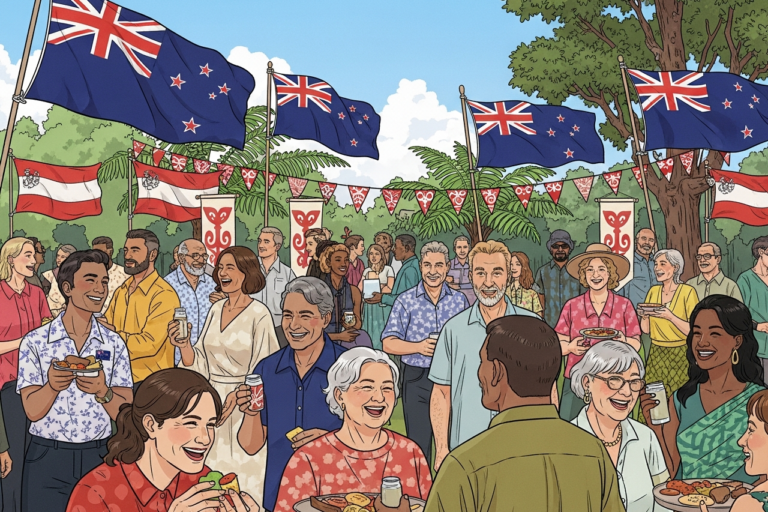
After the dawn service ends, the Treaty Grounds turn lively with the Waitangi Day Festival. This is a free and whānau-friendly event. New Zealanders from all backgrounds come together on this day for fun and community.
There are many stages at the Treaty Grounds. You can watch kapa haka and other cultural performances. There is also live music from local and national artists. The air is full of sound and colour. People feel happy and full of energy.
This festival is about people coming together. There are:
-
Over 150 stalls selling arts, crafts, and clothes.
-
Lots of food choices for all to enjoy.
-
Fun things for kids such as bouncy castles and games.
-
The chance to meet and spend time with people from across the country.
Commemorative Speeches and Official Proceedings
During Waitangi Day, the main events happen as the festival goes on. The day is known for speeches made by political leaders, Māori dignitaries, and other officials. These talks often focus on the Treaty of Waitangi, how people from different backgrounds get on in the country, and where the country is heading.
You will see and hear these speeches at the Treaty Grounds and at Te Tii Marae. They give a space for people to talk about big ideas. The media watch these events closely. Broadcasts share what is said with the rest of the country, so it is easy for everyone to follow the main points and issues of the day.
The Waitangi National Trust is the group in charge of these events and helps to make sure everything runs well. These speeches are an important part of the day. People get to talk together about what the Treaty of Waitangi means now and to check if leaders are sticking to its rules and ideas.
Regional Celebrations Across New Zealand
Waitangi might be the main place people think about, but Waitangi Day celebrations take place all over the islands of New Zealand. Towns and cities across New Zealand come together with their own events for this national holiday. People in every part of the country get a chance to join in with these Waitangi Day celebrations.
There are big festivals held in large cities. There are also smaller events in local parks, and each area brings its own special touch to the day. Now, we can have a closer look at how places like Auckland, Wellington, and Christchurch remember this important date.
Waitangi Day in Auckland and Notable Venues
Auckland, as New Zealand’s largest city, hosts a variety of Waitangi Day events. These city celebrations provide opportunities for Aucklanders to engage with the Treaty’s history and enjoy a day of culture and community. Notable venues often include Ōrākei Marae and the Manukau Institute of Technology’s Ngā Kete Wānanga Marae.
A significant hub for Waitangi Day celebrations is often the Auckland War Memorial Museum. The museum typically hosts a full day of events, including special exhibitions, cultural performances, and family-friendly activities that explore the meaning of the Treaty and the history of the region.
Many local parks and community centres across the Auckland region also hold their own festivities, making it easy for everyone to join in.
|
Venue/Event Location |
Typical Activities |
|---|---|
|
Auckland War Memorial Museum |
Cultural performances, exhibitions, family activities |
|
Ōrākei Marae |
Pōwhiri (welcome ceremony), kapa haka, discussions |
|
Hoani Waititi Marae |
Waitangi Day commemorations and festival |
|
Local Parks (e.g., Barry Curtis Park) |
Free music concerts, food stalls, community gatherings |
Wellington’s Special Events and Festivals
Wellington is the nation’s capital, and it has lots of special events and festivals for Waitangi Day. The main event is Te Rā o Waitangi. This is a big free festival at Waitangi Park on the waterfront. The day is all about bringing people together to celebrate the national day.
The festival is full of life. Local music, dance, and live music from both tangata whenua (people of the land) and tangata te tiriti (people of the treaty) give people something great to watch. It is a time for everyone to come as one and show unity and friendship. That is what the day is for.
Besides the fun, the Wellington festival also gives people a space to learn about the treaty. Places like the National Library help with this. There are many food trucks and market stalls around. It is a full day for the family to eat, enjoy, and learn.
Unique Commemorations in Christchurch & Canterbury
In Christchurch and around Canterbury, people mark Waitangi Day with events that are special to the local area. The South Island has its own history with the Treaty, and these celebrations show respect for that link.
These events can happen at old pā sites or nearby parks. There is often a festival feel that brings whānau and the community together. The focus, much like in the Bay of Plenty, is on bringing people out to join in.
There may be a formal welcome called pōwhiri, shows with singing and dancing, food stalls, and fun things for children to do. These local events let the people in Christchurch and Canterbury, just like those in the Bay of Plenty, mark Waitangi Day close to home. They help everyone take part in celebrating New Zealand’s history in a way that makes sense for their own area.
Traditions, Customs, and Symbolism
Waitangi Day is full of traditions, customs, and symbols. They make this day special. These come from both Māori and Pākehā ways. They show how the country stands on both cultures. When you know these things, you see more in the day and what it means.
There are formal Māori rules, called tikanga, that are used in the main events. There is also food and music when people gather together in the community. Every part means something. Here, you can find some of the main traditions and signs people see with the marking of te tiriti o waitangi.
Māori Protocols (Tikanga) and Practices
Māori ways of doing things, called tikanga, are very important during Waitangi Day, especially at Waitangi and at Te Tii Marae. These customs help make sure everything is done with respect and that the culture is shown the right way. At these events, leaders and visitors are welcomed onto the marae with a pōwhiri.
The pōwhiri is a welcome that has many steps. These include speeches, called whaikōrero, songs, or waiata, and the hongi, where people press noses. The hongi is special and shows coming together and sharing life with each other.
These traditions are not just for show. They are a true part of Māori life and matter to the talks that happen on Waitangi Day. Here are some main tikanga you may see:
-
Pōwhiri: The special welcome onto the marae.
-
Whaikōrero: Formal talks usually made by men.
-
Waiata: Songs that back up the speakers.
-
Hongi: The greeting with noses touching.
People at te tii marae and Waitangi show these important customs on this day.
Food, Music, and Local Festivities
Beyond the formal ceremonies, Waitangi Day is a time to celebrate for many New Zealanders. People enjoy good food, live music, and fun events in their towns. Across New Zealand, parks and public places fill up. People get out to make the most of the summer sun and a day off work.
Food is a big part of this day. At the Waitangi Day festival and other gatherings, you will see many food stalls. People can pick from a Māori hāngī (food made in an earth oven), Kiwi barbecue, or even food from other countries. There’s something for everyone to enjoy.
Live music is a big part of Waitangi Day, too. It helps make the day feel lively and full of fun.
-
You will hear concerts and shows by well-known and new artists from New Zealand.
-
Local events often have kapa haka shows, school bands, and groups from the community.
-
All these things let people come together. It’s a nice way to feel good and proud about being from New Zealand.
Symbols Associated with Waitangi Day
There are a few strong symbols that people think of with Waitangi Day. Each one shows us something different about what this national day means to New Zealand. The treaty of Waitangi is the main symbol. The paper that was signed, and what it stands for, sit at the heart of Waitangi Day.
Flags are also very important to this day. At the Waitangi treaty grounds, you will see different flags go up. There is the New Zealand flag. There is the United Tribes’ Flag from 1834. People also see the Tino Rangatiratanga flag, which is about Māori sovereignty. Putting these flags up together shows how the story between Māori and the Crown is always changing and growing.
When people visit the treaty grounds, they also see clear symbols. There is the Treaty House. There is Te Whare Rūnanga, the carved meeting house. These places matter. Both are where New Zealand truly began as a country of two peoples. These buildings and the land remind us of the founding document and the many promises in it.
Conclusion
Waitangi Day is an important day for everyone in New Zealand. It reminds us of our history, our culture, and who we are as a country. The day started with the signing of the Treaty of Waitangi, which is a key moment in our story. Now, it has grown to be a big day that both Māori and Pākehā people share.
People all over the country come together. They join in things like cultural shows and local events. This brings us a real sense of being together and seeing what makes the treaty of waitangi special. Taking part in these Waitangi Day traditions also helps us all know more about our past. It gives everyone in New Zealand a feeling that they belong together, no matter where they come from.
If you want to get to know more about the Treaty of Waitangi or see the celebrations for yourself, you can look for events and customs happening near you. It’s a great way to take part in what Waitangi Day means to all of us.
Frequently Asked Questions
Why is Waitangi Day significant in New Zealand’s history?
Waitangi Day is important in New Zealand because it remembers the signing of the treaty of waitangi, which is the country’s founding document. This happened in 1840. It was a big moment for New Zealand as it made a link between Māori and the british crown. The national holiday is a day for people to think about and remember this partnership.
What are traditional ways to celebrate Waitangi Day?
People in New Zealand mark Waitangi Day in many ways. Lots of New Zealanders go to community festivals. These festivals often have live music, food stalls, and shows that share culture. One important tradition is going to the dawn service at the Waitangi Treaty Grounds. But you do not have to be at the treaty grounds to join in. Going to any event that brings people together is in the real spirit of Waitangi Day.
How has the meaning of Waitangi Day changed over time?
Waitangi Day has changed over time in New Zealand. It started as a day just to remember the treaty of Waitangi. Now, it is more than that. The day is for people to come together and celebrate. But it is also a time for protest and talk about the treaty of Waitangi. This shows that people in New Zealand have strong feelings about their national day. There is still talk about who they are as a country and how the treaty fits into their story.