Key Highlights
-
The Feast of Corpus Christi is also called the Solemnity of the Most Holy Body and Blood of Christ. On this day, people celebrate the real presence of Jesus in the Holy Eucharist.
-
The feast started in the 13th century. Pope Urban IV started it after a famous Eucharistic miracle.
-
“Corpus Christi” is Latin for “Body of Christ.”
-
In New Zealand, Catholic groups mark the feast with special Masses and processions in the community.
-
Some main customs are Eucharistic adoration and Benediction of the Blessed Sacrament.
-
The feast does not have a fixed date. People celebrate it on the Sunday after Trinity Sunday.
Introduction
Have you ever thought about what the Feast of Corpus Christi means? In the Catholic Church, this feast day is a strong show of faith. It honours the Real Presence of Jesus Christ in the Eucharist. At this time, people join together in their communities. Many take part in special Masses or Corpus Christi processions to show their love and follow their beliefs. The Feast of Corpus Christi is an old custom. It brings all believers across the world, and here in New Zealand, together. It is a special day for the Catholic Church and is one of the most important parts of being Catholic.
The Meaning and Significance of Corpus Christi in the Catholic Church
The Solemnity of the Most Holy Body and Blood of Christ is also called Corpus Christi. This important part of the Catholic faith is a day given to thinking about the Real Presence of Jesus Christ in the Holy Eucharist. Every year, Catholics get together on this day to proudly honour the most holy body and the blood of Christ.
This day is set aside to let people really think about the gift of the Blessed Sacrament. On Corpus Christi, many take time to give thanks to Jesus. He gives himself as food for our souls and always stays with us. The celebration shows that, during the Mass, the presence of Christ is real in the bread and wine. They believe he is truly there—his body, blood, soul, and godly side. Now, we can look more into why this day matters and talk about what the name is all about.
Understanding the Feast’s Importance in Faith
The importance of Corpus Christi comes from its focus on the institution of the Eucharist. Even though Holy Thursday also remembers this event, Corpus Christi gives people a chance to have a more open and happy celebration outside the serious time of Holy Week. It is a special day in the church’s liturgical calendar, made to honour the real presence of Christ in the sacrament.
This feast shows again what Catholics believe. It is not just that Jesus is a sign or a symbol in the Eucharist, but that he is truly there. The celebration reminds everyone about Christ’s promise to stay with his people. It brings a lot of hope and strength to those who believe, and tells them that they are not alone.
When people take part in this day, they show how thankful they are for this big gift. The presence of Christ in the Eucharist is seen as the most important part of Christian life. It feeds people’s spirit and brings them closer to God’s love. This is a time for deep thought and for the community to come together and praise.
What ‘Corpus Christi’ Translates to in English
The name “Corpus Christi” is taken straight from Latin. In English, it means “Body of Christ.” This short name sums up what the feast is all about. It is a time for people to celebrate and give respect to the actual body of Jesus Christ, found in the Holy Eucharist.
The word points to this strong belief. The consecrated host is not just a sign or picture—it’s the Most Holy Body of Christ. This day lets the faithful openly say that they trust in this mystery. They use the time to honour the special event, which is at the heart of their lives with God.
The full name for this solemn time is “The Most Holy Body and Blood of Christ.” This name gives a bigger picture. Still, most people know it as Corpus Christi. Those few words show the deep truth that Catholics hold. They celebrate the loving and lasting presence of Jesus. He gave his life for people, and that’s what is shown in the blood of Christ, the most holy body, and the consecrated host.
Origins and Historical Background of Corpus Christi
The Feast of Corpus Christi comes from the 13th century and has strong medieval roots. This special day started after St. Juliana of Mont Cornillon had a series of visions. There was also a big Eucharistic miracle that got a lot of attention from the Church.
Pope Urban IV saw that these things were very important. He asked the well-known theologian Thomas Aquinas to make the liturgical texts for the new feast. In 1264, Pope Urban issued the papal bull called Transiturus de hoc mundo. This made the Feast of Corpus Christi a part of the universal Church. Below, we will see how the main miracle began everything and learn more about how this tradition of the feast of corpus christi grew.
Medieval Roots and the First Miracle Story
The story of Corpus Christi starts with St. Juliana of Mont Cornillon. She was a Belgian nun and started having a series of visions when she was young. In these visions, she saw the full moon, but there was a dark spot on it. She felt this was the church’s way of saying the liturgical calendar did not have one special feast day to honour the Blessed Sacrament.
This idea got stronger after the Eucharistic Miracle of Bolsena took place in 1263. It happened to a German priest who was saying Mass in Bolsena, Italy. He had doubts about the Real Presence, but while saying the words of consecration, the host started to bleed. The blood stained the altar cloth, called the corporal.
People soon told Pope Urban IV, who was in Orvieto at the time. He was the reigning pope. When he heard about the Eucharistic miracle, he believed the story was a sign from God that the Real Presence is true. This became the final push that was needed for the church to create a universal feast day for the Eucharist.
Why the Tradition Began—and its Early Spread
Following the Miracle of Bolsena, Pope Urban IV acted to formalise the celebration. In 1264, he issued the papal bull Transiturus de hoc mundo, which officially instituted the Feast of Corpus Christi as a universal feast for the entire Catholic Church. This was a direct response to the miracle and the visions of St. Juliana, aiming to strengthen faith in the Eucharist.
To create the specific prayers and hymns for the feast, the Pope turned to one of the greatest minds of the Church, St. Thomas Aquinas. As a Doctor of the Church, Aquinas composed beautiful liturgical texts, including the famous hymns Pange Lingua and Tantum Ergo, which are still sung today during Eucharistic adoration.
Although the feast was established by Pope Urban IV, its observance became more widespread after Pope Clement V reaffirmed it at the Council of Vienne in 1311.
|
Key Figure |
Contribution to Corpus Christi |
|---|---|
|
St. Juliana |
Had visions indicating the need for a feast honouring the Eucharist. |
|
The German Priest |
His doubts led to the Eucharistic Miracle of Bolsena, which confirmed the Real Presence. |
|
Pope Urban IV |
Officially established the Feast of Corpus Christi for the universal Church in 1264. |
|
St. Thomas Aquinas |
Composed the beautiful liturgical texts and hymns for the Mass and Office of the feast. |
|
Pope Clement V |
Reaffirmed the feast, helping to ensure its spread throughout the Catholic world. |
Corpus Christi Traditions Across New Zealand
Across New Zealand, the celebration of Corpus Christi is an important time for the Catholic Church. People in different parishes may do things a bit differently. But the main parts of the Solemnity of Corpus Christi are the same everywhere. It is always about prayer, worship, and bringing people together.
At the centre of this celebration are special Masses to honour the sacrament. There is time set aside for eucharistic adoration as well. The most well-known part is the eucharistic procession. These things let people show their faith and their respect for the real presence of Christ in the Eucharist in a public way. Now, let’s see how these traditions show up in local areas. There may also be some new Kiwi customs around the presence of Christ and the celebration of Corpus Christi.
Community Processions, Masses, and Local Celebrations
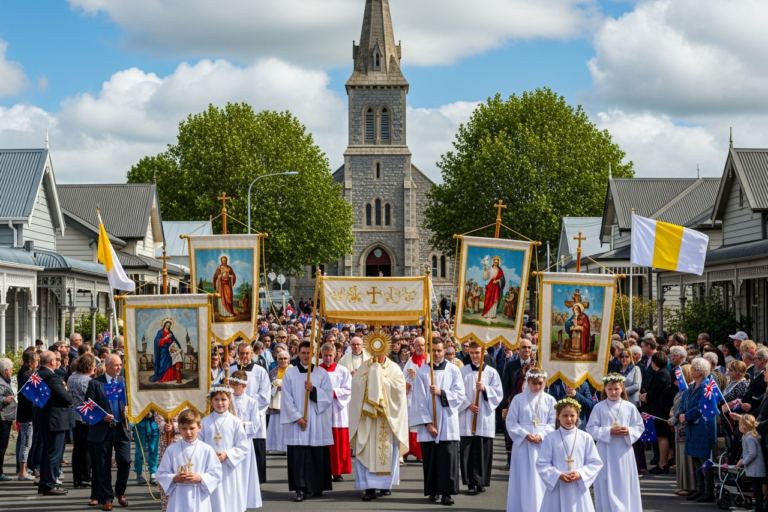
The most well-known custom for Corpus Christi is the eucharistic procession. After a special Mass for the celebration of the eucharist, the priest puts the consecrated host in a monstrance. He walks with it through the streets. The people follow him and join in. This is a show of faith and love for the blessed sacrament.
In New Zealand, Corpus Christi is not a public holiday. It is also not a holy day of obligation. This means people do not have to go to Mass on that day. Still, many parishes set up these processions, often on church grounds or through neighbourhoods. The procession often ends with the benediction of the blessed sacrament. This is a special blessing given with the eucharist.
Local celebrations can include:
-
A solemn Mass. This has hymns and readings that focus on the eucharist.
-
A public eucharistic procession run by a priest.
-
Times of quiet prayer and eucharistic adoration before the blessed sacrament.
-
Community gatherings or morning teas after, giving people a way to connect.
Unique New Zealand Customs and Cultural Influences
In New Zealand, the celebration of the feast is shaped by the country’s mix of people. The main Catholic traditions stay the same. Still, the local cultures like Māori, Pasifika, and others bring their own feel to the celebration. You can see this in the songs picked for church, the way the place is decorated, and the strong sense of community (whanaungatanga) at the events.
The Catholic Church in New Zealand also takes part in worldwide movements such as the National Eucharistic Revival. This movement wants to help people understand more about the gift of the Eucharist and be closer to it. New ideas, prayers, and a new focus on the Eucharist come in through these events, which help people join in the celebration of the feast in a deeper way.
So, the celebration of Corpus Christi in New Zealand is both a worldwide Catholic tradition and something special to this country. It is a day that people live out their faith in public. The celebration brings everyone together to honour the gift of the Eucharist in a way that feels true for each person and for everyone as a group.
Conclusion
To sum up, Corpus Christi is a special moment of faith and community for Catholics all over New Zealand. When we look at its long history and different customs, we can see this feast day brings people closer together and helps them feel they belong. The lively walks, and warm masses, show how people come together to make the Eucharist mean so much in Catholic life. When we take part in these customs that make Corpus Christi stand out, we not only honour our past but also make our faith stronger. If you want to know more about how to get ready for this beautiful feast day, you can reach out for some help.
Frequently Asked Questions
When is Corpus Christi Celebrated Worldwide and in New Zealand?
Corpus Christi is a feast day that does not have a fixed date in the Church’s calendar. It is usually held on the Thursday after Trinity Sunday. But in New Zealand and some other places, people celebrate it on the Sunday after that. This way, more people can take part in the feast day.
How Can Catholics Prepare for Corpus Christi?
You can get ready for Corpus Christi by taking some time to pray and think about what the Eucharist means. Some good ways to do this are by going to eucharistic adoration, going to Mass more often before the day, or learning more about this sacrament. These can help you prepare your heart for the celebration.
What Are Some Interesting Facts About Corpus Christi?
An interesting fact is that Pope Urban IV asked St. Thomas Aquinas, who is known as one of the greatest thinkers in the Church, to write the songs and prayers for the Feast of Corpus Christi. In some places, the Feast of Corpus Christi is still a public holiday. This shows just how important it is for history and culture.