

Living in Canada means being part of a vibrant culture where English and French coexist. Whether you are navigating government forms, planning a trip to Quebec, or simply connecting with francophone neighbours, knowing the months of the year in French is a practical skill that opens doors.
Learning these basics is more than just memorizing words; it’s a way to participate more fully in Canadian life. From booking a winter getaway in février to celebrating Canada Day in juillet, understanding the calendar connects you to the rhythm of the year across the country.
This guide breaks down the French months with simple pronunciation tips, grammar rules, and cultural insights to help you feel confident using them in your daily life.
The 12 Months in French and English
Here is a simple list of the months in English and their French equivalents. You might notice right away that French months look quite similar to English ones, which makes them easier to remember.
Note: Unlike in English, the names of months in French are not capitalized.
|
English |
French |
|---|---|
|
January |
janvier |
|
February |
février |
|
March |
mars |
|
April |
avril |
|
May |
mai |
|
June |
juin |
|
July |
juillet |
|
August |
août |
|
September |
septembre |
|
October |
octobre |
|
November |
novembre |
|
December |
décembre |
Pronunciation Guide
Getting the pronunciation right can feel intimidating at first, but breaking the words down into sounds makes it much simpler. Here is a phonetic guide to help you practice.
- janvier: [zhahn-vyay] (Think of the “zh” sound like the “s” in “measure”)
- février: [fay-vree-ay]
- mars: [marss] (The “s” is pronounced at the end)
- avril: [ah-vreel]
- mai: [may] (Rhymes with the English word “say”)
- juin: [zhwan] (A soft nasal sound at the end)
- juillet: [zhwee-ay] (The “ll” sounds like a “y”, similar to “yet”)
- août: [oot] (Depending on the region, the “a” is often silent)
- septembre: [sep-tahm-bruh] (The “re” at the end is very subtle)
- octobre: [ok-toe-bruh]
- novembre: [no-vahm-bruh]
- décembre: [day-sahm-bruh]
Listening to native speakers on the radio or in videos can also be very helpful to fine-tune your accent.
Important Grammar Tips
French grammar has specific rules for using months that differ from English. Remembering these three points will help you write and speak correctly.
1. No Capitalization
As mentioned earlier, you do not capitalize months in French unless they appear at the very beginning of a sentence.
- Correct: J’adore le mois de mai.
- Incorrect: J’adore le mois de Mai.
2. Masculine Gender
All months in French are masculine nouns. While you generally don’t use articles like le or un directly before the month when talking about the date, it is good to know they are masculine for other grammatical agreements.
3. Using “En”
When you want to say something happens “in” a certain month, use the preposition en. You do not need an article.
- Correct: Je voyage en avril. (I am traveling in April.)
How to Use Months in Sentences
Putting these words into context helps them stick. Here are some common phrases you might use in conversation or see in writing.
- Mon anniversaire est en mars. (My birthday is in March.)
- Il fait très froid en janvier au Québec. (It is very cold in January in Quebec.)
- L’école commence en septembre. (School starts in September.)
- Nous allons en vacances en août. (We are going on vacation in August.)
Notice how en is used consistently to indicate the timing of the event.
Seasonal and Regional Notes
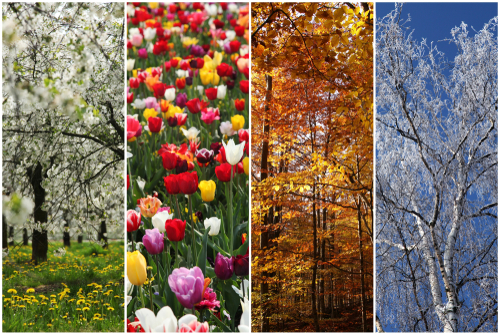
In Canada, our seasons are distinct, and they shape how we talk about the year. Associating months with seasons and holidays can help you remember them.
L’Hiver (Winter)
- décembre, janvier, février: These are the snowy months. Winter officially begins in late décembre.
- Event: Le Carnaval de Québec often takes place in février.
Le Printemps (Spring)
- mars, avril, mai: The snow melts and the maple syrup season (le temps des sucres) usually happens around mars or avril.
L’Été (Summer)
- juin, juillet, août: Warm weather and festivals.
- Event: La Saint-Jean-Baptiste (Fête nationale du Québec) is celebrated on the 24th of juin.
L’Automne (Autumn)
- septembre, octobre, novembre: The leaves change colour.
- Event: Unlike in the United States where Thanksgiving is in November, Canadian Thanksgiving (l’Action de grâce) takes place in octobre.
Activities to Learn & Practice
Consistency is key when learning a new language. Here are a few simple activities to help you memorize the months.
- Change your calendar: Buy a bilingual calendar or switch the language settings on your phone’s calendar to French. Seeing lundi 12 octobre every day reinforces the vocabulary effortlessly.
- Flashcards: Create a set of flashcards with the English month on one side and the French on the other. Test yourself for a few minutes each morning.
- Weather reports: Watch a French weather forecast (like MétéoMédia). You will hear the days and months repeated frequently in a visual context.
Cultural Insight
For francophone Canadians, the months are often tied to cultural rhythms. In Quebec, for example, July 1st is not just Canada Day; it is commonly known as “Moving Day” (le jour du déménagement), where thousands of leases end and people move to new apartments.
Understanding these cultural nuances helps you connect more deeply with friends and colleagues. It shows that you are interested not just in the language, but in the life and traditions of the people who speak it.
Conclusion
Learning the months in French is a manageable and rewarding step in your language journey. It helps you navigate plans, understand the calendar, and connect with Canada’s bilingual identity. Start by memorizing a few months at a time, listen to how they are pronounced, and try using them in short sentences. Before you know it, you will be planning your vacances en juillet with confidence.
Frequently Asked Questions
Why are French months not capitalized?
In French grammar, months and days of the week are considered common nouns, not proper nouns. Therefore, they are written in lowercase unless they start a sentence.
Are there different names for months in other Francophone countries?
Generally, no. The names of the months are standard across the French-speaking world, from France to Senegal to Canada. Pronunciation accents may vary, but the words remain the same.
Where can I hear native pronunciation?
You can hear native pronunciation on websites like Forvo, on French-language news sites like Radio-Canada, or by using language learning apps like Duolingo or Babbel.