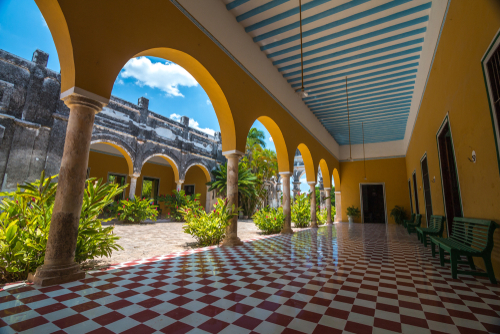

When you live in the UAE, it can be easy to forget that not everywhere is full of futuristic skylines, glass-fronted towers, and modern smart homes. From the pagodas of Asia to the trulli of Italy and the cave houses of Spain, many countries are full of traditional architecture. And one of the best examples of design honouring the past is in the traditional homes in Mexico. Mexican architecture, specifically the hacienda and adobe styles, reflects centuries of culture and community life.
At Remitly, we’re all about global lifestyles, so whether you’re just fascinated with other cultures, considering property investment, or love learning about design, you’re in the right place. We’ll cover the origins of traditional homes in Mexico, what defines the hacienda and adobe styles, and how these structures continue to be popular today.
The roots of Mexican architecture
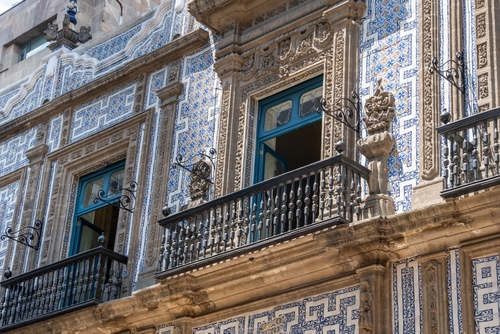
In contrast to the UAE’s modern architecture, traditional Mexican architecture is something that has evolved over centuries. To understand its significance, we first need to learn where the adobe and hacienda-style homes came from and how the landscape contributed to some of their most defining features.
A blend of cultures
It all started with Indigenous Mesoamerican communities, like the Olmec, Maya, and Aztecs. They used the materials at hand, such as clay, stone, and wood, to construct their dwellings. Their priorities? Environmental harmony and communal spaces.
Then, in the 16th century, with the arrival of the Spanish, construction techniques and materials began to evolve to combine the Indigenous and Spanish styles. The Spanish brought distinct elements like intricate tile work, archways, and interior courtyards into the mix.
The early Mesoamerican style wasn’t replaced; it was simply augmented by the Spanish influence. The result is a clear Mexican style that’s welcoming, colourful, and connected to the land.
Climate considerations
Before air conditioning and central heating, building construction was the best way to address climate concerns. Not only is the Mexican climate hot, but the coasts tend to be humid.
To ensure comfort, the traditional homes in Mexico were built with:
- Smaller exterior openings: Smaller windows and doors limit direct exposure to the sun.
- Shaded courtyards: Because the popular interior courtyard is flanked by four walls, it’s easy to shade the entire space. This central courtyard also allows airflow throughout the home.
- Thick walls: These provide insulation from the sun and were often made from adobe or stone.
- Roof overhangs: Deep roof overhangs also shaded the exterior walls from the sun.
Hacienda-style homes: Grand estates
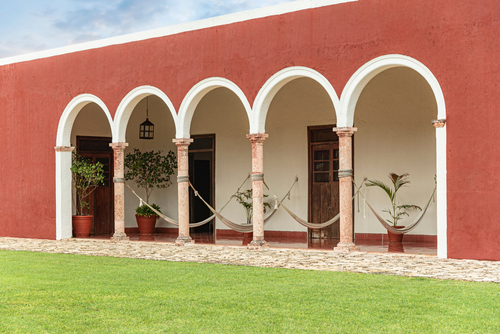
When you think of haciendas, you might picture vast rural estates with industries like farming, ranching, or mining. And you’d be right. These colonial-era properties aimed to be self-sufficient and functioned as a compound.
While there has been a shift in the use of many haciendas since their heyday in the 17th and 18th centuries, many remain. They’ve been repurposed into boutique hotels, cultural institutions like museums, and even private luxury residences. These new spaces still benefit from the “compound” nature of the hacienda style, like living quarters, workspaces, and open land.
How to recognise a hacienda
If you know the key features of haciendas, you’ll be able to recognise them easily. Perhaps the most defining element is a connection to the outdoors. Large gardens and shaded terraces blur the line between indoor and outdoor living. Interior courtyards are the ideal communal space, but also provide climate-friendly airflow to the entire home.
Haciendas also have arches, called arcos, to frame the doorways and patios. Fountains are popular for their serene and cooling effect, and they can be simple or grand, depending on the hacienda’s style.
As for the construction materials, they combine to create a really solid-feeling structure. Thick stone walls, exposed wood beams, and clay roof tiles are beautiful and functional. Wrought iron touches and warm, earthy tones, like terracotta and ochre, complete the grand yet welcoming look.
Adobe and Pueblo styles: Earthy and efficient
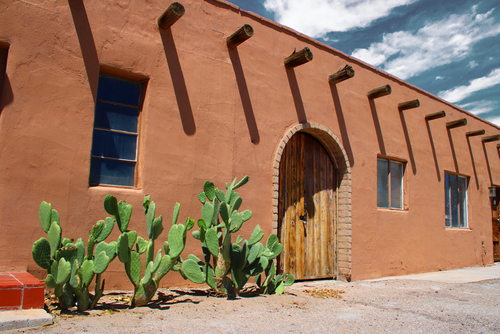
Popular in Mexico’s north, where the climate is desert-like and semi-arid, adobe (often called Pueblo) homes are made with adobe bricks. Pueblo architecture is a cultural building tradition that commonly uses adobe as its primary material.
What is adobe?
Adobe, which is the Spanish word for mudbrick, is just that. They’re traditionally made from sun-dried mud mixed with straw and water, although straw is sometimes substituted with grass. The result, once the bricks are dry, is a building material that offers excellent natural insulation.
The one issue is that the bricks require months to dry in the sun. To avoid long lead times for the bricks, more modern homes rely on materials that give the look of adobe without this time-consuming process. Now, the bricks are often dried in a kiln and reinforced with materials like asphalt, cement, or lime. This increases the bricks’ strength and water resistance.
Recognising the visual style of adobe
Adobe architecture homes are characterised by clean lines, compact layouts, and materials sourced locally. These are their main features:
- Flat roofs: The roofs of adobe homes are flat to help collect the scarce rain that falls in the dry regions of Mexico.
- Rounded edges: Look for rounded, soft edges that are shaped by hand.
- Wood beams: Expect protruding wooden roof beams, called vigas. They extend through to the exterior of the home and are crucial for both structural integrity and style.
Above all, the adobe construction methods and Pueblo architectural traditions embody simplicity without sacrificing beauty or function.
Distinctive design elements of traditional Mexican homes
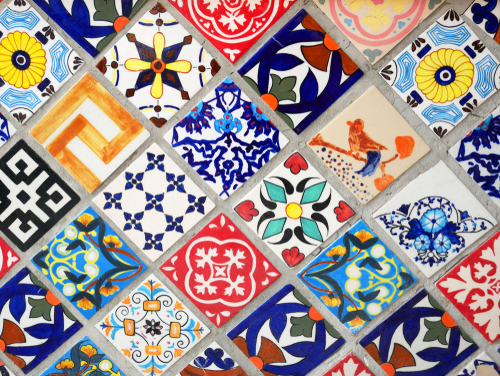
Traditional homes show their character in many ways, from thoughtful details to culturally important elements and practical layouts.
Talavera tiles
One of the most recognisable features of traditional homes in Mexico is the use of Talavera tiles. These hand-painted ceramic tiles, originally influenced by Spanish and Moorish techniques, are easy to spot due to the intricate patterns and vivid colours. They often include geometric and floral elements.
You may find them decorating an adobe kitchen, an outdoor fountain or a courtyard, or a staircase. They are beautiful and easy to clean, so it’s a win-win.
Colours and textures
Traditional Mexican homes also value a distinct (and bold) colour palette. Tones like ochre, deep green, sunny yellow, and terracotta are iconic. To make traditional Mexican homes even more eye-catching, the walls are textured with stucco to contrast the smooth tilework and edges.
Enclosed courtyards
The interior courtyards act as the heart of a traditional Mexican home. The walls offer privacy, shade, and areas to decorate with tile and vivid colour. These are gathering places for families to celebrate and for kids to play safely.
Using multiple doors opening onto the courtyard, residents can create cross breezes while maintaining separation from the street and passersby. This is an ideal way to cool down the entire home when temperatures dip in the evening.
Modern living in traditional homes
As in many cities around the world, there’s a growing appreciation for historic architecture and traditional character. In Mexico, this is especially true in cities like Merida and San Miguel de Allende, where the historic townhouses called casonas are being lovingly restored.
The idea behind restoring a traditional Mexican home is to preserve its unique features and style while making it more comfortable for today’s needs. The goal is to maintain the home’s original charm while adding modern conveniences. Ideally, the plumbing and electrical wiring are updated, and amenities like high-speed internet, fully-equipped kitchens, and modern climate control are added.
Where to find traditional Mexican architecture
In truth, hacienda and adobe architecture are found throughout Mexico, but here are some of the best areas to see these homes up close:
Paquimé
Located in the state of Chihuahua, the Archaeological Zone of Paquimé is among the oldest settlements in the country built entirely with adobe. Although the site is in a ruined state, it’s possible to tour the many structures and see remnants of ceremonial monuments. It was constructed in what is now Casas Grandes between 700 and 1475.
El Camino Real
This translates to “The Royal Road” and is commonly referred to as El Camino de la Plata or “The Silver Route” In contrast to Paquimé’s largely ruined structures, there are several well-preserved adobe dwellings along this route. They currently operate as restaurants and shops. The most noteworthy are located in Cholula and Mapimi.
Hacienda El Carmen
Beautiful examples of Mexican colonial design are much easier to find across Mexico, and many hacienda-style homes now function as luxury hotels. El Carmen is in Ahualulco, near Guadalajara. It still functions as a working ranch and boasts picturesque gardens, impressive continuous arches, lovely pools, and vibrant colours.
Hacienda San Gabriel de las Palmas
This is another luxurious hotel with a varied history. It dates back to 1529 and was originally built as a Franciscan monastery. Abandoned in 1558, it has since been a sugarcane plantation and a military barracks before becoming a hotel.
For added authenticity, San Gabriel still has hundreds of pieces of original furniture. You’ll see everything from curved ceilings to stone walls to beautiful courtyards. The high-end interiors and patios give way to a lush 60-acre estate. It’s a great place to spend your next holiday.
Why traditional Mexican homes still inspire
From the stately grandeur of the hacienda to the efficiency and simplicity of adobe homes, these architectural styles embody a commitment to honouring the landscape, centuries of adaptation, and skilled craftsmanship.
No matter where you’re from, you can likely relate to the importance these styles place on history and family. Shared spaces for a sense of community, sustainable building, and natural energy efficiency only complement the beautiful colours and intricately-painted tiles that adorn the homes.
Whether you want to bring a touch of Mexican tradition to your UAE home or are looking for a hacienda or adobe property, you won’t regret it.
FAQs
Can foreigners buy traditional homes in Mexico?
Yes. Foreigners can legally buy property in Mexico, and that includes traditional homes like haciendas, casonas, and adobe houses. The real estate trust system, known as fideicomiso, also permits foreigners to retain ownership of Mexican property in the Restricted Zone. This zone is for homes within 50 km of the coast or 100 km of an international border.
What is the difference between a hacienda and a casona?
Both haciendas and casonas are rooted in Mexican colonial design, but they served different purposes. A hacienda is typically a large, rural estate originally used for industrial production, like agriculture or ranching. A casona, on the other hand, is a grand residential home usually found in city centers or historic towns, built for wealthy families.
Are adobe homes durable?
Absolutely, as long as the adobe home was built well and properly maintained. Some traditional homes in Mexico are still in great shape hundreds of years after they were built. Since adobe homes are best-suited to dry climates, as long as prolonged moisture is avoided, the structure should remain sound.
Is it expensive to maintain a traditional home?
While a traditional home requires more upkeep than a new one, it can be manageable. The key is to keep up with maintenance to control humidity and preserve both the roof and overall structure. Luckily, since traditional homes in Mexico source many materials locally, when work is needed, the expenses can be lower.