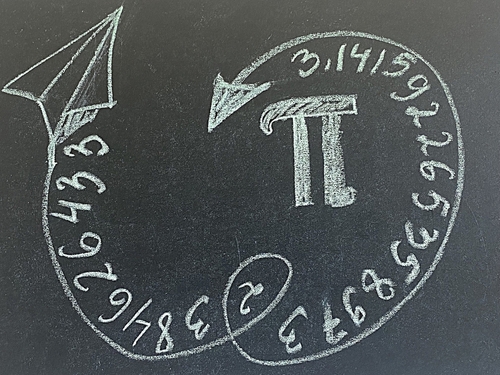

Imagine a classroom buzzing with energy as students cheer over fresh slices of apple pie. Picture friends gathered around a pizza, debating who can remember the most digits of an infinite number. This isn’t just a lunch break—it’s a global celebration of mathematics.
On Saturday, March 14, 2026, the world will once again observe Pi Day. It is a quirky, delicious, and educational holiday dedicated to the mathematical constant $\pi$ (pi). Why March 14? Because the date—3/14—mirrors the first three digits of pi, 3.14.
While math can sometimes feel abstract or intimidating, Pi Day changes the equation. It transforms a complex concept into a community event filled with creativity, food, and fun. Whether you are a math enthusiast, a teacher looking for activities, or simply someone who loves a good slice of pizza, Pi Day 2026 offers a perfect excuse to celebrate the universal language of numbers.
What Is Pi Day?
At its core, Pi Day is an annual celebration of the mathematical constant $\pi$. This Greek letter represents the ratio of a circle’s circumference to its diameter. No matter how large or small a circle is—from a tiny button to a massive planet—the distance around it is always roughly 3.14 times the distance across it.
The date was chosen for its numerical significance. In the month/day format used in the United States, March 14 is written as 3/14. These digits match the initial approximation of pi (3.14).
The holiday has humble but enthusiastic roots. It began in 1988 at the Exploratorium, a science museum in San Francisco. Physicist Larry Shaw and his colleagues organized the first celebration, which included marching around circular spaces and eating fruit pies. What started as a small gathering has since grown into an international phenomenon recognized by math lovers everywhere.
When It Happens in 2026
Mark your calendars: Pi Day 2026 falls on Saturday, March 14. Because it lands on a weekend, it offers a unique opportunity for families and communities to host larger events outside of school hours.
This date holds another special connection for science history buffs. March 14 is also the birthday of Albert Einstein. Celebrating the world’s most famous theoretical physicist alongside the world’s most famous number adds an extra layer of meaning to the festivities.
Why Pi ($\pi$) Matters
You might wonder why a single number deserves its own holiday. $\pi$ is fundamental to our understanding of the universe. It is the constant ratio that defines circles, but its influence reaches far beyond simple geometry.
Pi is an “irrational number.” This means it cannot be written as a simple fraction, and its decimal representation goes on forever without ever repeating a pattern. Computers have calculated $\pi$ to trillions of digits, yet we have never found the end.
This infinite number is essential in various fields:
- Architecture and Engineering: Used to design arches, bridges, and tunnels.
- Physics: Crucial for understanding waves, light, and sound.
- Space Exploration: NASA uses $\pi$ to calculate spacecraft trajectories, determine the size of craters, and understand the composition of planets.
Without pi, many of the modern technologies and structures we rely on simply wouldn’t exist.
Traditions & Fun Ways to Celebrate
Pi Day is famous for blending intellectual challenge with lighthearted fun. Here are some of the most popular ways people celebrate.
Eat Pie & Pizza
The most common tradition relies on a simple pun. Because “pi” and “pie” sound identical in English, food is a central part of the day. Fruit pies (apple, cherry, pumpkin) are staples, but circular savory foods are just as popular. Pizzas, quiches, and cookies allow everyone to participate, regardless of their sweet tooth.
Pi Recitation Challenges
For those who love a mental workout, recitation contests are a highlight. Schools and math clubs often host competitions to see who can memorize the most digits of pi. While most people stop at 3.14 or 3.14159, serious competitors memorize hundreds or even thousands of digits.
Pi-Themed Activities
Creativity shines on Pi Day. Teachers often organize scavenger hunts where students look for circular objects to measure. Arts and crafts projects might involve making paper chains representing the digits of pi (assigning a different color to each number). Trivia quizzes about math history are also a great way to engage groups.
Educational Events
Educators use this day to make math approachable. Instead of standard lectures, classrooms might feature puzzles, games, and real-world experiments. It helps students see math not just as a subject in a textbook, but as a tool that describes the world around them.
Pi Beyond the Classroom
The celebration extends well beyond school walls. Universities, museums, and scientific institutions often host public events. For example, the Exploratorium in San Francisco continues its tradition with annual festivities. NASA’s Jet Propulsion Laboratory frequently releases a “Pi in the Sky” challenge, inviting students and the public to solve real-world space problems using pi.
Commercial businesses join in too. It is common to see pizzerias and bakeries offering specials—often pricing items at $3.14 or offering 31.4% discounts. It is a rare moment where commerce and calculus intersect.
Why Pi Day Is More Than a Number
Pi Day is important because it changes how we view mathematics. For many, math can seem rigid or difficult. Pi Day flips that narrative. It frames math as something curious, beautiful, and even tasty.
It celebrates the joy of learning. It reminds us that there are constants in our universe that connect us all. Whether you are an astrophysicist calculating an orbit or a child measuring a bicycle wheel, you are using the same number. It is a celebration of curiosity and the human desire to understand the world.
How You Can Celebrate in 2026
Since Pi Day 2026 is on a Saturday, you have plenty of time to plan a memorable day. Here are a few ideas to get you started:
- Host a Pie Bake-Off: Invite friends over for a baking competition. Judge the pies based on taste and “circular perfection.”
- Organize a Pi Digit Challenge: Create a friendly competition to see who can memorize the most digits. You can even print out the first 100 digits as a cheat sheet for beginners.
- Learn Something New: Watch a documentary about mathematics or read up on the history of pi. Understanding the history behind the number makes the day even more meaningful.
- Share Fun Facts: Use social media to spread the word. Share trivia using the hashtag #PiDay to spark conversations with your network.
Frequently Asked Questions
What is the exact time to celebrate Pi Day?
While the entire day is celebrated, the “official” peak moment is at 1:59 PM. This creates the sequence 3.14159 (3/14 at 1:59), representing the first six digits of pi.
Is Pi Day an official holiday?
Yes. In 2009, the U.S. House of Representatives passed a non-binding resolution recognizing March 14 as National Pi Day. It is also celebrated globally, though not always as a public bank holiday.
How many digits of pi do we know?
Thanks to supercomputers, we now know pi to more than 100 trillion digits. However, for most scientific calculations (even for space travel), we only need the first 15 to 40 digits to be precise.
Can I celebrate if I’m not good at math?
Absolutely. Pi Day is for everyone. You don’t need to be a mathematician to enjoy a slice of pie or appreciate the shapes around you. It is about curiosity, not testing.
Making Math Memorable
Pi Day 2026 is more than just a date on the calendar. It is a bridge between education and community. It is a chance to honor one of the most fascinating numbers in history while enjoying time with friends and family.
So, circle Saturday, March 14, 2026, on your calendar. Whether you spend it solving puzzles or sharing a pizza, take a moment to appreciate the number that helps the world go ’round.