
If you are planning a trip to Japan in early 2026, or if you are already living there, you might spot a red date on the calendar in mid-February. That date is National Foundation Day, known locally as Kenkoku Kinen no Hi. It is one of Japan’s most historically significant public holidays, yet it is often celebrated much more quietly than national days in other countries.
For travelers and residents alike, understanding this holiday helps you navigate the country better. Since it is a national holiday, you can expect changes to public services, transportation schedules, and business hours. It is also a unique opportunity to witness a blend of ancient mythology and modern Japanese life.
This guide breaks down everything you need to know about National Foundation Day 2026. We will cover when it falls, the fascinating history behind it, and what you can expect if you are in Japan on this day. Whether you are looking to join the festivities or simply want to know if the banks are open, we have you covered.
Understanding Kenkoku Kinen no Hi
National Foundation Day is dedicated to commemorating the founding of the nation and fostering a love for the country. Unlike many other countries that celebrate independence from a colonial power or a revolution, Japan celebrates its legendary origins.
The date, February 11, was chosen to mark the traditional accession of the first Emperor of Japan, Emperor Jimmu. According to ancient Japanese chronicles like the Nihon Shoki, this event took place in 660 BCE. While historians view this date as largely mythical, it remains a symbolic marker for the long continuity of the Japanese imperial line and the nation itself.
The holiday has a somewhat complex history. It was originally celebrated as Kigensetsu (Empire Day) starting in 1873 during the Meiji period. However, it was abolished after World War II. It wasn’t until 1966 that the holiday was reinstated under its current name, Kenkoku Kinen no Hi, and first observed again in 1967.
When is National Foundation Day 2026?
In 2026, National Foundation Day falls on Wednesday, February 11.
Because it lands on a Wednesday, it provides a mid-week break for students and workers. Unlike years when a holiday falls on a Sunday and is observed on the following Monday, there will likely be no “substitute holiday” attached to the weekend. It will simply be a single day off in the middle of the week.
This is helpful information if you are handling administrative tasks. Since it is a national holiday, you should plan for the following closures:
- Banks and financial institutions: Closed.
- Post offices: Most branches will be closed, though central offices may offer limited services.
- Government offices: Closed (including ward offices and immigration centers).
- Schools: Closed.
However, convenience stores, supermarkets, and most retail shops will remain open. In fact, restaurants and shopping areas may be busier than usual as people enjoy their day off.
The Legend of Emperor Jimmu
To understand why this specific day matters, you have to look back at Japanese folklore. The story goes that Emperor Jimmu was a descendant of the sun goddess Amaterasu. After a series of victorious battles, he ascended to the throne at the Kashihara Palace in what is now Nara Prefecture.
While there is no historical evidence that Jimmu actually existed or that the nation was founded in 660 BCE, the legend is deeply woven into Japan’s cultural identity. February 11 was calculated during the Meiji era by converting the traditional lunar calendar date to the Gregorian solar calendar.
Today, the holiday is less about asserting historical fact and more about reflecting on the nation’s heritage. It is a day intended for citizens to recall the founding of the nation and cultivate a heart that loves the country.
How Japan Celebrates (and How You Can Too)
If you are expecting fireworks and massive street parties like the Fourth of July in the US or Bastille Day in France, you might be surprised. National Foundation Day is a relatively understated affair in Japan. Because of its pre-war associations with nationalism, many Japanese people treat it simply as a day of rest rather than a day of intense patriotic demonstration.
However, there are still ways to observe the day:
Shrine Visits
Shinto shrines often host festivals called Kenkoku-sai on this day. The most prominent celebrations happen at Meiji Jingu Shrine in Tokyo and Kashihara Jingu Shrine in Nara. Kashihara Jingu is particularly significant because it is enshrined to Emperor Jimmu and sits on the site where he is said to have ascended to the throne. If you visit these sites, you will likely see processions, traditional music, and dignitaries paying their respects.
The Parade in Tokyo
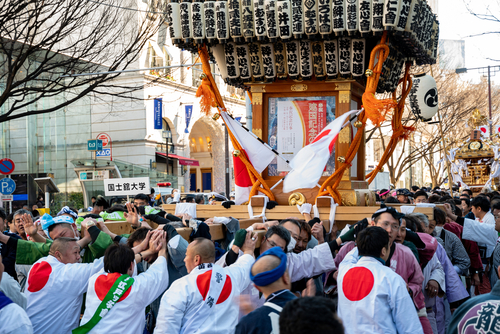
One of the few large-scale public events is the celebratory parade in Tokyo. It typically runs between Meiji Jingu Gaien and Meiji Jingu Shrine. You can see marching bands, portable shrines (mikoshi), and people carrying Japanese flags. It is a lively, colorful event that offers great photo opportunities if you are in the Harajuku or Omotesando area.
Seeing the Flag
You will notice the Japanese flag, the Nisshoki (or Hinomaru), displayed on public buses, government buildings, and some private businesses. It is one of the few days of the year when the flag is so prominently visible across the city.
Practical Tips for Travelers
Traveling in Japan on a public holiday requires a little extra planning. Here is how to make your Wednesday, February 11, 2026, go smoothly.
- Transportation: Trains and subways will run on a holiday schedule. This usually means slightly fewer trains during rush hour times compared to a regular weekday, but they will still be frequent enough for convenient travel.
- Crowds: Popular tourist spots, especially in Kyoto and Tokyo, will be busier than a standard Wednesday. If you plan to visit a major theme park like Tokyo Disneyland or Universal Studios Japan, buy your tickets in advance.
- ATMs: While most bank ATMs function on holidays (often with a small surcharge), it is always safer to withdraw cash on Tuesday, February 10, just in case.
- Etiquette: If you encounter political sound trucks (black vans broadcasting messages) or protests, which occasionally happen on this day due to the holiday’s political history, simply continue on your way. It is best to observe from a distance and remain respectful of the local customs.
Frequently Asked Questions
Is National Foundation Day a good time to visit Japan?
Yes. February is cold, but typically dry and sunny in regions like Tokyo and Osaka. While the holiday brings some crowds to shrines, it is generally not as chaotic as “Golden Week” in May or the New Year period. It allows you to see a unique side of Japanese culture without overwhelming travel disruptions.
Are shops and restaurants open on February 11?
Yes. Unlike New Year’s Day (January 1), National Foundation Day is a prime shopping day. Major department stores, malls, and restaurants will be open and likely bustling with locals enjoying their day off.
Why is National Foundation Day considered controversial by some?
The controversy stems from the holiday’s previous iteration as Kigensetsu (Empire Day), which was used to promote nationalism and loyalty to the Emperor before World War II. Because of this history, some people feel the holiday still carries those old associations. However, for most modern Japanese citizens, it is simply a peaceful public holiday.
What happens if I need medical help on this holiday?
Large hospitals may have restricted hours for non-emergency consultations, similar to a Sunday schedule. However, emergency rooms remain open 24/7. It is helpful to check the website of your local clinic beforehand to see if they are accepting walk-ins.
Do I need to book Shinkansen tickets in advance?
Since February 11, 2026, is a Wednesday, it does not create a long weekend. Therefore, Shinkansen (bullet train) travel is unlikely to be fully booked weeks in advance. However, reserved seating is always recommended for peace of mind.
Enjoying the Day
National Foundation Day 2026 offers a distinct look into Japan’s long history. Whether you spend the Wednesday watching the parade in Omotesando, exploring the grounds of Kashihara Jingu, or just enjoying a day of shopping in a busy district, it is a day to appreciate the unique culture of the country.
By knowing what to expect and planning for bank closures, you can relax and enjoy the experience. It is a moment to pause, much like the locals do, and appreciate the history that has shaped the Japan we see today.