
For millions of people around the world, the Lunar New Year is the most significant festival of the calendar. It is a time for honouring ancestors, gathering with family, and welcoming new beginnings. While the exact date changes every year based on the cycles of the moon, the spirit of the celebration remains constant.
Looking ahead to 2026, we are preparing to welcome the Year of the Horse. If you are planning travel, organising family reunions, or simply want to understand the traditions behind this vibrant holiday, this guide covers everything you need to know.
When is Lunar New Year 2026?
The Lunar New Year in 2026 falls on Tuesday, 17 February.
Unlike the Gregorian calendar, which is based on the sun, the traditional Chinese calendar is lunisolar. This means the start of the new year is determined by the new moon that appears between late January and late February.
The festival typically lasts for 15 days, concluding with the Lantern Festival. However, the public holiday duration varies depending on the country. In China, for example, most people enjoy a week off work to return to their hometowns.
Entering the Year of the Horse
Every year in the Lunar calendar is associated with one of the 12 animals of the Chinese zodiac. 2026 marks the transition from the Year of the Snake (2025) to the Year of the Horse.
People born in the Year of the Horse (including 1930, 1942, 1954, 1966, 1978, 1990, 2002, 2014, and 2026) are believed to possess specific personality traits. In Chinese culture, the Horse represents energy, happiness, and a love for freedom.
Characteristics of the Horse
Those born under this sign are often seen as:
- Energetic and active: They rarely stand still and love to be in the thick of the action.
- Independent: They value their freedom and space.
- Optimistic: They tend to have a positive outlook on life.
- Witty: They often have a sharp sense of humour and are popular in social groups.
The Fire Element
Each zodiac year is also associated with one of five elements: Gold (Metal), Wood, Water, Fire, or Earth.
2026 is specifically the year of the Fire Horse. This combination happens only once every 60 years. The Fire element is said to amplify the Horse’s natural traits, making this year’s influence particularly passionate, adventurous, and perhaps a little volatile. It is predicted to be a year of high energy and significant movement.
Key traditions and customs
While specific customs can vary between regions and families, several core traditions define the Lunar New Year celebrations.
Sweeping the dust
Preparations begin days or even weeks before the new year arrives. A vital tradition is “sweeping the dust”. This involves a thorough deep clean of the house. The symbolic meaning is to sweep away any bad luck from the previous year to make room for good luck to enter.
It is important to finish all cleaning before New Year’s Day. Sweeping or cleaning on the first day of the year is strictly avoided, as tradition says you might sweep away your new fortune.
The Reunion Dinner
The most important meal of the year takes place on New Year’s Eve. Known as the Reunion Dinner, this is when extended families gather to share a feast. Even family members who live far away will make a significant effort to return home for this meal.
The dishes served are chosen for their symbolic meanings:
- Fish: The Chinese word for fish sounds like the word for “surplus”. Eating fish symbolises having money and luck left over at the end of the year.
- Dumplings: Shaped like ancient silver ingots, dumplings represent wealth. Legend says the more dumplings you eat, the more money you will make in the coming year.
- Noodles: Long noodles represent a long life. They should be eaten without cutting them.
- Glutinous Rice Cake (Nian Gao): This symbolises achieving new heights or improving one’s status in the coming year.
Wearing red
You will see red everywhere during the Lunar New Year. In Chinese culture, red is the colour of luck, joy, and happiness. It is also believed to ward off evil spirits.
People decorate their homes with red lanterns, red couplets (poetry written on red paper), and red paper cuttings. It is also customary to wear new red clothes to ring in the year, symbolising a fresh, lucky start.
The tradition of the Red Envelope (Hongbao)
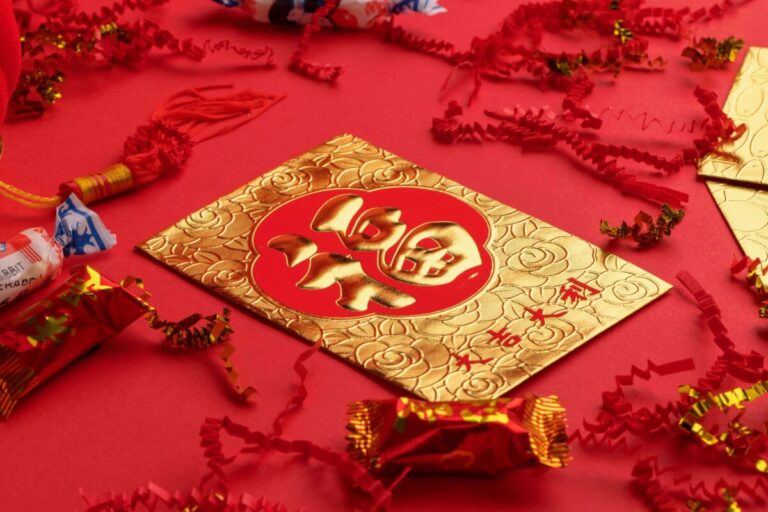
One of the most loved traditions, especially for children, is the exchanging of red envelopes. Known as Hongbao in Mandarin or Lai See in Cantonese, these are small red packets containing money.
Who gives and who receives?
Generally, red envelopes are given by married couples and elders to unmarried people and children. Adult children also give red envelopes to their parents and grandparents as a sign of respect and gratitude.
The rules of giving
There are a few unwritten rules regarding lucky money:
- New notes: It is respectful to use crisp, new banknotes.
- Avoid the number four: The number four sounds like the word for “death” in Chinese, so amounts containing four (like 40 or 400) are avoided.
- Favour the number eight: Eight is considered the luckiest number, so amounts like 80 or 800 are very popular.
- Digital envelopes: In recent years, sending “digital red envelopes” through apps has become increasingly popular. This allows people to maintain the tradition even when they cannot be physically present.
At Remitly, we understand that sending money home is often about more than just the funds—it is a way to participate in these vital family traditions from thousands of miles away.
Celebrations beyond China
While often referred to as Chinese New Year, this festival is celebrated widely across Asia, each culture adding its own unique flavour.
Vietnam (Tết)
In Vietnam, the Lunar New Year is called Tết Nguyên Đán, or simply Tết. It is the most important celebration in Vietnamese culture.
- Food: A central dish is Bánh Chưng, a square sticky rice cake filled with mung beans and pork, wrapped in banana leaves.
- Flowers: Vietnamese families decorate their homes with peach blossoms (in the north) or yellow apricot blossoms (in the south).
South Korea (Seollal)
In South Korea, the celebration is known as Seollal. It is a three-day holiday where families return to their hometowns.
- Dress: Many Koreans wear traditional clothing called Hanbok.
- Rituals: A key tradition is Sebae, where children bow deeply to their elders to wish them a happy new year. In return, they receive blessings and money.
- Food: The main dish is Tteokguk (rice cake soup). Eating a bowl of this soup is said to make you one year older.
Preparing for a prosperous 2026
As we move closer to February 2026, you can start making small preparations to ensure a smooth celebration.
- Check your travel documents: If you plan to visit family abroad, 2026 is expected to be a busy travel year. Book flights early.
- Settle debts: It is traditional to pay off any personal debts before the New Year arrives to start with a clean financial slate.
- Plan your remittances: If you cannot travel home, sending money is a powerful way to show you care. Ensure your accounts are set up so your red envelopes arrive on time.
The Year of the Fire Horse promises to be dynamic and full of life. By understanding these traditions and planning ahead, you can ensure that you and your loved ones embrace all the good fortune the new year has to offer.