

As a freelancer, securing international clients is a major achievement. It opens up a world of new opportunities and diverse projects. However, it also introduces a new challenge: getting paid in a foreign currency. Navigating exchange rates, transfer fees, and currency stability can feel complicated, but understanding your options is the first step toward protecting your hard-earned income.
Choosing the right currency to be paid in can have a significant impact on your financial well-being. A stable currency can protect your earnings from sudden drops in value, while a widely used one can simplify the process of receiving and using your money.
This guide will walk you through the key factors to consider when choosing a payment currency. We will explore some of the most stable and widely accepted currencies for freelancers, helping you make an informed decision that secures your finances and simplifies your international transactions.
Why Does Your Payment Currency Matter?
When you work with international clients, the currency you get paid in can affect the final amount you receive. There are three main reasons why this choice is so important for freelancers.
1. Exchange Rate Fluctuations
Currency values are always changing. The exchange rate between your client’s currency and your local currency can fluctuate daily. If you get paid in a currency that weakens against your own, you could lose money by the time you convert it. For example, if you invoice for $1,000 USD and the exchange rate is favorable, you might receive more in your local currency. But if the dollar weakens, that same $1,000 invoice will be worth less.
2. Transfer Fees and Conversion Costs
Moving money across borders often involves fees. Banks and payment platforms can charge for international transfers, and they might also take a percentage when converting currencies. Getting paid in a major, widely-used currency can sometimes reduce these costs because they are easier and cheaper to process.
3. Currency Stability
Some currencies are more stable than others. Stable currencies, often called “hard currencies,” are less likely to experience drastic changes in value. They are typically backed by strong, stable economies. Getting paid in a stable currency provides a safety net, protecting your income from the economic or political instability that might affect less reliable currencies. This financial security allows you to budget and plan with greater confidence.
What Are the Best Currencies to Get Paid In?
When selecting a payment currency, it’s often best to choose one that is stable, widely accepted, and easy to convert. These are often referred to as “hard currencies” because they are seen as reliable stores of value. Here are some of the top currencies for freelancers to consider.
The U.S. Dollar (USD)

The U.S. dollar is the world’s primary reserve currency, making it one of the most stable and widely accepted options. The vast majority of international trade is conducted in USD, and many freelancers around the world prefer it for its reliability.
- Stability: Backed by the world’s largest economy, the USD is a safe bet against extreme volatility.
- Acceptance: Nearly every international payment platform and bank handles USD, making transfers simple and straightforward.
- Simplicity: Invoicing in USD is a standard practice for freelancers globally, which can make you appear more professional to international clients.
The Euro (EUR)

The official currency of 20 of the 27 European Union member states, the euro is the second-largest reserve currency in the world. Its strength is supported by the combined economic power of the Eurozone countries.
- Stability: As a major global currency, the euro is stable and trusted worldwide.
- Wide Use: If you work with clients in multiple European countries, getting paid in EUR can simplify your finances by eliminating the need for multiple currency conversions.
- Low Transaction Costs: Transfers within the SEPA (Single Euro Payments Area) zone are often fast and free, which is a major benefit if you and your client are in participating countries.
The British Pound (GBP)

Despite the UK’s exit from the European Union, the British pound remains one of the world’s strongest and most traded currencies. London’s status as a global financial hub helps maintain the pound’s stability and importance.
- Strength: The GBP has historically been a strong currency, often holding a high value against others.
- Trusted: It is a well-regarded currency in international finance and trade.
- Considerations: Its value can be influenced by UK-specific economic events, so it’s wise to keep an eye on financial news if you choose to be paid in pounds.
The Swiss Franc (CHF)
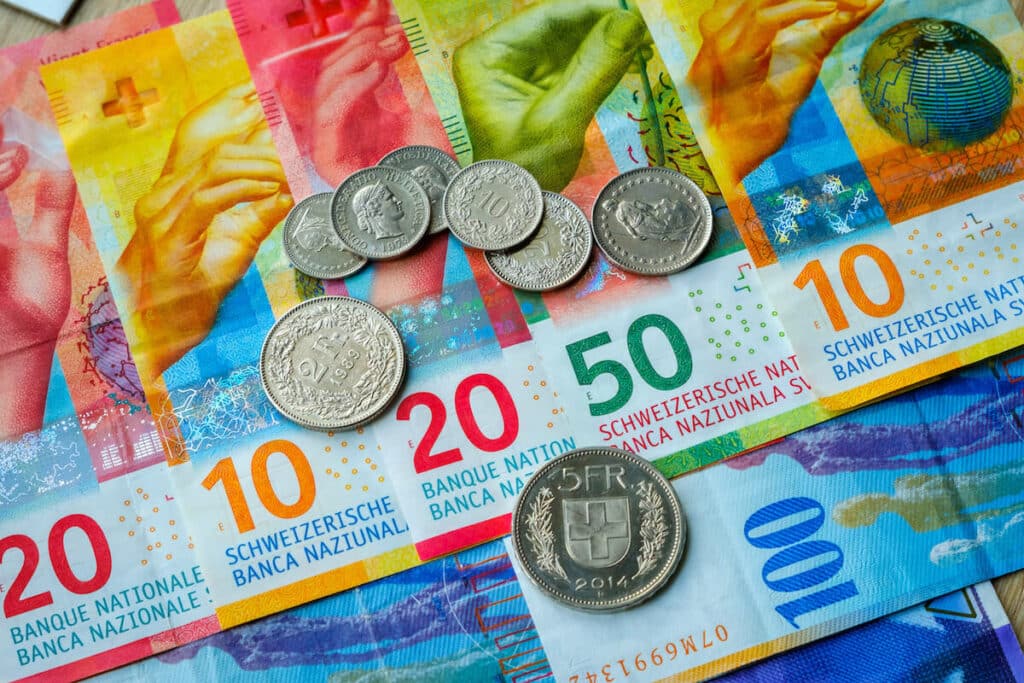
Switzerland’s reputation for political neutrality, a strong economy, and a robust financial sector makes the Swiss franc a classic “safe-haven” currency. During times of global economic uncertainty, investors often turn to the CHF, which helps keep its value stable.
- Exceptional Stability: The franc is known for being one of the most stable currencies in the world.
- Security: Switzerland’s independent monetary policy helps protect the franc from the volatility seen in other regions.
- Lower Liquidity: While extremely stable, the CHF is not as widely traded as the USD or EUR, which might mean slightly higher conversion fees depending on your bank or payment service.
The Japanese Yen (JPY)

The Japanese yen is another major safe-haven currency, backed by Japan’s large and developed economy. It is the third-most-traded currency in the foreign exchange market.
- Stability: Like the Swiss franc, the yen is considered a safe choice during times of economic turmoil.
- High Liquidity: Because it’s widely traded, converting JPY is usually straightforward and cost-effective.
- Ease of Use: If you have clients in Japan or other parts of Asia, receiving payments in yen can be very convenient.
How to Choose the Right Currency for You
The “best” currency depends on your individual circumstances. Here are a few questions to ask yourself:
- Where is my client located? Sometimes it’s easiest to invoice in your client’s local currency, especially if it’s one of the major ones listed above.
- What is my home currency? Consider the strength and stability of your local currency relative to your payment currency. If your home currency is volatile, holding your earnings in a more stable currency might be a good strategy.
- What are the transfer costs? Research the fees associated with different currencies on your preferred payment platform. Services like Remitly offer clear fee structures so you know exactly what to expect.
- What is my risk tolerance? If you prefer financial predictability, a stable, safe-haven currency like the USD or CHF is a great choice.
A Secure Financial Future
Choosing the right currency to get paid in is a key part of managing your freelance business. By opting for stable and widely accepted currencies like the U.S. dollar, euro, or Swiss franc, you can protect your income from volatility and simplify your international transactions. Some services, such as Remitly, allow freelancers to receive international payments and hold funds in USD, providing flexibility around when to convert to local currencies.
Always consider your location, your client’s location, and the costs involved. Using a reliable money transfer service can provide peace of mind with transparent fees and secure, on-time delivery. By making a thoughtful choice, you can ensure that you keep more of your hard-earned money and build a more secure financial future as a global freelancer.
Frequently Asked Questions
What is the best currency for freelancers to get paid in?
It depends on your location and how you use your income. However, being paid in stable global currencies like USD, EUR, or GBP is often beneficial. With Remitly, you can receive these currencies and convert them to your local currency at transparent rates when it suits you.
How do exchange rates affect my freelance income?
Exchange rates directly impact how much you actually take home. If rates change between invoicing and payment, you could lose part of your income. Remitly reduces this uncertainty by showing you the exact rate before the transfer, so you know what you’ll receive in your local currency.
Should I open a bank account in a different currency?
That can help if you’re consistently paid in a specific foreign currency. But if you’re using Remitly, you don’t necessarily need a foreign currency account — the platform lets you receive payments in USD, EUR, and others, then securely converts them to your local currency for deposit or pickup.
What payment platform is best for reducing fees?
Remitly offers competitive, transparent fees with no hidden exchange markups. You see the full cost and delivery timeline before sending. This makes it easier to budget and plan compared to platforms that add margin to the exchange rate or charge high flat fees.
Is it better to receive payments in my local currency or a foreign currency?
Receiving payments in a foreign currency like USD may help if your local currency is volatile. Remitly supports this by allowing you to receive in foreign currencies and convert only when it’s most advantageous — giving you more control over timing and value.