
Driving on a quiet highway is simple. You stay in your lane, watch your speed, and enjoy the ride. But then you see it on the horizon: a massive tangle of concrete ramps, overpasses, and merging lanes rising high above the ground.
For many drivers, entering a multi-level interchange can feel overwhelming. The road seems to twist in every direction at once. You might wonder if you are on a road or a roller coaster.
These structures can look confusing from the ground. However, they are incredible feats of engineering. They are designed to solve a difficult math problem: how to move thousands of cars in different directions without them stopping. Instead of traffic nightmares, we can view them as monuments to human problem-solving.
This article explores some of the most complex road interchanges in the world. We will look at why they are built, how they work, and what the future holds for these concrete giants.
What Makes a Road Interchange Unique?
Not every highway exit counts as a complex interchange. Engineers and city planners look at specific criteria when they design these massive structures.
Number of Levels and Ramps
A standard highway junction might have two levels. The most complex interchanges often have four or five distinct levels of traffic stacked on top of each other. This vertical scale allows traffic to flow freely in all directions without traffic lights.
Unusual Shapes
Some interchanges look like standard clovers. Others look like turbines, spirals, or knots. These unusual shapes are often the result of engineers trying to fit many lanes into a small or oddly shaped piece of land.
Traffic Density
The “craziness” of an interchange is often defined by how many cars it handles. The busiest interchanges in the world manage hundreds of thousands of vehicles every single day.
Engineering Challenges
Building a flat road is straightforward. Building a road that curves 100 feet in the air while carrying heavy trucks is much harder. Engineers must account for wind, earthquakes, and the weight of the concrete itself.
Stack Interchanges That Defy Gravity
When there is no room to build out, engineers build up. “Stack” interchanges are famous for their towering height. They layer roads on top of one another to separate traffic.
The High Five (Dallas, Texas)
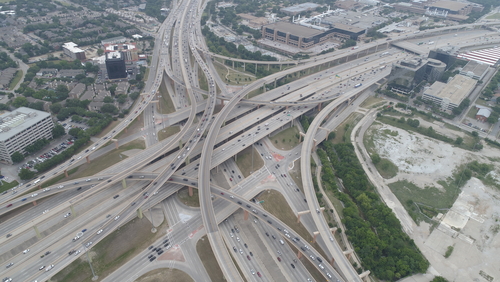
The High Five Interchange in Dallas is a prime example of vertical engineering. As the name suggests, it features five distinct levels of traffic. It rises 120 feet into the air, which is as tall as a 12-story building.
From the ground, the supporting columns look like a concrete forest. For drivers on the top level, the view is impressive, though perhaps a bit scary for those afraid of heights. This design allows huge volumes of traffic to move through the intersection without slowing down.
The Judge Harry Pregerson Interchange (Los Angeles, California)
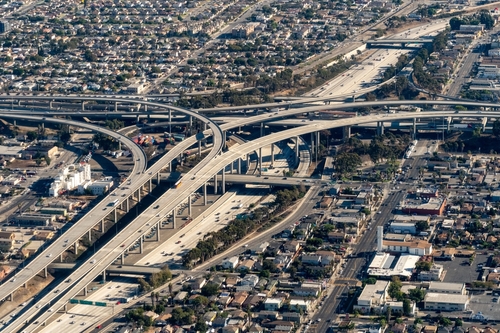
This interchange is one of the busiest in the United States. It includes carpool lanes, transit lanes, and connectors for two major interstates. The structure is so complex that it has appeared in several action movies. Its layers of overlapping ramps make it a marvel of structural engineering.
Interchanges That Look Like Abstract Art
Sometimes, function creates unexpected beauty. When viewed from a satellite or a drone, some interchanges look less like roads and more like geometric art.
The Turbine Interchange
Turbine interchanges are designed to look like a spinning fan or machine part. They use sweeping, curved ramps to move traffic smoothly from one highway to another. While efficient, they require a lot of land. From the air, the symmetry is striking. Examples of this style can be found in places like Jacksonville, Florida.
Spaghetti Junction (Birmingham, UK)
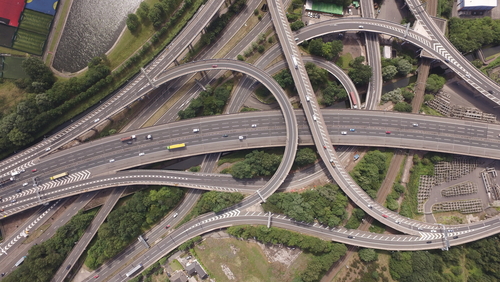
Gravelly Hill Interchange is famously known as “Spaghetti Junction.” It earned this nickname because, from an aerial view, the twisting roads look like a plate of pasta. It was one of the first major complex interchanges in the United Kingdom. While the nickname sounds funny, the design manages traffic for 18 different routes.
Urban Giants Built Under Extreme Pressure
In megacities, space is expensive and scarce. Engineers cannot simply buy more land to build a wide interchange. They must build around existing skyscrapers, rivers, and neighborhoods.
The Puxi Viaduct (Shanghai, China)
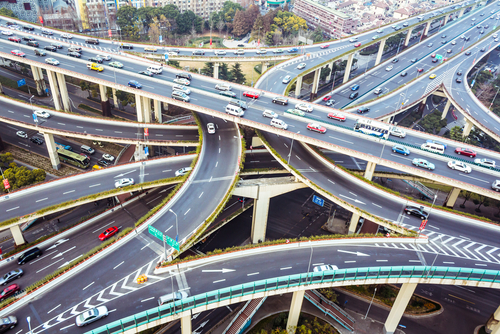
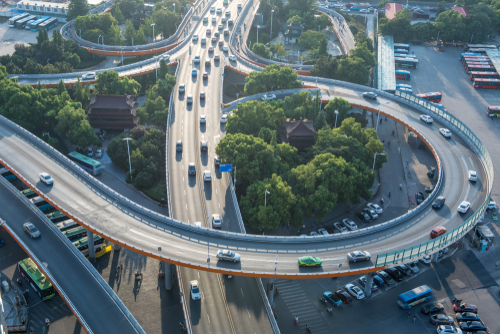
Shanghai is one of the most densely populated cities on Earth. The Puxi Viaduct is a massive interchange that handles traffic for thousands of commuters. It is located right in the middle of the city. At night, it is lit up with blue lights, turning the infrastructure into a city landmark. It shows how cities can adapt to handle millions of cars without stopping the flow of life below.
Balancing Efficiency and Community
Building these giants in a city requires tough choices. Engineers must balance the need for speed with the impact on the people living nearby. These interchanges often use sound barriers and clever routing to minimize noise and disruption for residents.
Interchanges Designed Around Geography
Sometimes, the land fights back. Engineers often have to build roads in places that are steep, wet, or prone to earthquakes.
The Kawazu-Nanadaru Loop Bridge (Japan)
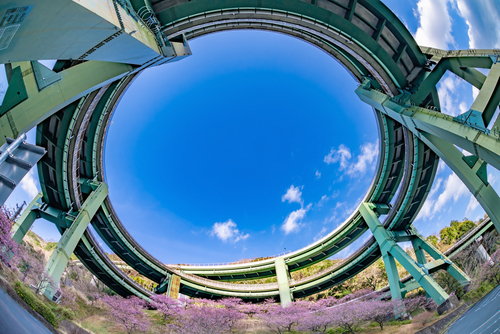
In mountainous regions, you cannot simply build a straight road up a steep hill. The grade would be too steep for cars and trucks. In Japan, engineers solved this with a double spiral loop. Drivers spiral upward on the road to gain elevation. It looks like a coil spring. This design is safer and prevents engines from overheating on a steep climb.
Earthquake Resistance
In places like Japan and California, interchanges must survive earthquakes. Engineers use special materials and flexible joints. This allows the concrete structures to sway slightly during a tremor instead of cracking. It is invisible safety engineering that keeps thousands of drivers safe every day.
Driver Experience: Navigating the Madness
Looking at these interchanges is one thing. Driving on them is another.
The Confusion Factor
For a local commuter, navigating a five-level stack is just part of the morning routine. For a visitor, it can be stressful. You have to make split-second decisions while driving at highway speeds. Missing an exit might mean adding 20 minutes to your trip.
The Role of Signage
Clear signs are the most important safety feature of any complex interchange. Engineers spend a lot of time deciding where to place signs so drivers have enough time to react. In recent years, GPS technology has also helped make these complex knots easier to navigate.
Safety First
Despite how scary they look, major interchanges are often safer than standard intersections. Because there are no traffic lights or cross-traffic, the risk of “T-bone” accidents is removed. The main risks are sideswipes from improper lane changes.
Criticism, Cost, and Controversy
Not everyone loves these massive structures. While they solve traffic problems, they come with downsides.
High Costs
Building a multi-level interchange costs hundreds of millions of dollars. They also require expensive maintenance. Bridges must be inspected, and concrete must be repaired.
Dividing Neighborhoods
Historically, large interchanges were sometimes built through low-income neighborhoods. This physically divided communities and lowered property values. Modern city planners are now much more careful about where they place these structures.
Environmental Impact
More lanes often encourage more driving. This is a concept called “induced demand.” Critics argue that building bigger interchanges just invites more cars, leading to more pollution.

Are Mega Interchanges Still the Future?
The era of building massive new interchanges may be slowing down in some parts of the world.
A Shift to Public Transport
Many cities are now prioritizing trains, subways, and buses. Moving people by mass transit takes up much less space than moving them in individual cars.
Smart Traffic Systems
Instead of building more concrete, cities are using technology. Artificial Intelligence (AI) can control speed limits and ramp meters to improve traffic flow on existing roads. This is often cheaper and faster than building new ramps.
Removal and Replacement
Some cities are even removing old highways to reclaim space for parks and housing. They are choosing walkable neighborhoods over high-speed car travel.
However, in growing economies where car ownership is rising, mega interchanges are still being built. They remain a necessary tool for connecting growing cities.
Beautiful, Baffling, and Unavoidable
Road interchanges are more than just concrete and asphalt. They are monuments to our desire to move. They represent our ability to overcome physical obstacles, whether it is a steep mountain or a crowded city center.
They can be beautiful, baffling, and sometimes frustrating. But they are a vital part of the modern world. The next time you find yourself flying along a ramp 100 feet in the air, take a moment to appreciate the engineering that keeps you moving.
Frequently Asked Questions
What is the biggest road interchange in the world?
It is difficult to name just one, as it depends on how you measure size. The “High Five” in Dallas is often cited for its height and complexity. The Gravelly Hill Interchange in the UK covers a massive amount of land area.
Why do some interchanges have spirals?
Spirals are used when roads need to change height quickly in a small space. It works like a spiral staircase. It allows cars to go up or down without the road being too steep.
Are stack interchanges dangerous?
Statistically, they are often safer than intersections with traffic lights because there is no cross-traffic. The biggest danger is drivers changing lanes suddenly if they are confused.
How do engineers decide which shape to use?
It depends on the land available, the number of intersecting roads, and the amount of traffic. A “cloverleaf” is cheap to build but can cause traffic jams. A “stack” is expensive but handles heavy traffic very well.
Meta Data
Meta title
8 of the World’s Most Complex Road Interchanges Explained
Meta description
From the “High Five” in Dallas to “Spaghetti Junction” in the UK, discover the engineering behind the world’s most complex road interchanges.