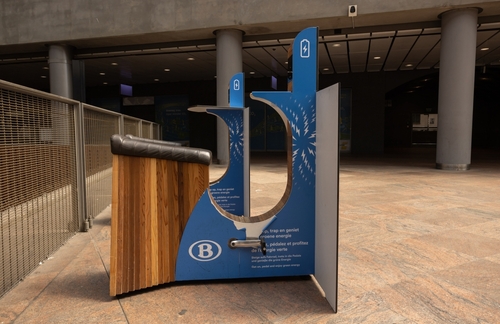

You’re at the airport. Your phone is at 8%. Every wall outlet within sight has someone camped next to it, and your flight boards in 45 minutes. Now picture this instead: you walk up to a stationary bike, plug in your phone, and start pedaling. No outlet needed. No scramble. Just you, generating your own power.
That’s not a hypothetical. It’s already happening at airports across the world.
Pedal-powered charging stations are one of those rare travel innovations that are both genuinely useful and surprisingly simple. They solve a near-universal travel frustration — the dead battery — without drawing a single watt from the grid. And as airports face mounting pressure to reduce their carbon footprint, these stations are quietly becoming part of a broader shift toward greener, more passenger-friendly design.
This post covers everything you need to know: how these stations work, which airports have them, and why this small idea matters more than it might seem.
What Are Pedal-Powered Charging Stations?
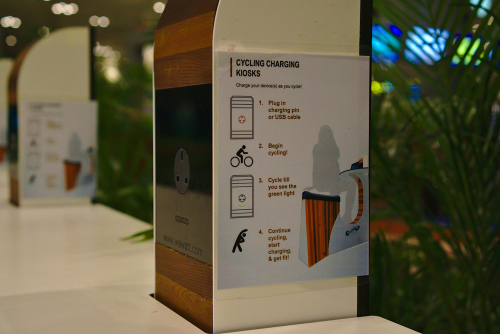
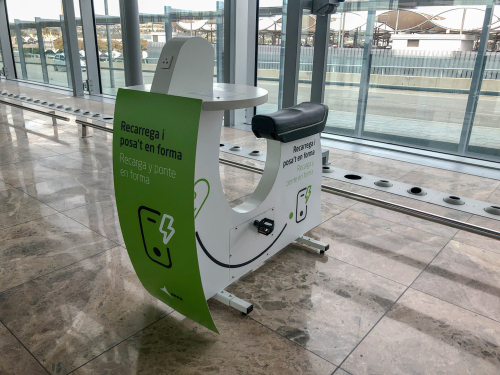
The concept is straightforward. You sit at a stationary bike connected to a dynamo — a small electrical generator — and pedal. The physical energy you produce gets converted into electricity, which flows directly to a USB or wireless charging port where your phone is plugged in.
The same basic technology has powered bicycle lights for over a century. Applied to phone charging, it works just as reliably.
Guanacaste Airport (LIR) in Liberia, Costa Rica, installed pedal stations in its East boarding lounge in January 2023, commissioned by airport operator Vinci Airports. Their stations, installed by Morpho Travel, generate 1% of an average phone’s battery charge per minute of pedaling. Spend 10 minutes on the bike and you’ll also burn up to 100 calories — not a bad use of a layover.
WeWatt, the Belgian company behind many of the world’s most widely deployed pedal charging units, reports that their stations can fully charge a smartphone in under 30 minutes.* According to Fast Company, 30 minutes of easy pedaling on a WeWatt unit takes roughly the same time as charging from a wall outlet. WeWatt has been building this technology since 2011, and their installations now span 20+ countries, with more than 2,000 units deployed worldwide.
Which Airports Have Them?
More airports than most travelers realize. Here’s where confirmed installations exist:
- Schiphol Airport, Amsterdam — One of the earliest and most prominent adopters. WeWatt’s cycling desks are stationed in waiting areas, letting passengers charge their devices and get light exercise while they wait for their flights.
- Guanacaste Airport (LIR), Liberia, Costa Rica — Installed by Vinci Airports in early 2023. The stations sit in the East boarding lounge, labeled with the phrase “movement is energy and energy is life.”
- Indianapolis International Airport (IND) — Features WeWatt human-powered charging kiosks on Concourse B, with four units installed throughout the terminal.
- Flagstaff Pulliam Airport, Arizona — Also equipped with human-powered charging stations.
- Long Beach Airport, California — Another US airport that has adopted the technology.
Beyond airports, railway stations across France and Belgium feature WeWatt cycling desks, so travelers on Eurostar or TGV routes may encounter them too.
The pattern is clear: airports with strong sustainability commitments tend to be early adopters. That’s not a coincidence — these stations serve as both a practical amenity and a visible signal of environmental intent.
How Do They Actually Work?
When you pedal, the dynamo converts rotational energy into electrical current. That current travels to the charging ports at the desk surface. The energy transfer is direct and immediate — there’s no storage delay between your effort and your device charging.
Vinci Airports describes their Costa Rica setup as using “dynamos connected to pedals” to generate energy through physical movement. Simple, reliable, and effective.
Some units take this a step further. Rock the Bike’s Recharge Station incorporates an ultracapacitor — a compact energy storage component — that can continue supplying charge for anywhere between 1 and 12 minutes after you stop pedaling, depending on how much surplus energy you put in. It’s a small but practical feature that prevents your device from cutting off the moment you pause to answer a question.
Charging speed is another common question. According to Smart Meetings, when pedaling at a consistent pace, the charging rate is comparable to a standard wall charger. The key word is consistent — pedaling in bursts slows things down. Maintain a steady rhythm, and you’ll match wall outlet speeds.
The physical effort involved is genuinely light. Rock the Bike notes that people can pedal comfortably in business attire without breaking a sweat, and that holding a full conversation while charging eight phones at once is entirely doable.
Why Are Airports Installing These — And Why Does It Matter?
The obvious answer is sustainability. Airports are large energy consumers, and many are under pressure — from regulators, passengers, and their own commitments — to find cleaner alternatives wherever possible.
Vinci Airports explicitly framed their Guanacaste installation as “a green solution to power generation” and a way to promote sustainable tourism. César Jaramillo, General Manager of Guanacaste Airport, put it directly: “We know that cell phones are part of our daily routine and that the time spent waiting for a flight can be used to charge them. This is how we implement innovative projects, as a pillar of VINCI Airports, that can add value to the experience of being in transit in our terminal and plant a seed of why sustainable tourism is the best option.”
WeWatt positions their product as generating real renewable energy on-site — including in off-grid locations where grid power simply isn’t available. That flexibility makes pedal stations relevant beyond airports, but it’s the airport use case that gets the most attention.
There’s also a wellness dimension. Katarina Verhaegen, the engineer who developed the WeWatt cycling desk, cited research in her conversations with Fast Company and NPR: “There are studies proving that gentle exercise while doing computer work, you’re more focused and more creative. Reading and memorizing speed is enhanced. For productivity, and creativity, it’s really good to do this.”
For frequent flyers who spend hours in transit, that’s not a trivial benefit. Light movement during long layovers has real effects on alertness and mood — and these stations make that movement effortless to access.
Airports also benefit from a passenger experience standpoint. The Indianapolis International installation generated notable organic social media attention — one passenger described it as “like fitting in a SoulCycle class while you scroll through Instagram.” That kind of positive word-of-mouth is hard to manufacture.
Practical Takeaways
If you’re passing through Schiphol, Guanacaste Airport, Indianapolis International, or Long Beach Airport, keep an eye out for the pedal stations. They’re worth using if your battery is running low and outlets are scarce.
To get the most from them:
- Pedal at a steady pace. Consistent pedaling delivers consistent charging. Aim for a relaxed, sustainable rhythm rather than short bursts.
- Start with a modest goal. If you’re at 20% battery, 15–20 minutes of steady pedaling will make a meaningful difference.
- Bring your own cable. Most stations offer USB ports, but wireless charging is available on some newer units. Having your cable on hand guarantees compatibility.
The Bigger Picture
Pedal-powered charging stations are a small idea with real staying power. They address a genuine problem — the dead battery scramble — while fitting neatly into airports’ broader sustainability goals and their passengers’ growing interest in wellness during travel.
The technology isn’t new. The application to airports, however, is still spreading. Most travelers haven’t seen one yet. That will change.
Next time you’re stuck at a gate with a dying phone, you might not need to battle a stranger for the last wall outlet. You might just need to start pedaling.
Frequently Asked Questions (FAQs)
How long does it take to charge your phone using a pedal-powered station?
At a relaxed, steady pedaling pace, you’ll add roughly 1% battery per minute. A full charge from zero takes around 30 minutes — similar to a wall outlet. The effort is light enough to read, scroll, or hold a conversation while you pedal.
Which airports currently have pedal-powered charging stations?
Confirmed installations include Schiphol Airport in Amsterdam, Guanacaste Airport (LIR) in Costa Rica, Indianapolis International Airport in Indiana, Flagstaff Pulliam Airport in Arizona, and Long Beach Airport in California. Several train stations across France and Belgium also feature these stations.
Do they charge as fast as a regular wall outlet?
When pedaling consistently, yes — manufacturers and users report comparable charging speeds to a standard wall charger. Maintaining a steady rhythm matters more than pedaling hard.
Are these stations free to use?
In all reported airport cases, yes. They are a free passenger amenity available to anyone in the terminal.
*This article may reference third-party products, services, brands, or websites for informational purposes only. Such references do not constitute an endorsement, sponsorship, or recommendation by Remitly. All third-party names, trademarks, and brands are the property of their respective owners. Remitly is not responsible for the accuracy, legality, or content of external third-party websites or materials.