
Europe is older than its cathedrals. Long before the great medieval churches, before the Roman Empire, before classical Greece, people were building structures across this continent that have survived thousands of years, and in some cases tens of thousands. Many are still standing today.
What counts as a building is worth clarifying. Archaeologists typically require a structure to have walls, an enclosed area, and to rise to a meaningful height, so standing stones and open stone circles generally don’t qualify. What remains within those boundaries is extraordinary: Neolithic villages preserved beneath Scottish soil, passage tombs in Ireland older than the pyramids, temples in Malta that predate writing itself, and Roman structures that have been in continuous use for nearly two millennia.
Here are some of the oldest buildings in Europe that are still standing and still telling their stories.
The Megalithic Temples of Malta — c. 3600–2500 BCE
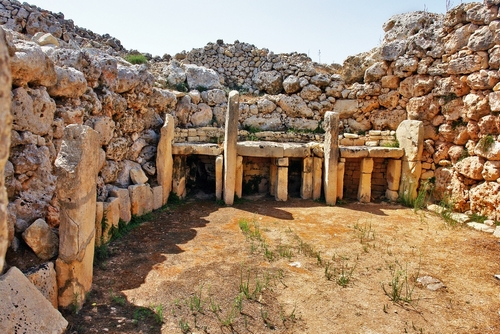
If there is one title that belongs to any single site, it belongs here. The Megalithic Temples of Malta rank among the earliest free-standing stone buildings in the world, with construction beginning around 3500 BCE. They predate both the Great Pyramids of Egypt and Stonehenge by centuries, and they were built without metal tools or the wheel.
Spread across the islands of Malta and Gozo, the temples number seven in total, each the result of an individual development. The Ġgantija temples on Gozo are the oldest of the complex, dating to between 3600 and 3200 BCE. They take their name from the Maltese word for “giant”, because local legend held they were built by mythical giants. The massive limestone blocks used in their construction make the legend understandable.
Six of the seven temples are designated UNESCO World Heritage Sites, remarkable not only for their age but for their diversity of form, decoration, and the sheer technical skill required to build them. The Tarxien complex contains intricate stone carvings. The Mnajdra temple is aligned with the sunrise during the equinoxes and solstices. Each temple is a unique architectural achievement, and together they represent one of the most extraordinary concentrations of prehistoric architecture anywhere on Earth.
Location: Malta and Gozo, Malta
Approximate age: Over 5,500 years
Newgrange, Ireland — c. 3200 BCE
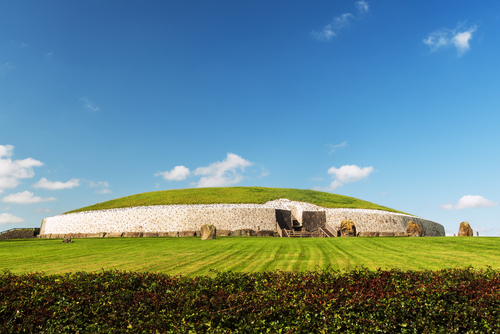
Built around 3,200 BCE, Newgrange in County Meath is 1,000 years older than Stonehenge and approximately 600 years older than the Great Pyramids of Giza. It is a passage tomb, a large circular mound with a stone-lined corridor leading to a central burial chamber, and one of the most technically sophisticated prehistoric structures in Europe.
The most remarkable feature of Newgrange is its astronomical precision. Every year during the winter solstice, between December 19 and 23, sunlight enters through a carefully positioned roofbox above the entrance and illuminates the entire inner chamber for exactly 17 minutes. This was not accidental. It required generations of astronomical knowledge and extraordinary engineering to achieve.
Newgrange is now considered “the great national monument of Ireland” by archaeologists, and alongside its sister sites Knowth and Dowth it forms the Brú na Bóinne UNESCO World Heritage Site. Around 200,000 people visit each year, and each winter solstice approximately 30,000 people apply by lottery for the 100 places available inside the chamber at dawn.
Location: County Meath, Ireland
Approximate age: Over 5,200 years
Skara Brae, Scotland — c. 3180–2500 BCE
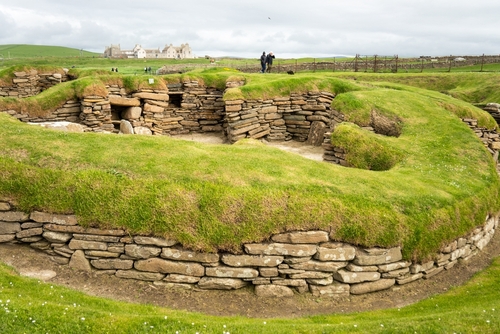
Skara Brae on the Orkney Islands is Europe’s most complete Neolithic village, occupied from roughly 3180 BCE to around 2500 BCE, making it older than both Stonehenge and the Great Pyramids. It has been called the “Scottish Pompeii” not because of volcanic destruction, but because it is preserved in similarly remarkable detail. Its ten clustered stone houses still contain their original furniture: stone beds, stone dressers, stone hearths, and storage recesses, all built from local flagstones.
The village was buried and forgotten for thousands of years beneath a grassy mound, until a severe storm in 1850 stripped away the covering and revealed the structures below. What emerged was extraordinary: a community of around 50 people living in interconnected underground dwellings, with a drainage system that included something resembling primitive toilets.
Each house is laid out to the same basic pattern: a single large square room with a central fireplace, a dresser facing the entrance, and beds built into the walls on either side. One structure contains no beds and appears to have served a ritual purpose. Like many things about Skara Brae, its exact significance remains unknown.
Location: Orkney Islands, Scotland
Approximate age: Over 5,000 years
The Cairn of Barnenez, France — c. 4500–4200 BCE
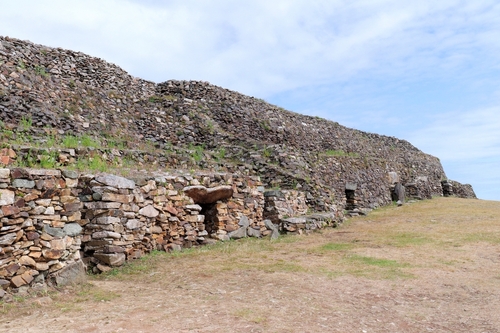
At over six and a half thousand years old, the Cairn of Barnenez in Brittany predates even the Great Pyramids of Giza. It is one of the oldest pieces of construction in the world: a massive stone mausoleum containing eleven passage tombs, built in two phases by communities who lived and died on the northern coast of what is now France millennia before any written record.
The cairn was formed by layering and slotting flat stones into a stepped structure that stretches roughly 72 metres in length. Excavations have revealed Neolithic pottery, tools, and carved symbols within its chambers. Tragically, part of the monument was damaged in the mid-20th century when it was used as a quarry. The stones had survived 6,000 years of history, only to be broken up for road construction. Ownership was transferred to the French government in the late 1950s, and what remains is now protected.
Location: Plouézoc’h, Brittany, France
Approximate age: Over 6,000 years
The Pantheon, Rome — 125 CE
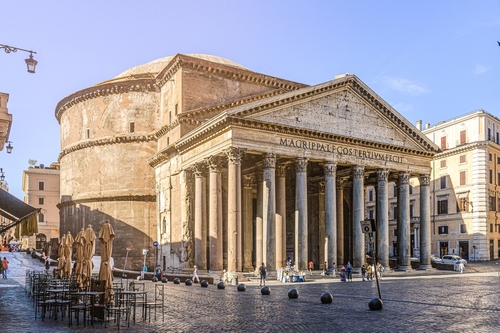
The Pantheon is not the oldest building in Europe, but it may be the most astonishing in terms of continuous use. Built during the reign of Emperor Hadrian around 117–125 CE, it has been in almost uninterrupted use for nearly two millennia: first as a Roman temple, then as a Christian church, and now as a museum and active Catholic place of worship. It is arguably the best-preserved ancient building in the world.
The dome of the Pantheon remained the largest in the world for more than 1,300 years after its construction. Its famous oculus, the circular opening at the apex, is still the building’s only source of natural light, flooding the interior with a moving circle of sunlight that traces the hours. The concrete used in its construction was so advanced that engineers and materials scientists still study its composition today, trying to understand how it has lasted so long.
An earlier temple on the same site was destroyed by fire in 80 CE, and Domitian rebuilt it before that too burned. Hadrian’s version is what stands today: two thousand years of Rome, still standing, still receiving visitors, still holding Mass on Sundays.
Location: Rome, Italy
Approximate age: Approximately 1,900 years
The Palace of Knossos, Crete — c. 1900 BCE
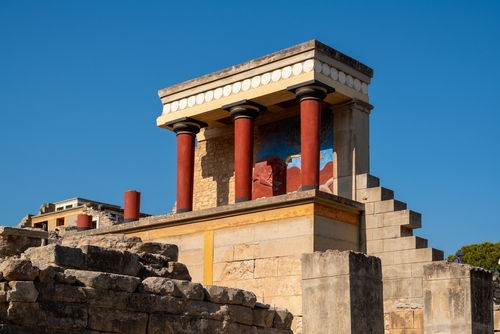
Dating back to around 1900 BCE, the Palace of Knossos on Crete was the ceremonial and political centre of the Minoan civilisation, often considered Europe’s first advanced society. Its ruins are among the most extraordinary in Europe, covering an area of approximately 150,000 square metres and revealing a level of architectural sophistication that seems improbable for its era.
The palace featured multi-storey buildings, sophisticated drainage systems, storage chambers, throne rooms, and frescoed walls depicting scenes of sport, ceremony, and daily life. It is the birthplace of the Minotaur legend, or rather, the real palace that inspired it, with its labyrinthine corridors and bull-worship iconography feeding centuries of Greek mythology.
The site was excavated and controversially reconstructed in the early 20th century by British archaeologist Arthur Evans, whose restorations, painted in vivid colours and supported with modern concrete, remain a source of debate among scholars. But even without Evans’s additions, the underlying structures are genuinely ancient and genuinely remarkable.
Location: Near Heraklion, Crete, Greece
Approximate age: Approximately 3,900 years
The Parthenon, Athens — 447–432 BCE
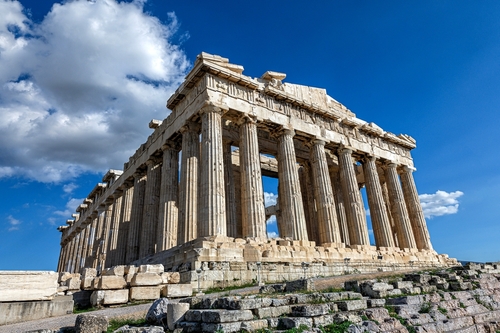
Built between 447 and 432 BCE during the Golden Age of Athens, the Parthenon is the crowning glory of the Acropolis and one of the most recognisable buildings ever constructed. Dedicated to Athena, goddess of wisdom and patron of the city, it was built at the height of Athenian imperial power and remains the definitive example of Doric architecture: precise, harmonious, and apparently simple, though deceptively sophisticated in its details.
Every horizontal surface in the Parthenon curves slightly upward toward the centre. Every column tapers and tilts slightly inward. These subtle optical corrections were built in deliberately to counteract the illusion of sagging that perfectly straight lines create at scale. The result is a building that looks more geometrically perfect than geometry itself allows.
The Parthenon has been a temple, a church, a mosque, and a gunpowder magazine. It was largely destroyed in 1687 when an explosion during a Venetian bombardment detonated the stored Ottoman munitions inside. The Greek government has been restoring it ever since, and the debate over its famous sculptures, removed to London by Lord Elgin in the early 19th century, continues to this day.
Location: Athens, Greece
Approximate age: Approximately 2,470 years
Maeshowe, Orkney — c. 2800 BCE
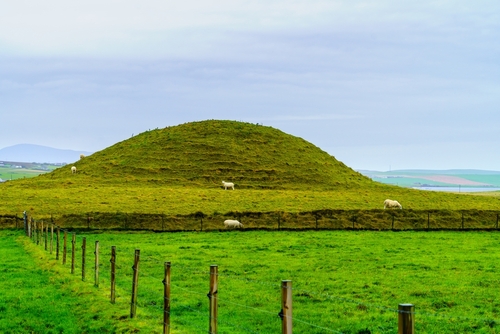
Maeshowe is a particularly well-preserved passage tomb on the Orkney Islands, built as a burial place with a sloping passage leading to a central chamber. It is remarkable for two distinct reasons separated by thousands of years. First, for the sophisticated Neolithic engineering of its construction, with massive flat stones fitted together so precisely that mortar was unnecessary. Second, for the Norse rune inscriptions carved into its interior walls by Vikings who broke in during the 12th century CE. These represent some of the largest collections of runic inscriptions found anywhere, and include, among more solemn epitaphs, what appears to be ancient graffiti boasting about buried treasure.
Maeshowe is also aligned with the setting sun at the winter solstice, when sunlight penetrates the passage and illuminates the back wall of the chamber. Like Newgrange in Ireland, this was almost certainly intentional: an astronomical calendar built into stone.
Location: Orkney Islands, Scotland
Approximate age: Approximately 4,800 years
What These Buildings Tell Us
Across thousands of years and dozens of cultures, the buildings on this list share something: they were built to last. The Neolithic communities who constructed Newgrange, Skara Brae, and the Maltese temples had no written language, no metal tools, and no wheeled transport, and yet they built structures that have stood for longer than recorded history.
The Romans built their temples and public buildings with a different intent: to project power, celebrate divinity, and anchor an empire. What they built in concrete and marble has proved equally durable.
That so many of these structures survive at all is partly luck. Burial beneath protective soil, placement on remote islands, the accident of remaining useful in successive civilisations. But it is also a testament to the quality of what was built. These were not temporary shelters. They were statements about community, belief, ambition, and the desire to leave something behind.
Frequently Asked Questions (FAQs)
What is the oldest building in Europe?
The Megalithic Temples of Malta are widely considered the oldest free-standing buildings in Europe and among the oldest in the world. Construction began around 3600 BCE, making them over 5,500 years old. They predate Stonehenge and the Egyptian pyramids and are designated UNESCO World Heritage Sites.
Is Newgrange older than the pyramids?
Yes. Newgrange in County Meath, Ireland was built around 3,200 BCE, approximately 600 years before the oldest pyramids of Giza and 1,000 years before Stonehenge.
What is the oldest continuously used building in Europe?
The Pantheon in Rome is a strong contender. Built around 125 CE under the Emperor Hadrian, it has been in almost continuous use for nearly 1,900 years: first as a Roman temple, then as a church, and now as a museum and active place of Catholic worship.
How were these ancient buildings preserved for so long?
Preservation varies by site. Many of the oldest Neolithic structures survived because they were buried beneath soil or midden material for thousands of years, protected from the elements. Others, like the Pantheon, survived because they remained in active use, since a building in use tends to be maintained. Remote locations, as in the case of the Orkney Islands sites, also helped limit both damage and disturbance.
Can you visit these ancient European buildings?
Most of them, yes. The Megalithic Temples of Malta, Newgrange, Skara Brae, Knossos, the Parthenon, the Pantheon, and Maeshowe are all open to visitors. Some, like Newgrange during the winter solstice, require advance booking due to limited access.
Were these ancient buildings built by the same civilization?
No. The sites on this list span thousands of years and dozens of distinct cultures: from unnamed Neolithic communities in Ireland and Scotland, to the Tarxien temple builders of Malta, to Minoan Crete, to the Classical Greeks, to Imperial Rome. What they share is not origin but ambition: the desire to build something permanent.