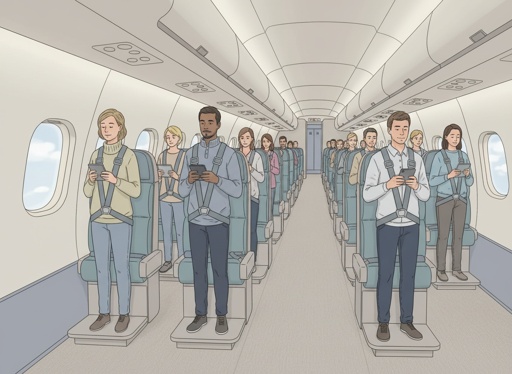

If you’ve spent time on a plane recently, you’ve probably noticed just how tight air travel can feel. Seats are closer together, legroom is limited, and ticket prices can vary wildly depending on when and where you’re flying. If you’re traveling to visit family, see the sights back home, or build a new life in a new country, those costs and discomforts can add up quickly.
Airlines and airplane designers have explored the concept of standing seats, sometimes called vertical seating, as a way to increase capacity and potentially lower fares. If the idea of flying while partially standing raises questions about comfort, dignity, and safety, you’re not alone in wondering what this could mean for real travelers.
In this Remitly guide, we’ll break down what standing seats actually are, why airlines are considering them, how aviation safety rules come into play, and whether this is something you’re likely to encounter when booking a flight. By the end, you’ll understand what’s real, what’s still under consideration, and what this could mean for your travel plans.
What are standing seats?
When we talk about standing seats on airplanes, it’s usually referring to a semi-standing or perched seating design, not passengers standing freely in the aisle. They are also known as vertical seats, and they support part of your body weight while keeping you upright.
How standing seats are designed
Most designs look quite different from traditional airplane seats. Instead of a wide cushion, armrests, and a full backrest, standing seats are built around a narrow, padded saddle, often compared to a bicycle seat, that supports part of your weight while helping you stay vertical.
Instead of settling fully into a seat, you’d lean slightly forward or backward, with your legs supporting some of your weight. A small backrest provides some stability, while a harness or set of straps helps keep your upper body secure during takeoff, landing, and in cases of turbulence. The idea isn’t that you’d be standing freely, but remain safe and supported in a fixed position.
Who designed them?
One of the most widely discussed designs comes from Aviointeriors, an Italy-based aircraft seating manufacturer. Their design, called the SkyRider, was first introduced as a concept in 2012 and has since been featured several times at aviation trade shows around the world.
Aviointeriors designed the SkyRider to reduce the distance between rows, allowing more passengers to fit into the same cabin space. Because it has been displayed repeatedly over the years, images of the seat often resurface online, sometimes giving the impression that it’s a new or for-launch product.
Aviointeriors has since clarified that the SkyRider isn’t part of its current product lineup and was never intended to be a ready-to-install airline seat. It was simply a design exercise, a way to explore ideas rather than a finalized seat meant for commercial flights.
Pros and cons of standing seats
Because this design takes up less space from front to back, rows could be placed closer together than with traditional seating. Airlines can pack in more passengers, boosting profits.
At the same time, this upright posture would feel very different from sitting as you’re used to, especially over longer periods. It’s one reason why standing seats are usually discussed only for short flights.
It’s also worth noting what proponents of these seats typically leave out: there’s little room for personal storage, no tray table in the usual sense, and limited ability to shift positions. And while the design focuses on maximizing space, it also offers less flexibility and comfort than standard economy seating—a trade-off that influences how travelers and regulators feel about the idea.
Why are airlines considering this?
The push for standing seats isn’t really about changing the flying experience just for the sake of it. It actually provides several benefits for air carriers:
Increased passenger capacity
Airlines carefully plan how to use the limited space inside an aircraft. Every row, seat, and aisle is planned with safety and efficiency in mind. Standing seats appeal to some because they could allow more passengers on a single flight.
Designers estimate that vertical seating could increase passenger capacity by around 20%, depending on the aircraft and configuration. For airlines operating popular short routes, such as flights between nearby cities or countries, higher capacity can make a meaningful difference in operating costs.
For example, a short-haul aircraft that typically seats 180 passengers might theoretically be able to carry over 200 passengers with vertical seating. More passengers per flight can help bring overall costs down.
Lower fares
For travelers with tight travel budgets, airfare is often one of the biggest expenses. This is especially true for frequent flyers who support family obligations across borders or maintain ties to more than one country.
Advocates for standing seats suggest that higher passenger capacity could lead to lower-priced plane tickets, particularly on flights under an hour. These seats would likely be optional, offered alongside traditional economy seating rather than replacing it entirely.
While there’s no confirmed pricing model, some proponents suggest standing-seat tickets could cost significantly less than standard economy fares. That idea naturally attracts attention, especially when travel costs feel unpredictable.
Improved operational efficiency
From an airline’s perspective, short flights are often about volume. Planes have to take off, land, and turn around quickly. If more passengers can be transported efficiently, routes may become easier to sustain.
That said, efficiency alone doesn’t determine whether an idea moves forward. Airline interiors are among the most tightly regulated parts of air transport, and every potential benefit must be balanced against safety, comfort, and public acceptance.
Are standing seats safe?
Safety is the biggest and most important concern, and it’s also the main reason standing seats remain just a concept rather than a standard option.
Regulatory approval hasn’t happened yet
As of now, no standing seat design has been approved by the Federal Aviation Administration (FAA) or the European Union Aviation Safety Agency (EASA). European regulators have also confirmed that they haven’t received any applications for vertical or semi-standing seating designs.
Without approval from regulators, airlines cannot legally install or use standing seats on commercial flights.
This approval process is neither quick nor simple. Aircraft seats must undergo extensive testing to prove they protect passengers not just during routine flight, but also in emergency situations. That’s why new seating options often take years, or even decades, to move from concept to reality.
Key safety challenges
Several unanswered safety questions make approval difficult.
- Emergency brace position
In an emergency landing or crash scenario, passengers must be able to assume a brace position that reduces the risk of injury. Traditional seats allow people to bend forward and protect their head and upper body, but it’s not yet clear how a safe, effective brace position would work in a semi-standing posture.
- Emergency requirements
Aviation rules require that a fully loaded aircraft can be evacuated in 90 seconds, even if some exits are blocked. Regulators need to be confident that harnesses can be released quickly, upright seating won’t slow movement, and increased passenger density doesn’t create bottlenecks. Even small delays can make a design unacceptable.
- Turbulence protection
Severe turbulence can happen without much warning. Seats and restraints need to protect passengers’ heads, necks, and spines during sudden movement. With more weight placed on the legs at a different body angle, designers must show that standing seats can provide the same level of protection as traditional seats.
Why the process takes time
Aviation safety standards are intentionally strict. While this can feel frustrating when innovation seems slow, those rules are a big part of why air travel is widely considered one of the safest ways to travel long distances.
Until standing seat designs can meet every requirement and prove they do so consistently, they’re likely to remain a concept rather than a real option on flights.
Will you actually see standing seats on planes?
Given how often the idea appears in news stories, it’s fair to wonder whether standing seats are just around the corner. For now, it appears unlikely. While the idea gets a lot of attention, it hasn’t moved from design displays to real aircraft cabins yet.
Why the idea keeps coming back
Standing seats tend to resurface when pressure on air travel becomes more visible: when airlines talk about rising operating costs, when aviation trade shows showcase new design concepts, or when frustration over shrinking legroom grows, this conversation often starts back up again.
However, standing seat designs give airlines and manufacturers a way to explore what might be possible someday and to see how travelers react to the idea. In many cases, the goal isn’t immediate adoption, but discussion.
Practical limitations
If standing seats ever received regulatory approval, their use would likely be very limited. You’d most likely see them on short flights, where time in the air is measured in minutes rather than hours.
Plus, they would almost certainly be optional, offered alongside traditional seats rather than replacing them entirely. This option would appeal to travelers who are willing to trade some comfort for a lower fare on a very short flight.
That said, longer routes, overnight flights, or international journeys wouldn’t be practical settings for vertical seating.
Public acceptance
Safety rules are only part of the equation. Airlines also pay close attention to how you experience a flight. Many travelers already find flying tiring, especially when balancing work, family responsibilities, and long distances between countries. For some, even getting a little rest on a plane can make a big difference, something that would be far more difficult in a semi-standing position.
Stand-up seats raise real questions about fatigue, accessibility, and overall comfort, concerns airlines can’t ignore. How people feel during and after a flight plays a meaningful role in whether any new seating idea moves forward.
What this means for future flights
Standing seats on airplanes are one of the most debated ideas in modern aviation. While they’re often discussed as a way to fit more passengers on flights and potentially lower fares, these vertical seating concepts come with significant challenges.
Regulators haven’t approved stand-up seats. Safety concerns around emergency preparedness, evacuation, and turbulence protection have kept them from moving forward. While designers continue to explore new ideas, there’s no indication that standing seats will become a common feature of commercial flights anytime soon.
For travelers, that means the flying experience you’re familiar with is unlikely to change dramatically in the near future. While airlines will keep looking for ways to manage costs and offer affordable options, they continue to put passenger safety first.
FAQs
What is a standing seat on an airplane?
A standing seat is a proposed type of airplane seating where passengers are in a semi-standing or perched position, rather than fully seated in a traditional seat.
Have any airlines started using standing seats?
No. Some low-cost airlines have expressed interest, but no standing seat designs have been approved or used on commercial flights.
Why haven’t standing seats been approved?
The main concerns include passenger safety during emergencies, evacuation speed, protection during turbulence, and the ability to meet strict aviation safety regulations.
How much cheaper would a standing seat ticket be?
The exact amount is unclear, but some proponents suggest fares could be significantly lower than standard economy tickets on short-haul flights.