
Ever wondered, “Do I need a passport to go to Canada if I have a REAL ID?” Your confusion is understandable. The rules around international travel sometimes change and can be unclear. While a REAL ID is valid for domestic US flights and access to some federal facilities, international travel is a different story.
At Remitly, we want to make it easier for you to see more of the world. In this guide, we’ll break down exactly what you need to visit Canada from the United States (US), examine the key differences between a REAL ID and a passport, so you can travel with confidence.
Understanding REAL ID: what it can and can’t do
The US introduced REAL ID in 2005, setting new standards for driver’s licenses and identification (ID) cards. So, REAL ID is more of a standard than a specific piece of identification.
Your driver’s license could be a REAL ID, but so could a state identification card. If it is, you’ll see a REAL ID star in the top right-hand corner of your ID card.
As of May 7, 2025, REAL ID became mandatory to board domestic flights within the US or to enter federal buildings.
But although it allows you to get on a domestic flight, it’s not a valid travel document for international trips. That means you can’t use it to get into Canada, Mexico, or any other foreign country. Even if you’re just driving into Canada for the day, passport requirements still apply.
A REAL ID-compliant license ID card isn’t enough because it does not prove US citizenship or legal status. It only proves your identity.
If you’re traveling to Canada, you’ll need additional documentation depending on how you’re getting there. If you’re flying, you’ll need a valid US passport for all travelers, including children. If you’re driving over the border, you can also use a passport card, an Enhanced Driver’s License (EDL) from certain states, or a Trusted Travel Program card like NEXUS.
These documents satisfy both Canadian and US border entry requirements for those traveling by road.
| Document type | Purpose | Accepted for Canada travel? | Notes |
| REAL ID | Domestic flights, federal facilities | No | Not valid for crossing international borders |
| US passport | International air, land, or sea travel | Yes | Required for air travel; also valid by land or sea |
| Passport card | Land and sea travel to Canada, Mexico, the Caribbean, and Bermuda | Yes | Not valid for air travel |
| Enhanced Driver’s License (EDL) | Land and sea travel to Canada | Yes | Only available in certain US states |
| Trusted traveler card (NEXUS, SENTRI, FAST) | Expedited border crossings | Yes | Must be used at designated lanes or kiosks |
Ultimately, a REAL ID can improve convenience for domestic travel, but it doesn’t replace the need for a passport. Getting a REAL ID for travel to Canada won’t work. A passport is still your best bet for traveling internationally. Always confirm your Canada travel documents before your trip to make sure you have a smooth entry into the country and back into the US.
We’ll get into this in more detail below.
Passport requirements for travel to Canada
A valid US passport is still the most reliable and widely accepted travel document for Canada, along with anywhere else in the world. But there are other options, depending on how you’re traveling.
To fly into Canada
For a flight, you should have a passport book for everyone who is traveling, including children and infants. A passport card is not enough if you plan to fly.
Canadian immigration officers will not let you into the country if you don’t have the right ID, and you probably won’t even get that far. Generally, airlines will check your identification before you leave, and if you don’t meet the passport requirements Canada has in place, they won’t allow you to get on your flight.
To drive or sail to Canada
The rules are slightly different for travel by land or sea. If you’re driving over the border into Canada, you can use a passport card. You can also use an Enhanced Driver’s License issued by Michigan, Minnesota, New York, Vermont, or Washington.
Trusted Travel Program cards like NEXUS make things even easier. With a NEXUS card, you can drive right through the designated lane at the border and show your card to the automatic reader. You probably won’t even have to talk to anyone. However, remember that to use this program, everyone in your vehicle must be a NEXUS member.
The same also applies if you enter Canada by boat. So if you’re taking a cruise to Alaska and stopping off in Vancouver, a passport card or EDL is enough to confirm your identity and citizenship.
Holding a valid passport makes all of this simpler, because it’s accepted no matter what method of travel you use. If you want the smoothest entry to Canada and back into the US, a valid passport complies with all the rules, so you don’t have to worry about different standards for different methods of travel.
Alternative documents: passport cards and enhanced IDs
A valid US passport might be the gold standard for travel to Canada. But not everyone has a passport, and if you’re not a frequent traveler, you may feel you don’t need one.
Let’s take a look at some of the alternative documents you can use to visit Canada without a passport. Each method has its limitations, so make sure you fully understand when it can and can’t be used before you start your journey.
Passport cards
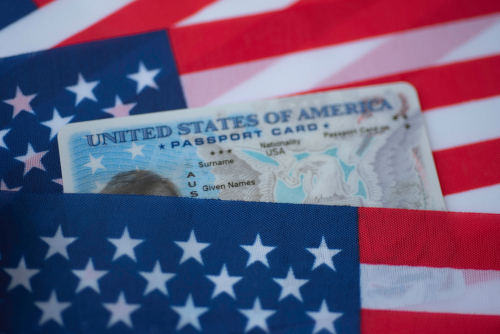
A US passport card is a wallet-sized version of a traditional passport book. Issued by the US Department of State, they serve as official proof of both identity and US citizenship. They meet the passport requirements Canada has established and allow you to enter the country by road or sea.
Pros
- Valid for road and sea entry
- Cheaper than a passport book
- More portable and harder to damage than a passport book
Cons
- Not valid for international air travel
- Only valid for land and sea travel to Canada, Mexico, Bermuda, and the Caribbean
- Application takes a similar length of time to a passport book—around four to six weeks for standard processing.
Enhanced Driver’s Licenses (EDLs)
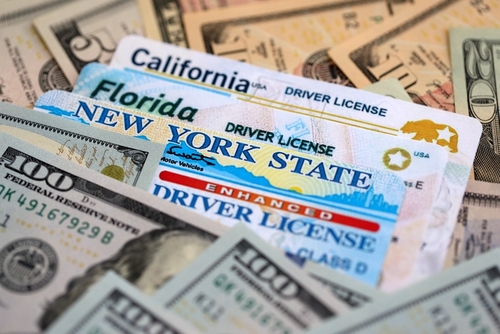
An EDL is a great solution for people who frequently enter Canada by road. They are issued in most US states that share a border with Canada: Michigan, Minnesota, New York, Vermont, and Washington.
The cost and processing time for these vary depending on your state. In general, they cost around USD $30-$50 more than a regular driver’s license, and the processing time is usually two to six weeks.
Pros
- Since it’s also your driver’s license, it means you need one less piece of ID
- Meets Canadian passport requirements
- Cheaper than a passport
Cons
- More expensive than a regular driver’s license
- Must be renewed every few years, depending on the policies of your state.
NEXUS Card
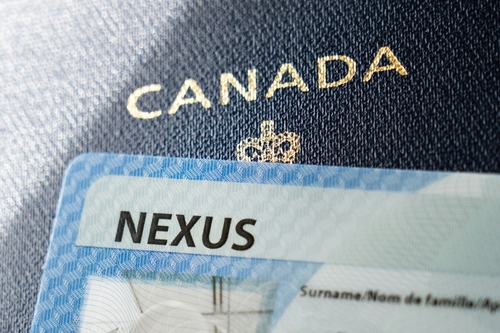
Probably the easiest way to enter Canada—whether you fly, drive, or sail—is with a NEXUS Card. This scheme was specifically set up to make travel easier for people who cross the border frequently.
However, to get a NEXUS card, you need a valid passport in the first place.
It can take from 12 to 24 months to qualify for this program, and comes with a processing fee of USD $120 per adult applicant. Once you have your card, you’ll be able to use designated travel lanes with expedited customs processes. But because of the cost and time frame involved, it’s really only useful if you intend to make frequent border crossings.
Pros
- Expedited travel lanes
- Reduced customs checks
Cons
- More expensive than other IDs
- Requires a valid passport
- Long application time
Special considerations and exceptions
Getting the travel documents Canada requires is usually straightforward. However, some special cases are easy to overlook. Knowing the rules in advance can help avoid stressful surprises at the border.
Minors traveling to Canada
For children under 18 traveling by land or sea, a passport is still recommended. But you can use a combination of documents that show the child’s full name, date of birth, and citizenship status. This includes:
- Birth certificate
- Certificate of citizenship or naturalization
- Certificate of Indian status
Remember that photo ID will be required along with these documents, so make sure you have it for each child.
You may also be asked to prove your legal custody of the child, so bring any legal custody documents with you. If you share custody with another parent or guardian, try to get a consent letter that includes the full name, address, and telephone number of the other parent or guardian. Customs officers will often check with the other parent, so make sure you keep them fully informed.
Cruise passengers
Cruise travel follows slightly different requirements, depending on the itinerary. If you’re taking a closed-loop cruise—one that begins and ends in the same US port—you can use a passport card, EDL, or even a combination of a birth certificate and a government-issued photo ID to travel through Canadian waters.
Remember, though, that if the cruise ends in a different port from the one it starts from, it’s not a closed-loop cruise. That’s true even if both ports are in the US. For example, if you cruise from Los Angeles to Alaska, you’re not taking a closed-loop cruise, and you’ll need to carry a valid passport with you.
Realizing you have the wrong documentation
If you reach the border or the airport and find out that your REAL ID or driver’s license isn’t enough to let you into Canada, you’ll most likely be denied entry. Border agents cannot make exceptions to the rules, no matter what reason you may have.
Emergencies
If you absolutely need to cross the border in a hurry, the US Department of State offers expedited passport processing. It takes two to three weeks to get a passport this way.
You can get a passport within 14 days if you can prove that you have international travel already booked. There’s also a 72-hour service for life or death emergencies.
Plan your Canada trip with confidence
Now you know that a REAL ID is not enough to travel to Canada by itself. The best document will always be a valid passport, as it works for air, land, and sea travel. However, if you aren’t flying, you can also use an EDL, a passport card, or some other forms of ID to enter Canada.
Get your documents in order well before you travel, and you won’t be surprised at the border, and you can enjoy the Great White North more easily.
FAQs
Can I use my REAL ID to fly to Canada?
No. REAL ID is only valid for domestic flights within the US. Flights into Canada require a valid passport or other documentation proving citizenship.
What’s the difference between a passport book and passport card for Canada travel?
A passport book and a passport card have the same information. Both meet the passport requirements Canada has established. However, passport cards are not valid for international travel by air. A passport card lets you into Canada by road or sea, but not by air.
Do children need passports to travel to Canada?
Children under the age of 18 can enter Canada with a birth certificate or certificates of citizenship or naturalization to prove their US citizenship, combined with a photo ID to prove their identity. However, this only applies to those entering Canada by road or sea. To fly into Canada, everyone needs a full passport, including children.
Can I drive to Canada with just an Enhanced Driver’s License?
Yes. Enhanced Driver’s Licenses demonstrate your citizenship and your identification, and are valid for travel into Canada by road.
What should I do if my passport expires while I’m in Canada?
If your passport expires while you’re in Canada, visit the nearest US embassy or consulate. You’ll find one in every major city in Canada, and they can issue a limited emergency passport that’ll allow you to return to the US.
How long does it take to get a passport for Canada travel?
The current processing time for a US passport is four to six weeks. It’s also possible to pay extra for an expedited service that takes around two to three weeks. In emergencies, you can apply to get a passport within 14 calendar days, or even within 72 hours if there’s a life or death emergency.