

In Japan, how you say hello often matters more than what you say. A greeting is rarely just a greeting—it signals respect, social awareness, and an understanding of your relationship with the person in front of you.
Japanese greetings shift depending on who you’re speaking to, what time of day it is, and whether you’re at work or among close friends. There is no single phrase that works in every situation, and using the wrong one—even with good intentions—can come across as awkward or disrespectful.
The good news? Once you understand the logic behind Japanese greetings, the patterns become clear. This guide covers the essential phrases, when to use them, and the cultural context that makes them land correctly. By the end, you’ll have practical phrases for everyday situations, cultural tips to avoid common missteps, and the confidence to greet people the right way.
The Most Common Japanese Greeting: こんにちは (Konnichiwa)
Most Japanese learners start here, and for good reason. Konnichiwa (こんにちは) is Japan’s closest equivalent to a general “hello”—but it comes with important boundaries.
What it means
The word is historically tied to the phrase konnichi wa gokigen ikaga desu ka (“How are you feeling today?”). Over time, it was shortened to just konnichiwa, meaning something close to “good day.”
When to use it
Use konnichiwa from late morning through early evening—roughly 10 AM to 6 PM. It suits semi-formal situations: with coworkers you don’t know well, acquaintances, shopkeepers, or anyone you’d greet politely but not warmly.
When not to use it
Avoid it with close friends, as it can feel stiff. It’s also not appropriate late at night.
How to pronounce it
Break it down as kon-ni-chi-wa. One thing catches many learners off guard: the は character at the end is normally pronounced “ha,” but here it’s read as “wa.” This is a quirk of older Japanese spelling that stuck.
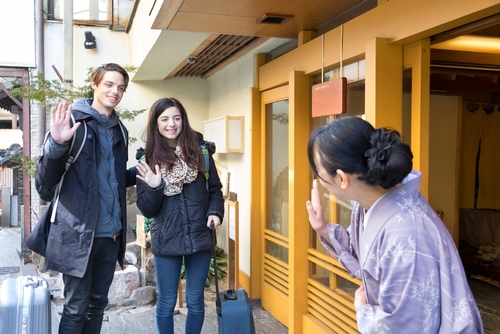
Casual Ways to Say Hello (Friends & Peers)
Among friends and peers, Japanese greetings become shorter, looser, and sometimes optional altogether.
やあ (Yā) — Light and friendly, similar to “hey.” More commonly used by men in casual settings.
どうも (Dōmo) — One of the most versatile words in Japanese. Depending on tone and context, it can mean hi, thanks, or even a brief apology. It’s a social shorthand that native speakers rely on constantly.
おーい (Ōi) — Used to call out to someone across a distance. Be careful with this one—it can sound rude or overly familiar if directed at a stranger or superior.
Cultural insight: Japanese friends often skip formal greetings entirely and jump straight into conversation. If someone you know well passes you without a greeting, don’t read into it—this is completely normal.
Time-Specific Greetings Used Daily in Japan
Time-based greetings are actually more common in Japanese daily life than general hellos.
おはようございます (Ohayō gozaimasu) — Good morning. The casual version, おはよう (Ohayō), is used with friends and family. Interestingly, this phrase is also used at the start of a work shift, regardless of the actual time—so you might hear it said at 10 PM in a restaurant kitchen.
こんばんは (Konbanwa) — Good evening. Use this after sunset in place of konnichiwa. The pronunciation follows the same pattern: は is read as “wa.”

Formal & Business Greetings
Two phrases are essential in formal and professional settings in Japan.
はじめまして (Hajimemashite) — Said when meeting someone for the first time. It roughly translates to “Nice to meet you” and is almost always followed by a self-introduction.
よろしくお願いします (Yoroshiku onegaishimasu) — This one has no clean English equivalent. It carries a sense of goodwill, trust, and anticipated cooperation. You’ll hear it at the end of introductions, in emails, and at the start of new working relationships. In professional settings, leaving it out can feel abrupt.
A quick note on keigo (honorific language)
Japanese has a formalized system of polite speech called keigo. The core principle: when in doubt, go more formal. Using overly casual language with a superior or a new colleague is a more serious misstep than being slightly too formal with a friend.

Greetings Used on the Phone
もしもし (Moshi moshi) — The standard phone greeting for personal calls. Its origins are debated, but it’s been Japan’s telephone greeting for over a century.
One important note: moshi moshi is not used in business calls. In a professional phone context, the expected format is to state your company name, followed by your own name—for example, “ABC-sha no Tanaka de gozaimasu” (“This is Tanaka from ABC Company”).
Greeting Superiors vs. Friends: Social Hierarchy Matters
Japanese social interactions are shaped by a clear hierarchy. The senpai/kōhai system—where senior members of a group are given deference by junior ones—affects everything from word choice to body language.
When greeting a superior, adjust your speech to a more formal register and bow more deeply. With peers and close friends, a slight nod or casual phrase is perfectly appropriate. Misjudging someone’s social position and greeting them too casually is a common mistake among learners.
Non-Verbal Greetings in Japan
Bowing (お辞儀 / ojigi) is central to Japanese greetings. The depth of the bow signals the level of respect:
- A slight nod (about 15°) — Used between peers or in brief, informal encounters
- A bow of around 30° — Standard for business introductions and respectful greetings
- A deeper bow (45° or more) — Reserved for expressions of deep gratitude or apology
Eye contact norms also differ. Sustained eye contact can feel confrontational in Japan, particularly with someone older or more senior. Personal space expectations are generally more conservative than in Western cultures.

Regional & Slang Greetings
Japan’s Kansai region—which includes Osaka and Kyoto—has its own dialect with distinct greetings. Maido (まいど) is a common Osaka equivalent of “hello,” especially in business and commercial settings.
Among younger speakers, you’ll hear casual variants like ossu (おっす), a shortened, rough form of ohayō used among male friends.
If you’ve picked up Japanese through anime, a word of caution: some greetings are stylized or exaggerated for dramatic effect. Yā, yā, yā or loud, drawn-out ōi calls can come across as theatrical in real conversation. Real-life Japanese speech is generally more understated.
Common Mistakes Foreigners Make
A few errors come up repeatedly among learners:
- Overusing こんにちは — Using it at night, with close friends, or in formal business settings where more specific phrases are expected
- Using もしもし in person — Moshi moshi is a phone-only greeting; saying it face-to-face sounds odd
- Misjudging formality levels — Defaulting to casual speech with someone you’ve just met can cause unintended offense
- Mispronouncing は as “ha” — In both konnichiwa and konbanwa, the final は is always “wa”
Quick Reference Table
|
Situation |
Greeting |
Formality Level |
|---|---|---|
|
Morning (general) |
Ohayō gozaimasu (おはようございます) |
Formal |
|
Morning (friends) |
Ohayō (おはよう) |
Casual |
|
Daytime |
Konnichiwa (こんにちは) |
Semi-formal |
|
Evening |
Konbanwa (こんばんは) |
Semi-formal |
|
First meeting |
Hajimemashite (はじめまして) |
Formal |
|
Business follow-up |
Yoroshiku onegaishimasu (よろしくお願いします) |
Formal |
|
Friends |
Yā (やあ) / Dōmo (どうも) |
Casual |
|
Phone (personal) |
Moshi moshi (もしもし) |
Casual |
How to Practice These Greetings
Shadow native audio — Find Japanese podcasts, YouTube videos, or language apps that include native speakers. Repeat phrases out loud immediately after hearing them to match rhythm and intonation.
Practice switching politeness levels — Take one situation, like meeting someone at work, and rehearse it in both formal and casual registers. This builds flexibility.
Use role-play scenarios — Practice a job interview introduction, a morning commute, and a phone call with a friend. Each scenario demands different language.
Find a language exchange partner — Platforms like HelloTalk or Tandem connect you with native Japanese speakers who want to practice your language in return.

Context Is Everything
There is no universal Japanese hello. The right greeting depends on the time of day, the relationship, the setting, and sometimes the region. That’s not a complication—it’s a feature of a language built around awareness of others.
If you’re ever unsure, default to formal. Japanese speakers, particularly those accustomed to interacting with learners, will appreciate the effort and rarely take offense at being greeted too politely.
Start with the phrases in this guide. Practice them in context. Over time, choosing the right greeting will feel less like a decision and more like second nature.
Frequently Asked Questions (FAQs)
How important is it to use the correct level of formality in Japanese greetings?
Using the correct level of formality is highly important in Japanese as it reflects respect and awareness of social hierarchies. While mistakes are understandable for beginners, striving for proper usage demonstrates cultural appreciation and effort, which is generally well-received.
What should I do if I accidentally use an informal greeting in a formal situation?
If you realize your mistake, a simple acknowledgment and switching to the appropriate expression is enough. Most Japanese speakers are understanding, especially if they notice you are learning.
Are there universal greetings I can use in any context?
Yes, some greetings like “Konnichiwa” (Hello) are considered neutral and can be used in various situations. However, always assess the context and the relationship with the other person to determine if a more formal greeting might be preferable.
How can I practice using Japanese greetings effectively?
Practice by integrating them into everyday scenarios, like greeting friends formally as a drill or role-playing different social situations. Listening to native speakers in media can also help improve your understanding and usage.
Do Japanese greetings vary by region?
Yes, regional dialects and customs can influence greetings. While standard Japanese is widely understood, being aware of regional variations can help you connect better with locals in those areas.