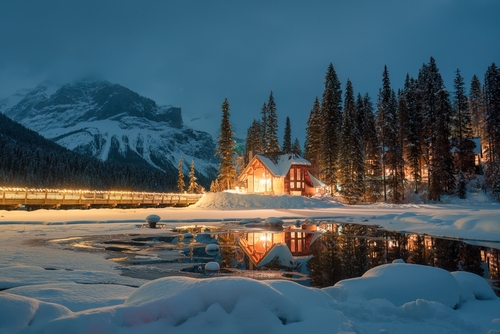

Many Americans dream of owning property abroad. Whether it’s a rustic getaway in Ontario’s cottage country or a ski chalet outside Whistler, Canada is a top choice for foreign investors. But can Americans buy property in Canada? Luckily, yes. The somewhat recent implementation of the foreign buyer ban may make the process more challenging, but you can still bring your vision to reality.
At Remitly, we’re all about breaking down borders, and home ownership is a great way to do just that. We’ll dive into the step-by-step process for buying property in Canada. We’ll also outline who’s eligible, what you can buy, financing for US citizens, and the tax implications of each option.
Understanding Canada’s “foreign buyer ban”
In 2023, Canada enacted the much-awaited Prohibition on the Purchase of Residential Property by Non-Canadians Act. This legislation aims to regulate the property market throughout the country, but especially in hotspots like Toronto, Vancouver, and Montreal, which are incredibly popular with foreign investors.
By halting residential property sales to foreigners for at least two years, authorities hope to address the housing shortage many Canadian citizens face. This policy was set to expire on January 1, 2025, but has since been extended until 2027.
Although commonly called the “foreign buyer ban,” it.
Who is exempt?
Despite its name, this non-Canadian residential property act doesn’t mean that foreigners can’t live in or purchase property here. For one, it doesn’t affect your ability to rent a house or apartment anywhere in Canada. It also means that buyers need to fall within specific exemptions, as the ban doesn’t apply to everyone.
The following parties are exempt from restrictions placed by the foreign buyer ban:
- Canadian citizens and permanent residents
- Foreign workers with temporary work permits
- International students
- Certain refugee claimants
- Non-Canadians with a spouse or common-law partner who’s a Canadian citizen, permanent resident, refugee, or person registered under the Indian Act.
The recreation exception: where can you buy?
Not only are there limits to who can purchase property as a non-Canadian, but the policy also places restrictions on where. US citizens buying in Canada aren’t allowed to go after real estate in two clearly defined areas, based on the previous Canada Census:
- Census agglomeration area: Defined as an area with a population of at least 10,000 people.
- Census metropolitan area: An area with a population of 100,000 people or more, with at least 50,000 of them living in its urban core.
The Canadian government published a map indicating which cities fall under either of these categories. While it does exclude all foreigners from making property purchases in desirable places like Southern Ontario or British Columbia’s Lower Mainland, it’s still possible to secure a recreational home in places such as:
- More remote areas of Muskoka in Ontario
- The Canadian Prairies, towards Manitoba and Saskatchewan
- Rural parts of the Maritimes, especially Prince Edward Island (PEI) and Southern Nova Scotia
- Smaller towns in Alberta or Quebec
Note that the location exemption applies to any foreign buyer, whether or not you meet the immigration and family status requirements.
The buying process: a step-by-step guide
Buying a property in Canada isn’t all that complicated, provided you’re covered by the “who” or “where” exemptions we’ve just outlined. All you need is a little research, plus a detailed step-by-step guide to prepare you for the process.
Step 1: Financing pre-approval
Americans can get a mortgage from a lender in Canada, but the requirements are stricter. While the minimum down payment is typically between 5% and 20% depending on the home cost, it’s higher for foreigners. Non-residents should set aside at least 35% of the purchase price to secure financing.
You’ll be asked to provide detailed financial information, including proof of income, current expenses, and your credit score. But if you follow the lender’s instructions, a pre-approval will make the process more efficient. You’ll know what you can afford and signal serious intentions to potential sellers.
Step 2: Assemble your team
When you’re buying across borders, you need a local’s expertise, and that starts with hiring a real estate agent. Choose one that’s knowledgeable about your desired area. It also helps if they’re used to dealing with foreign buyers. That way, they’ll understand your unique needs.
It’s also wise to find a Canadian lawyer with real estate expertise to handle title searches, contract reviews, compliance checks, and the final transfer of funds.
Step 3: Search and offer
Rely on your agent to source potential properties that meet both your preferences for size and neighborhood and the legal requirements for location. Set aside time to view the available options. Then, all that’s left is making a final decision on which property is “the one.”
Next, you’ll need to make an official offer. US citizens buying in Canada will find that the offer process is very similar to that back home, but there are subtle differences in aspects like the language. That’s where a local real estate agent and lawyer can help.
The written offer will detail:
- The offered price
- The closing date
- Contingent terms, such as the requirement for an inspection or approved financing
Step 4: Closing costs
It’s not just the offer price you need to consider in your calculations. The actual total costs will vary by city or province, so do your research to ensure your budget is sound. Typical closing costs include:
- Land transfer taxes, sometimes charged at both the provincial and municipal levels.
- Legal fees, which can range from a few hundred to several thousand dollars, depending on the complexity of the purchase.
- Inspection fees, typically ranging between $400 and $600 CAD (about $290 to $435 USD).
- Title insurance to protect potential buyers and lenders from things like fraud, boundary disputes, liens, and errors in public records.
- Appraisal fees, as some Canadian lenders may require an official appraisal to confirm the property’s value. Expect these to cost between $300 and $500 CAD (approximately $215 to $360 USD).
- Mortgage-specific costs, since if you’re not paying cash for the property, mortgage-related costs, like default insurance and underwriting fees, may apply.
Taxes and other financial considerations
Buying property in Canada as an American will likely be both familiar and different. The offer process is virtually the same, as is the search, but the taxes and financing are entirely different.
Non-Resident Speculation Tax (NRST)
Currently, only two Canadian provinces—British Columbia (BC) and Ontario—apply an NRST of 20% and 25% respectively to properties purchased by foreigners. This tax is a percentage of the final purchase price, so it can quickly add up.
In Ontario, the NRST applies to all property purchased by foreign nationals, but in BC, only five regions are eligible:
- Capital Regional District
- Fraser Valley Regional District
- Metro Vancouver Regional District
- Regional District of Central Okanagan
- Regional District of Nanaimo
Annual property taxes
Once you’ve purchased your Canadian home, you’ll be required to pay property taxes every year. As with most things, the amounts vary by province, property type, and location, just like in the US.
During the buying process, your realtor or lawyer will have access to details about the estimated annual property tax amount. That way, you’ll know all the running costs upfront.
Tax Implications in the US
Owning property in Canada doesn’t mean you’re immune from US tax rules. Because Americans must report global assets, you may need to inform the Internal Revenue Service (IRS) about:
- Rental income earned in Canada
- Foreign bank accounts that are used to manage the property
- Capital gains when you sell
Seeking cross-border tax advice is highly recommended to avoid surprises during tax season.
Currency exchange
We know that exchange rates fluctuate, but significant changes can mean the difference between affording your Canadian property or not. It’s a good idea to build in a buffer to your property-buying budget to absorb potential fluctuations.
US and Canadian currency concerns don’t end once the sale is done, either. They can affect the payment of closing costs, any subsequent mortgage, and renovation expenses, too.
Financing for US citizens
Before approaching a Canadian lender, know that things will work differently when you’re a foreign buyer.
How Canadian banks view financing for US citizens
While the financial ties between Canada and the US are undeniable, banks will still treat non-residents differently. Luckily, they are still open to lending to US citizens buying in Canada.
In general, expect the qualification criteria to be more rigorous, the down payments to be higher, and the maximum loan amounts to be lower.
What documentation will you need?
The necessary documents will be familiar if you’ve already purchased property in the US:
- Proof of income, such as recent pay stubs, tax returns, or employment letters.
- Credit history, which many Canadian banks can pull directly from US credit bureaus.
- Down payment verification showing the source of all your funds.
- Several months of bank statements.
- Government-issued ID and citizenship documentation, like a passport or permanent resident card.
Using US-based equity instead
If you’d rather keep your financing local, consider using the equity you’ve already built up in your US home. A Home Equity Line of Credit (HELOC) allows you to capitalize on your home’s value gains without selling the property.
Once you free up those funds, you can use them to purchase your Canadian property in cash. As an added benefit, cash buyers are often looked upon favorably by sellers.
Canadian property is within reach for American citizens
Although there are certain exceptions, Americans can buy property in Canada quickly and easily. The non-Canadian residential property act doesn’t have to be a deterrent. It just means you need to approach buying property in Canada a little differently.
Even if you’re not exempt from the ban based on your immigration status or family situation, a rural recreational property is still attainable. But whatever you do, don’t try to navigate the process alone. Local professionals are the key to saving time and money while staying within the rules.
Now, all you have to do is start looking for your dream Canadian getaway. You’ll be enjoying your vacation in the Great White North in no time.
FAQs
Can Americans buy property in Canada right now?
Yes, as long as you have Canadian citizenship or fall into one of the following categories:
- Canadian permanent residents
- Foreign workers with temporary work permits
- International students
- Refugees, but some exceptions apply
- Your spouse or common-law partner is a Canadian citizen, permanent resident, refugee, or person registered under the Indian Act.
Additionally, certain areas, like those with a population under 10,000 people, still permit foreign ownership of recreational properties.
Do I need to become a Canadian citizen to own a house there?
No, you don’t. Permanent residents, refugee claimants, non-Canadian workers with appropriate permits, foreign students with the correct approvals, and spouses of Canadian citizens or permanent residents are typically permitted to buy property in Canada.
What is the foreign buyer tax in Canada for 2025?
In 2025, foreign buyers are required to pay a Non-Resident Speculation Tax (NRST) of 20% in British Columbia and 25% in Ontario, respectively.
Can I live in Canada if I buy a house there?
No, purchasing Canadian property is not a path to citizenship. Property ownership and immigration status are entirely separate things. You can only live in Canada if you apply through a recognized immigration scheme, including work permits, family sponsorship, and the Provincial Nominee Program.
Are vacation homes exempt from the foreign buyer ban?
Yes, certain ones are. Foreigners can purchase vacation homes located outside of a census metropolitan area or a census agglomeration area, designated as such based on the most recent Census data. In general, property purchases in areas with a population under 10,000 are permitted.