
Key Highlights
- The Ogham alphabet is an old way of writing used for the early Irish language. People used it most often from the 4th to the 6th century.
- The script has a series of strokes made along a line in the middle. You can see them on many stone monuments.
- Some people call it the Celtic Tree Alphabet, but a lot of the letter names in this alphabet do not come from tree names.
- The carvings on these ogham stones were used to write personal names and show tribal groups. They were put there as memorials or to mark boundaries.
- You can still see this unique ancient script carved into stone monuments across Ireland, Wales, and Scotland.
Introduction
Have you ever seen strange lines cut into an old stone and thought about what they mean? You may have been looking at the Ogham alphabet, an ancient script from Ireland. This old writing system was made to show the sounds of the early Irish language. The Ogham script is like a window to the past. It helps us connect with history, keeping names and stories safe on stone monuments that have lasted for many years. Let’s find out more about this unique Irish writing system and see what secrets it holds.
Origins and History of the Ogham Alphabet
The true starting point of Ogham is still talked about, but people agree that it was used as a writing system for Old Irish by the 4th century AD. The ancient Irish alphabet might have taken some ideas from the Latin alphabet, but it has its own style and way to show the sounds of the old Irish language.
People used this Irish alphabet mainly to write words by carving them into the sides of big stones. This way of making inscriptions was at its most popular between the 4th and 6th centuries. You could find it not just in Ireland but also in places like Wales and Scotland, where Irish groups moved to. Ogham was very important to people in Ireland as it helped them share news and keep track of things.
Now, let’s see what people say about how this writing system first started and how it was used in those early days.
Theories on the Creation of Ogham
Many people have ideas about how Ogham started. One well-known thought is that Irish writers or druids made it to be a secret code when there was the threat of invasion from Roman Britain. Its way of writing was different. This made it hard for people who used the latin alphabet to read it.
Some say the name comes from the Irish god Ogma. He was linked to talking well and using language. If this was true, then the ogham script was a gift from the gods. The sharp marks in the script look like they were made by the point of a sharp weapon. This has led some people to think it may have come from military signals or had other real uses.
No matter where it really came from, the making of ogham was a smart move. It was an alphabet made for the sounds of the early irish language. It marks a big step in the story of irish culture and reading.
Early Use in Ancient Ireland
In ancient Ireland, the Ogham alphabet was mostly used to write on stone monuments. These weren’t long stories or poems. The Ogham inscriptions often showed personal names and tribal links. These stones kept memories, like a “here lies” sign, showing respect for ancestors and saving their family lines.
The carvings had a good reason for being there. They might have shown where a clan’s land ended. Think about an ancestor’s spirit helping to watch over the group’s borders—that idea meant a lot at the time. Using Old Irish on these stones gave people some of the first written signs of the language.
The way the writing used the side of a stone was smart. It used the stone’s natural edge as the center for carving strokes. That made the ancient Irish alphabet last long and gave people an open way to keep big facts for everyone, keeping names in stone.
Structure and Symbols of the Ogham Script
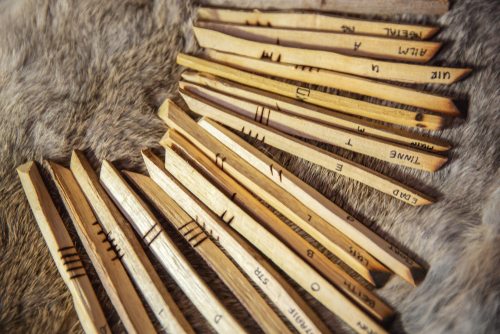
The Ogham script is a special writing system that uses a series of strokes. It is not like other writing systems where each letter has its own shape. Instead, Ogham uses groups of one to five straight or angled lines. These lines sit next to a main line called a stemline. Most of the time, this stemline is the edge of a stone.
Each group of strokes stands for a different letter. The letter names in this writing system are important too, since many of them are named after trees or things found in nature. Ogham is read from the bottom up, going in a straight line. Now, let’s look at the main letters and see how they connect to trees.
Main Letters and Alphabet Chart
The original Ogham alphabet consisted of twenty main letters, divided into four groups of five. Each group, or aicme, is defined by the direction and number of its strokes relative to the stemline. Later, as the Irish language evolved, a fifth group of extra letters, known as the Forfeda, was added in the manuscript tradition to represent new sounds not present in Old Irish.
This system allowed for a direct transcription of the Irish alphabet, which had different sounds compared to the Latin alphabet. An Ogham text chart provides a clear reference for how these strokes correspond to letters and sounds.
Here is a basic Ogham alphabet chart showing the original twenty letters:
| Group (Aicme) | Letter | Name | Latin Letter | Ogham Symbol |
|---|---|---|---|---|
| Aicme Beithe | Beith | Birch | B | ᚐ |
| Luis | Flame/Herb | L | ᚂ | |
| Fern | Alder | F | ᚃ | |
| Sail | Willow | S | ᚄ | |
| Nin | Fork | N | ᚅ | |
| Aicme hÚatha | hÚath | Hawthorn/Fear | H | ᚆ |
| Dair | Oak | D | ᚇ | |
| Tinne | Holly/Ingot | T | ᚈ | |
| Coll | Hazel | C | ᚉ | |
| Cert | Bush/Rag | Q | ᚊ | |
| Aicme Muine | Muin | Vine/Neck | M | ᚋ |
| Gort | Field | G | ᚌ | |
| Gétal | Broom/Killing | NG | ᚍ | |
| Straif | Sulphur/Blackthorn | Z | ᚎ | |
| Ruis | Elder/Red | R | ᚏ | |
| Aicme Ailme | Ailm | Pine/Elm | A | ᚐ |
| Onn | Ash/Gorse | O | ᚑ | |
| Úr | Heath/Earth | U | ᚒ | |
| Edad | Aspen | E | ᚓ | |
| Idad | Yew | I | ᚔ |
Connection to the Celtic Tree Alphabet
The name “Celtic Tree Alphabet” is a well-known term for Ogham, but it can be a bit unclear. Many people use this name because some of the letter names in Ogham are the names of trees. For example, Beith stands for Birch, Dair means Oak, and Sail is Willow. This is why people talk about Tree Ogham now.
But, it is good to know that not every letter in Ogham is named after a tree. There are letters like Gort, which means field, and hÚath, which means fear or terror. In old manuscripts, Ogham letters could stand for more than trees. Some letters are connected with colors, birds, or rivers. So, trees are only one part of what the script means.
The idea of the Ogham being a full tree alphabet is mostly something from the modern day. Robert Graves did a lot to spread this idea in 1948 in his book, The White Goddess. His book is interesting to read, but historians think it is not true to the facts. People should not think of it as a true source about old Irish or Celtic beliefs. The real facts are:
- Some Ogham letter names come straight from Old Irish tree names.
- Trees were very important to the Celts in the past.
- The idea of a “Tree Alphabet” is something new. It is not the way things were in the past.
Ogham Stone Carvings and Inscriptions
Ogham is easy to see on stone monuments found all over the Irish countryside and in other places too. These monumental inscriptions tell us most of what we know about how the script was used in early times. The earliest inscriptions are from the 4th century. They are some of the first things ever written in the Irish language.
People used these carvings mostly for names. It was simple, often just like “X son of Y.” This shows they were made to remember people or to show who owned the land before. Carving into stone was hard work, so it made the names important and lasting. Next, we’ll look at how to read these carvings and where you can go to see them.
Deciphering and Reading Ogham Stones
Reading Ogham stones is like figuring out a very old code, and that is pretty much what you are doing. The writing system uses a middle line called the stemline. Most of the time, this is just the edge of the stone. The Ogham inscriptions are read from the bottom to the top. The letters in Ogham are made with marks that often look like someone used the point of a sharp weapon. These letters sit in different places around this middle line.
To read these inscriptions, you have to know the four main kinds of Ogham letters. Each group comes from how the lines or marks are set. Look at the main principles:
- One to five lines that go straight across the stemline to the right side show the first group. These include B, L, F, S, and N.
- One to five lines that go straight across to the left side of the stemline show the second group. These are H, D, T, C, and Q.
The third group in Ogham has one to five lines going on a slant that cross the stemline. The last group is for vowels. These letters look like notches or short marks set right on the stemline. When you match these shapes to an Ogham chart, you will be able to spell the old names that were cut into the stones hundreds of years ago.
Locations and Notable Examples in Ireland
Ogham got its start in Ireland. Over time, as people moved, the use of Ogham spread, too. You can find the highest number of Ogham stones in the south-west part of Ireland. These are mostly in Kerry, Cork, and Waterford. This area is well known for having the most of these old stone markers. They still often stand in fields or old church sites, just where they were left long ago.
But the story of Ogham does not stay in Ireland. There are also many important Ogham stones in Wales. Most of these are in Pembrokeshire. Their inscriptions use both Ogham and Latin writing, which helped people learn how to read Ogham. You can also see Ogham stones in Scotland, the isle of man, and even in some parts of England.
If you want to visit some famous Ogham stones, check these spots:
- The University College Cork campus, where a group of stones is open for everyone to look at.
- Dunloe, County Kerry, which keeps a group of these stones safe in a covered spot.
- The National Museum of Ireland in Dublin, where there are some top examples on show.
Conclusion
The Ogham alphabet has a story that goes way back and shows us a lot about life in early Ireland. It is not just another way to write, but also a symbol of Irish roots and the celtic tree alphabet. The way ogham links to trees says a lot about what people in that time cared about and believed in. When you look at ogham inscriptions and stone carvings, you get to find out more about their world, and you see the skill and care put into making these ancient marks.
If you want to see your name in the ogham alphabet or you want to know more about celtic iron age writing, there is help out there for you. This is a chance to learn about a special part of the Irish and celtic story. Go on and enjoy finding out what makes this writing so important!
Frequently Asked Questions
How can I write my name using the ogham alphabet?
To write your name, you can use an Ogham alphabet chart. First, find the lines or strokes for each letter in your name. The Irish alphabet does not have the same sounds as English, so you might need to look for the closest sound for some letters. This writing system works well when you want to make special Ogham text using personal names. The Ogham writing system helps you get simple and unique Irish alphabet spelling for your own name.
Are there online tools for translating English into ogham script?
Yes, there are a lot of free tools on the internet that you can use to turn your English text into ogham script. These sites will make ogham text for you. You just have to type in your letters and the writing system will show right away. This helps you see how words and names will look in ogham.
Is ogham still used or taught today?
Ogham is not used for speaking or writing every day. But people like historians and those who love language still study it. The rich manuscript tradition keeps its story going. Today, you will see Ogham mostly in art, on tattoos, jewelry, or other creative things. It holds a special place in Irish and Scottish Gaelic history and culture.