
Key Highlights
Here’s a quick look at what you’ll learn about the katakana alphabet:
- The Japanese language has three writing systems. These are hiragana, kanji, and the katakana alphabet.
- Katakana is used when you write foreign words, loanwords, and foreign names.
- It has 46 basic characters. These characters stand for syllables, just like hiragana does.
- There are many common Japanese words you might already know. For example, “computer” (コンピュータ) and “tutor” (チューター) are written in katakana.
- When you learn katakana, you open a door to a whole new part of the Japanese writing system and new Japanese words.
Introduction
Welcome to the world of the Japanese language! If you have started with hiragana, your next step is to learn katakana. At first, katakana may look different but it has the same sounds as hiragana. So, you may ask, why do you need a second set of alphabets? One good reason is that katakana is used for many foreign words in Japanese. It is the way you read many words you see in daily life. When you know both hiragana and katakana, reading Japanese signs, menus, and pop culture things will get much easier. Learning these Japanese alphabets is an important part of your journey with the Japanese language.
Understanding the Katakana Alphabet in Japanese Writing
The Japanese writing system is like no other. Katakana has a clear and important job in it. You can think of katakana as the way many people in Japan show a word comes from out of the country. When you see words written in this set of sharp lines and shapes, you know that word did not start in Japan. It is a simple way to point out something foreign.
Each katakana character stands for a sound. It is a syllable, just like the sounds you find in hiragana. This means katakana is a part of the japanese syllabary, and it helps you know how to say the word out loud. The Japanese writing system uses katakana to bring new, foreign words into the japanese language. At the same time, this keeps those words set apart from other japanese words.
In this text, you can find out more about katakana’s job in writing, where it comes from, and how people use it today.
What Is Katakana? Purpose and Role in Japanese Script
Katakana (カタカナ) is one of the two main ways to write sounds in the japanese language. The other one is called kana. Katakana is mostly used for writing foreign words. People call these loanwords. These words come from things, names, and places that are not from japanese or chinese. For example, if your name is Sarah, you write it in katakana like サラ (Sara).
This way of writing helps set apart foreign words from native japanese words. Native japanese words are written in hiragana or kanji. This is good for learners of japanese. When you see katakana, you can sound out the word. Often, you will know that it comes from english or another foreign language. So, “computer” is written as コンピュータ (konpyūta).
Katakana makes it easy for japanese to use and change words from other countries. It works like a bridge between japanese and a foreign language. Katakana is one of the japanese alphabets you need to learn if you want to read modern japanese. You will find it on restaurant menus, in books, and in school papers—all over japan.
Historical Origins and Development of Katakana
The story of katakana starts with kanji. Kanji is the writing system that came to Japan from China. Around the 9th century, some Buddhist monks needed a way to read and mark Chinese texts. They made a kind of shorthand. To do this, they took pieces of hard Chinese characters and used these to show Japanese sounds. This new script was simple, and it became katakana.
This is why each katakana character looks more angled and plain than the fancy kanji that it came from. For example, the katakana character “e” (エ) comes from the kanji 江. At first, people used this short style for official documents and to make reading Chinese writing easier.
Later, the japanese writing system changed and grew. Now, there are three main scripts. Kanji is still used for main meanings. Hiragana is used for native japanese words and grammar. Katakana is used for special jobs. Knowing this story shows why japanese uses more than one script and how katakana found its own place in the language.
When and Why Katakana Is Used in Modern Japanese
In modern Japan, katakana is a big part of the Japanese writing system. You see it often. People use katakana mostly to show words taken from other languages. This makes it easy for English speakers to know some words, since many loanwords are close to what you see in English.
Katakana is not just for loanwords, though. It’s also used to add stress to some Japanese words. In English, you do this with italics or bold. Katakana can help show sound words, known as onomatopoeia. It’s also common for technical terms. Many companies use katakana for their names. Toyota (トヨタ) and Suzuki (スズキ) are two big examples.
Here are the main times you will see katakana:
- Foreign words and loanwords: for things like “beer” (ビール, bīru) or “ice cream” (アイスクリーム, aisu kurīmu).
- Foreign names and country names: such as “America” (アメリカ, Amerika).
- Emphasis: to help some Japanese words stand out in the sentence.
- Onomatopoeia: words used to show a sound.
Katakana helps people with foreign words, Japanese words, and names like America in Japan. It is one part of the Japanese writing system and works well for both English and Japanese speakers.
Katakana vs. Hiragana: Key Differences and Uses
While katakana and hiragana are both types of Japanese syllabaries, they have a different look and are used in different ways. You can think of them as two styles for the same set of sounds. Hiragana letters are more smooth and curvy. But katakana letters look sharp and have more straight lines.
The main difference is how people use them. Hiragana is used with native Japanese words, help words like particles, and at the end of verbs. Katakana is for foreign loanwords, to show stress or attention, and for some technical words. Now let’s look at how they look, when people use them, and see some real examples.
Visual Distinctions Between Katakana and Hiragana
The first thing you will see when looking at katakana and hiragana is how they look. Hiragana characters are round and smooth. They almost seem like they were drawn with a simple soft line. This makes sense in the japanese language because they came from a flowing style of writing. Take the hiragana for “a” as an example. It is written as あ.
Katakana, on the other hand, uses lots of straight lines and sharp points. A katakana character looks more blocky or stiff. For example, the katakana for “a” is ア. The reason for this look comes from the way katakana began. Because katakana came from taking small parts of harder kanji, they had to be quick and easy to read.
These looks help people understand japanese as they read or write. When you see rounded hiragana, you know it is usually a word from japanese or something with grammar. When you spot a sharp katakana character, one will think of a loanword or something getting more focus. Knowing the difference between these two is very important when starting to learn japanese.
Common Contexts for Using Katakana vs. Hiragana
Knowing when to use katakana and when to use hiragana is very important for reading and writing in the japanese writing system. Both of them have the same sounds, but they do different jobs. Hiragana is used for most of the native japanese words and is important for grammar.
You see hiragana in japanese for particles. These connect the parts of a sentence, and it shows where the verb and adjective endings are in words. People also use hiragana for words that do not have a common kanji, and for furigana. Furigana is when small hiragana letters show how to say a kanji word. You find furigana in books for kids, or for people who are learning to read japanese. On the other hand, katakana is used for words that come from other languages.
Here is a simple guide for how to use them:
- Hiragana: This is used for most native japanese words (like ありがとう, arigatō), for grammar particles, and the endings on verbs and adjectives.
- Katakana: This is for loanwords (like コンピュータ, konpyūta), for foreign names, for onomatopoeia, and when you want to give a word extra focus.
The japanese writing system uses hiragana, katakana, and kanji. It is good to know the right use for each part. This way, you can read and write better in japanese. If you get used to
Examples of Words Written in Katakana and Hiragana
Seeing words side-by-side is one of the best ways to understand the different roles of hiragana and katakana. Let’s take a common concept and see how it’s written. The native Japanese word for “car” is kuruma, written in hiragana as くるま. However, the English word “car” is also used as a loanword, written in katakana as カー (kā). They both mean car, but their script tells you their origin.
This pattern applies to countless Japanese words. You’ll find a native term written in hiragana and a corresponding loanword from a foreign language written with katakana characters. This is especially true for modern technology, food, and pop culture concepts.
Here are a few more examples to illustrate the difference. Notice how the katakana words are adapted from an English word, while the hiragana words are of Japanese origin.
| Script Type | Japanese Word | Romaji | Meaning |
|---|---|---|---|
| Katakana | ビール | bīru | Beer (from English) |
| Hiragana | さけ | sake | Sake (Japanese rice wine) |
| Katakana | ペン | pen | Pen (from English) |
| Hiragana | ふで | fude | Writing brush |
The Complete Katakana Chart Explained
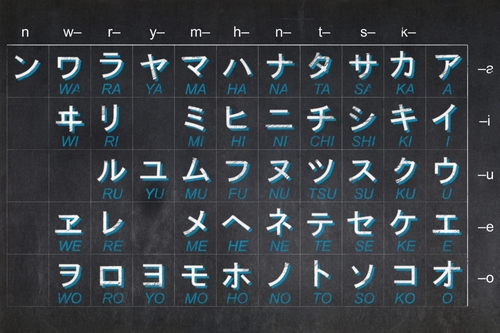
Ready to see all the characters at one time? The katakana chart can be your guide as you start learning this script. Like hiragana, the basic katakana chart shows the 46 main katakana characters in a grid called gojūon, or “fifty sounds”. The grid puts the five main vowels and their consonant matches together. This helps making it easy to follow and use when you are working to learn all the basic katakana.
Seeing how the chart works is the first step to knowing and saying these katakana characters right. We will start by checking out the 46 basic katakana symbols. After that, we will get into the extended sounds. These give even more range to the Japanese alphabets and your Japanese skills.
Katakana Characters: The 46 Basic Symbols
The katakana system starts with 46 basic characters. This group has five vowels (ア, イ, ウ, エ, オ), forty pairs made with a consonant and a vowel (like カ, キ, ク, ケ, コ), and one single consonant, ン (n). Each character in this japanese syllabary stands for its own sound. So when you get the pronunciation for one, you will say it that way every time you see it in a word.
These characters appear in a chart. The chart begins with the vowels. Then, you see consonants joined with those vowels (you get a k-line, s-line, t-line, and more). The “s” line shows サ (sa), シ (shi), ス (su), セ (se), and ソ (so). This neat way of organizing makes it a lot easier to learn basic katakana.
If you have already learned hiragana, you probably know these sounds. Now you have to match sounds you already know with a new group of sharp, angled basic characters. Try to make a strong connection in your mind, so each sound always matches the same katakana sign. This will help you remember the basic katakana script well.
Extended Katakana Sounds: Voiced, Semi-Voiced, and Contracted Forms
Beyond the basic 46 characters, katakana also uses special marks to make new sounds. These are very important for good Japanese pronunciation, especially when using foreign words. There are two main marks called dakuten and handakuten. The dakuten (〃) looks like two small lines. This mark makes a consonant sound “stronger.” For example, it changes the “k” in カ (ka) into a “g” in ガ (ga).
The handakuten (゜) is a small circle. It is used with “h” sounds. When you add it, it turns “h” sounds into “p” sounds. For example, ヒ (hi) turns into ピ (pi). Katakana also has small versions of ヤ (ya), ユ (yu), and ヨ (yo). If you join these with a character that ends with “i,” you get a single new sound or syllable, such as キャ (kya).
These extra forms help katakana write sounds not usually found in Japanese. This is a good way to show the real sound when you use loanwords from English or other languages. Using katakana like this helps you get a closer Japanese pronunciation for foreign words and new sounds.
Reference Tools: Where to Find Printable and Online Katakana Charts
Having a good katakana chart near you is important when you are just starting to learn Japanese. The good news is, you can find many useful resources online. If you search online, you will see many websites have printable katakana charts in pdf format. You can print one and put it on your wall or keep it on your desk to peek at any time. This is a great way for people who need to see things often to remember them.
A lot of language learning websites and apps also have interactive online katakana charts. These charts often come with audio so you can hear how to say each character. This can help you get a good accent. Some places even let you practice typing in Japanese katakana, so you can learn by doing and not just looking.
If you like to use something you can touch and write on, here are some good options to try:
- Language Learning Websites: Most of these sites for Japanese will offer a free katakana chart in pdf format that you can print.
- App Stores: Look for “katakana chart” or “Japanese learning” in app stores to find apps with charts and quizzes.
- Online Marketplaces: You can buy laminated katakana charts or flashcard sets too.
These are some easy ways to get a katakana chart and practice Japanese katakana daily. Just pick what works best for you!
Beginner’s Guide: How to Start Learning Katakana Alphabet
Taking the first step to learn katakana can seem scary at first, but with the right way to study, you can get the hang of it fast. The key for this is to divide it into small parts. Do not try to remember all the characters at one time. Pick a few to start with, and practice those until you know them well.
At first, get to know the katakana chart. After that, start practicing the characters. You can write the letters again and again. You can also use flashcards, or read easy words in Japanese from real life. If you have a plan to follow, learning the Japanese language will be much better and easier. Here, we will talk about the tools you will need and the steps you can take to start learning Japanese and katakana.
What You’ll Need to Begin Learning Katakana (Resources & Equipment)
You do not need a lot of special things to start learning katakana. In fact, the simplest tools can help the most. The key thing is to use resources that work for you and make you want to practice katakana often. It is good to use different ways to learn like reading, writing, and using tools you can work with.
Begin with simple things like a pen and paper. When you write the katakana by hand, you get to know the shapes and the right way to write them. After that, you can use digital tools and other things to help you remember what you saw before. Many people say that mnemonics, or little tricks that connect the look of a katakana to a picture, help a lot.
Here are the basic things you need before you start:
- A printable katakana chart for you to look at anytime.
- A notebook and pen, so you can keep up your writing practice.
- Flashcards you can hold or look at on the internet, so you can test yourself over and over.
- A list of katakana mnemonics to make it quicker to remember each shape.
- Access to an app or a website where you can take quizzes and work on your reading.
Using these tools, you will find it is much easier to practice katakana and learn each one in a way that works best for you.
Step-by-Step Guide to Mastering Katakana
Ready to get started with Japanese katakana? If you use a step-by-step way to learn, it can help make the 46 characters look less tough. In fact, you can make big progress. You want to know how the system works before you try to remember every symbol. This way, you will not just know the shapes. You will also learn how to use them the right way.
Begin by learning the katakana chart and the sound each piece has. Then practice by writing them. This will help you remember with your hand as well as your mind. When you are able to tell what each one is and write them out, use memory tricks like mnemonics to help things stick. Soon, you can start reading and writing real words.
Here is a simple guide to help you learn Japanese katakana:
- Step 1: Get to know the katakana chart.
- Step 2: Practice writing each katakana, and try to use the right stroke order.
- Step 3: Use mnemonics and flashcards to help remember each shape.
- Step 4: Begin reading and writing common loanwords.
Step 1: Familiarize Yourself with the Katakana Chart
Your first mission is to get to know the katakana chart. Print the katakana chart out or keep it open on your screen. You don’t need to memorize the whole thing at one time. For now, just take a look at it. Notice the way it’s set up. The katakana chart has rows and columns that match up with vowel and consonant sounds. This layout will help you as you learn.
Start with one row at a time. You can begin by learning the five main vowels: ア (a), イ (i), ウ (u), エ (e), オ (o). Say these sounds out loud. Pay attention to how their shapes look. When you feel good with the vowels, move on to the first consonant row, also known as the “k-line.” This has these katakana: カ (ka), キ (ki), ク (ku), ケ (ke), コ (ko).
The goal is not to just drill the japanese syllabary into your head. Right now, you want to make the katakana and its structure feel more simple and less confusing. If you break the japanese katakana chart into small, clear groups, you will build a way of thinking that will help you learn even more as you go.
Step 2: Practice Writing and Stroke Order for Each Character
Now it is time to grab a pen and get started. Writing the characters is an important step in learning katakana. This helps your hands learn the shapes until they become second nature. When you practice katakana, make sure you watch the stroke order for each one. In the japanese writing system, each character needs to be written in a certain sequence and direction.
Why should you care about stroke order? It makes your writing clear and balanced. It also helps tell the difference between similar katakana characters. For example, you need to use stroke order to tell apart シ (shi) and ツ (tsu), or ソ (so) and ン (n). Many times, these small differences are only from the first stroke or which way you write. There are the online guides and apps that show the right japanese writing system order for each katakana with step-by-step videos.
Start by tracing the shapes. Then, try to write each katakana character from memory. You can fill a page with the “a-line” first, then move on to the “k-line,” and keep going. Doing this type of practice may feel slow, but it is one of the best ways to get good at katakana and use the japanese writing system well. Keep at it, as this steady practice lets the characters feel easy and part of your every day work.
Step 3: Memorize Katakana Using Mnemonics and Flashcards
With so many katakana characters that look the same, it is hard to just memorize them by repeating. But mnemonics and flashcards can help a lot! Mnemonics help you make a picture in your head or a short story to remember a katakana character. For example, the katakana character ケ (ke) looks like the letter “K.” This small link can help you remember it better.
You can search for pre-made mnemonic systems for katakana online, or you can try making your own. If you make your own, the memory will stick more. Using mnemonics along with flashcards can be a good way to get the katakana in your head. Try to look at the character, say what it is, like “ke,” and then turn the card over to see if you are right.
Here are some ways you can use these tools for katakana:
- Use a flashcard app like Anki or Quizlet.
- Make flashcards you can hold, putting the katakana character on one side, and the romaji on the other.
- Try a mnemonic system that works for you, like the one in the Katakana Memory Hint app.
- Go over your flashcards every day for a few minutes to help keep katakana in your head.
Step 4: Read and Write Common Loanwords in Katakana
After you have a good idea of the single katakana characters, you can start using them with real words. This part can be the most fun because you get to see how people use katakana in the japanese language. Start with easy loanwords, especially the ones that come from english, because you may often notice them first.
Begin by reading words that are simple. If you look at a word such as カメラ (kamera), break the word into each syllable: “ka-me-ra.” You will soon see this is the japanese way to write “camera.” Doing this helps you connect the katakana symbols to words you know, which helps you learn better.
Here are a few ways to get better at reading katakana:
- Find lists of everyday katakana loanwords on the internet.
- Read japanese restaurant menus. You will find many things in katakana.
- Look for the names of countries and people who are famous that are shown in katakana.
- Take english words you know and try to write them with katakana characters.
Conclusion
In the end, learning the Katakana alphabet helps you better understand and enjoy the Japanese language, especially when you work with loanwords. When you know what makes Katakana special and how people use it, you can read Japanese much more easily. It helps you a lot, whether you are trying to see how Katakana is different from Hiragana, or you are using useful things to study.
Every time you practice, you get a little better. Using tools like printable charts and flashcards can make it much easier for you. Try to enjoy each step along the way. When you enjoy it, you will learn more about Japanese and get closer to speaking well.
If you want to learn even more about the Japanese language and want a way just for you, you can get a free meeting with our language experts.
Frequently Asked Questions
Why does Japanese use katakana for foreign words and loanwords?
The Japanese language uses katakana when writing foreign words and loanwords. This helps make these words stand out from other words you see in the Japanese writing system. The sharp look of a katakana character gives a quick clue that a word is not native to Japanese. This use of katakana keeps things clear and easy to understand in the writing system.
What are some tips for quickly memorizing katakana characters?
To memorize the katakana alphabet fast, try using different ways to learn. Write the characters every day. This helps build muscle memory. You can use mnemonics to connect the shapes to their sounds. Test yourself often by using flashcards. This way, you check what you remember. Break the Japanese syllabary into small groups. When you do this, learning katakana will not seem as hard.
Are there online katakana keyboards or typing tools for practice?
Yes, you can find many online tools and resources to help you practice Japanese katakana. To start, you can turn on the Japanese keyboard on your computer or phone. This lets you type in Japanese katakana right away. There are websites, such as Kana Pro, that give you typing exercises. You can pick which characters to work on. These tools help you get faster and better at typing in katakana.
What are the most common mistakes beginners make with katakana?
People new to katakana often get mixed up with look-alike characters. For example, many confuse シ (shi) with ツ (tsu). They also mix up ソ (so) and ン (n). Another thing that comes up a lot is not using the right stroke order. If you skip that, it can make your writing hard to read. Students also get the dash (ー) wrong. It shows a long vowel sound in katakana, and if you say it wrong, your word can mean something else. It helps to pay close attention to things like using the dash, the correct way to write tsu and shi, and practicing the stroke order for all katakana.