
Key Highlights
Here’s a quick look at what we will cover in this guide to Egyptian hieroglyphs:
- Egyptian hieroglyphs, also called “medu netjer” or “words of the god,” were seen as something special made by god Thoth.
- This system uses word signs, sound signs, and symbols that help show what a word means.
- People wrote hieroglyphs not only to keep records but also used them on temples, tombs, and amulets to bring magical protection.
- In time, simpler writing styles called hieratic and demotic came about, and people used them every day for business and reading.
- The discovery of the Rosetta Stone was a big help for Jean-François Champollion to figure out how to read the old script in the 1800s.
- Symbols like the Ankh, Eye of Horus, and Scarab were very important for their culture and beliefs.
Introduction
Welcome to the amazing world of Egyptian hieroglyphics! For many years, the detailed symbols in ancient Egypt have caught the eye of experts and people who just love to learn. This script was more than just a way to share messages. It was a big part of pharaonic life. It brought together art, language, and what people believed. In this blog, we will go back in time. We will look at one of the oldest writing systems. We will learn about its symbols, what the sounds mean, and why it was so important to the lives of ancient Egyptians.
The World of Egyptian Hieroglyphs
Egyptian hieroglyphics are one of the oldest writing systems in the world. This visual language helped bring the lives of ancient Egyptians to the modern world. The symbols were not just nice to look at. They were used as a working way to share messages and lasted for over 3,000 years. The ancient Egyptian writing system played a big part in religion, running the country, and marking important events.
People used hieroglyphs on everything from big writings on temple walls, to stories and records on papyrus scrolls. Knowing about this script helps you see into the daily life, beliefs, and history of ancient Egyptians. Now, let’s see what made this visual language from the egyptian writing system so special and why it was important for their society.
Defining Hieroglyphs: Ancient Egypt’s Visual Language
Egyptian hieroglyphic writing is built on pictorial signs. The ancient Egyptians named these signs “medu netjer,” which means “the gods’ words.” They thought that the god Thoth gave them this script. The egyptian writing is not just like other simple writing systems. It mixes different types of signs so it can show more meaning.
The hieroglyphic writing system uses three main kinds of signs. Logograms stand for a whole word. Phonograms are signs for sounds, almost like the letters we use now. Determinatives go at the end of a word and are not said out loud. These help people know what the word means. For example, if a name has a symbol of a man next to it, it tells people that the name is for a man.
Using all these made ancient egyptian writing both detailed and a bit tricky. At first, there were over a thousand different hieroglyphs. By the time of the Middle Kingdom, there were about 750 signs left. The way the ancient egyptians set it up let them write in a way that was both exact and beautiful.
The Role of Hieroglyphs in Everyday and Sacred Life
Hieroglyphs were not just a way for people in ancient Egyptian civilization to talk or write. Many believed this sacred writing had special powers. They felt that it could protect them both during life and after death. That is why you see so many hieroglyphs carved into temple walls, statues, and even on things like personal funerary items and papyrus sheets. People did not just use these words for reading. They wrote hieroglyphs to make the divine words work and help keep them safe.
The formal script was used mainly on big monuments and for religious purposes, but life in ancient Egypt was busy and the people needed quicker ways to write. That is why egyptian scribes developed easy scripts, called hieratic and demotic, for use with daily life tasks. These made it simple to write fast on papyrus or even on broken pieces of pottery, which they called ostraca. Egyptian scribes were really important in this work.
Hieroglyphs touched many parts of life in ancient Egypt:
- Religious Texts: Words from religious texts, like the Book of the Dead, were often put on coffins. These spells and prayers were there to guide people after death.
- Administration: Scribes kept order by using simple scripts to record things like taxes, supplies, and money events.
- Personal Items: Items such as amulets or even clothes had hieroglyphs added to them for protection.
People used the sacred writing
Origins and Early History of Egyptian Hieroglyphs
The exact beginning of ancient Egyptian hieroglyphs is still being studied. It looks like their start came from very old rock art. The earliest writing system in Egypt showed up near the end of the fourth millennium B.C. People used signs that showed animals and things. These early marks were found in rock carvings and on pottery. They made way for a more structured way of writing.
Around 3150 B.C., just before the Old Kingdom, we find the first clear hieroglyphic writing. These early examples already used the main ideas of the writing system. People used them to record names of important rulers, places, and historical events. Now, we will look at when this writing began and talk about the myths about its creation.
The Birth of Egyptian Writing: When and Why It Began
The start of ancient Egyptian writing goes back to about 3200 B.C. The oldest proof was found in tombs at Abydos, a well-known place west of the Nile River. These early signs were seen on small pieces of ivory or wood that were tied to goods. This shows people used them to keep records in a society that was getting bigger. Many think that egyptian writing began with rock pictures made long ago by groups living out in the desert.
These signs were not yet part of the first alphabetic script, but they became an important step toward it. People used them mainly for everyday jobs, like saying what was in a group of goods, the amount, or where something came from in a tomb. It is clear that the first push for ancient egyptian writing came from a need to watch over money matters, which helped rulers control tax and trade.
As time went on, especially from the Early Dynastic Period into the Old Kingdom, people used egyptian writing for more things. At first it was just for labeling. By the time of the second dynasty, the script was also used for talking about royal wins and for religious purposes. What started as a way just to keep up with things grew into a big system. This system ended up playing a big role in shaping the whole society.
Myths and Legends Surrounding the Creation of Hieroglyphs
In ancient Egyptian culture, people saw writing as a gift from the gods, not something humans made up on their own. There was a story that god Thoth, who had the head of an ibis, created hieroglyphs. Thoth was known for wisdom, knowledge, and magic. He looked after the scribes, too. People called their writing system “medu netjer.” This means “the gods’ words,” and they did that to honor Thoth. Because of this, the hieroglyphic script was seen as a kind of sacred writing.
There is a story that goes on from there. Thoth brought his new invention to the sun god, Re. Thoth said writing would make people wiser and help them remember things better. But Re did not agree. He was afraid that people would count on writing and not on their own memory, and that this would make them lose some knowledge and wisdom.
Even though Re was worried, god Thoth still gave the skill of writing to a special group called the scribes. Because of this story, scribes were very important in Egyptian history. People believed the hieroglyphic script had magical and sacred power. When a person wrote in this script, it was seen as something holy, meant to last forever.
Evolution and Transformation Over the Centuries
The Egyptian language and its hieroglyphic script have a long history. Over thousands of years, they changed to fit new needs and new ideas. While people used the rich pictures, or hieroglyphs, on big things like monuments, they also made simpler, quick scripts for everyday writing. The script went through a lot of changes during big historical events, like in the Old Kingdom, the New Kingdom, and later times.
In the end, the rise of other groups and new religions led to a drop in this script. When the Roman Period started, Greek ideas were everywhere. As Christianity spread, the Coptic alphabet soon took over and replaced the old scripts. Here, we will look at key times of change and see how outside forces helped shape this journey of the egyptian language.
Key Historical Periods in Hieroglyphic Development
The development of hieroglyphs can be tracked through several key historical events and periods in Egyptian history. In the beginning, during the Early Dynastic Period and the Old Kingdom, the script was standardized and used for monumental inscriptions and administrative records. The famous Pyramid Texts, the oldest known religious writings, were inscribed during this era.
During the Middle Kingdom, the script was refined, with the number of commonly used signs reduced to around 750. This period also saw the emergence of literary texts written in a cursive form of hieroglyphs known as hieratic. The New Kingdom continued this tradition, with grand inscriptions on temples at Karnak and in the Valley of the Kings.
The script continued to be used through the Ptolemaic and Roman periods, but its use became increasingly restricted to priests and temples. The last known hieroglyphic inscription dates to A.D. 452 at the temple of Isis on Philae.
| Period | Timeframe | Key Developments in Writing |
|---|---|---|
| Early Dynastic & Old Kingdom | c. 3150–2181 BCE | Standardization of script; use on monuments and in Pyramid Texts. |
| Middle Kingdom | c. 2055–1650 BCE | Script refined to ~750 signs; literary texts in hieratic emerge. |
| New Kingdom | c. 1550–1069 BCE | Extensive use on temple walls and in the Book of the Dead. |
| Late & Greco-Roman Period | c. 664 BCE–395 CE | Development of demotic script; hieroglyphs restricted to religious use. |
Influences from Other Writing Systems of the Ancient World
Egyptian hieroglyphs are special, but they did not change on their own. Most big changes in the egyptian language came from things people needed to do. This need led to new, simpler writing systems. The hieratic script, which was a faster way to write, showed up around the same time as the old hieroglyphic writing. Scribes used the hieratic script to write with a brush on papyrus. They wrote things like notes for business, government, and stories.
Some time later, in the 7th century BCE, there was another big change. The demotic script came from the hieratic script. It was more simple and used as the main way to write for people every day. The demotic script did not look much like the old hieroglyphs, and it soon took the place of hieratic in most non-religious documents.
Later on, the egyptian language changed again because of outside people. Ancient Greek had a lot of influence. As Christianity spread, people in Egypt started using the coptic alphabet. The coptic alphabet was based on the ancient Greek alphabet, but it had some extra letters taken from demotic to show sounds that Greek did not have. This change marked the end of the old hieroglyphic writing systems and was the start of the coptic language.
Structure of the Egyptian Hieroglyphic Script
The Egyptian hieroglyphic script is not just an alphabet. This egyptian writing uses a smart mix of signs that work together. There are three main kinds of signs in the egyptian writing system. These hieroglyphic signs can show full words, sounds, or ideas. This makes the system useful and also hard to learn.
Some of the signs act as phonetic glyphs. These show sounds, much like the letters we use now. Other signs look like pictures and stand for an idea instead of a sound. This mix is what makes egyptian writing different from most other old scripts. Let’s look at the different types of signs. We should talk about the signs that act as alphabetic consonants and the ones that help people know what the words mean.
Alphabetic Signs: The 24 Consonantal Hieroglyphs
Inside Egyptian hieroglyphic writing, there was a main group of about 24 signs. People often call this group the hieroglyphic alphabet. Each sign in the hieroglyphic alphabet stood for just one sound. For instance, a mouth sign (?) meant the “r” sound. A horned viper (?) meant the “f” sound.
This group of signs was one of the first times people made symbols for single sounds. It came before the first alphabetic script that used signs for letters. Still, the Egyptians did not use only this type of sign. They kept using these alphabetic signs and other types of signs together. When a word was written out with these hieroglyphic alphabet signs, there would often be extra signs added in too.
Vowels were left out in ancient Egyptian. Today, people who study egyptian hieroglyphic writing add in an “e” sound to help when saying words out loud. The 24 single-sound signs were the heart of the hieroglyphic writing. They let people spell out any word, even new or foreign names like Ptolemy and Cleopatra.
Phonograms, Ideograms, and Determinatives Explained
Beyond the basic alphabet signs, the hieroglyphic script is made up of three main kinds of signs. These types work with each other. Knowing about these is important if you want to know how this language works.
The first group is phonetic glyphs or phonograms. These hieroglyphic signs show sounds. A sign like this can stand for one, two, or three consonants. The set of 24 single-consonant signs is the easiest kind of phonogram to work with.
The next group is called ideograms or logograms. In this group, a hieroglyphic sign stands for a whole word or an idea. For example, the picture of a sun can just mean “sun.” Sometimes the same sign will be a phonogram in one place and an ideogram in another. This can confuse the reader at times.
Now, there is the third set, which are called determinatives. These signs do not have a sound. They come at the end of words to show what the word means. Determinatives help people reading the signs know which meaning is right, since some words can mean more than one thing. Here are some examples:
- A man’s picture after a name shows it belongs to a man.
- Walking legs as a symbol tell you the verb has to do with motion.
- A papyrus roll tells the reader the word means something you cannot touch, like an idea.
The mix of these three types of hier
Common Egyptian Hieroglyphic Symbols and Their Meanings
Egyptian hieroglyphic inscriptions are full of interesting symbols. These hieroglyphic symbols meant a lot to people in Egyptian culture. Many of them were more than letters or sounds. Many symbols stood for gods, ideas, and different parts of life and what comes after. You often see gods, animal figures, and things from daily life in these pictures.
You can find this art and these symbols all through Egyptian history. They show up on temple walls, in their art, and even on amulets people would wear. Now, let’s look at some well-known and sacred ancient Egyptian symbols. We can learn the stories behind them.
Popular Symbols: Eye of Horus, Ankh, and Scarab
There are thousands of ancient Egyptian symbols, but a few are very well-known and have deep meaning in egyptian culture. One famous symbol is the Eye of Horus. It looks like a person’s eye with marks that make it look like a falcon’s. The Eye of Horus is a sign of healing, protection, and getting better after harm. The idea comes from a story where the god Horus lost his eye while fighting Seth. Later, his eye was magically fixed.
Another popular sign in ancient egyptian symbols is the Ankh. The Ankh looks like a cross with a loop at the top. It stands for life that goes on forever. The Ankh is also the Egyptian word for “life.” Many gods are shown holding the Ankh to show they can give life to pharaohs. You can see the Ankh in a lot of tomb art and people used it for lucky charms and jewelry.
The scarab beetle is another important symbol. The Egyptians saw it as a sign of coming back to life or starting fresh because they saw this beetle roll balls of dirt, which they linked to the sun god Ra as he moved the sun over the sky.
- Eye of Horus: A symbol of healing, well-being, and protection.
- Ankh: Represents eternal life and divine power.
- Scarab: Shows rebirth, change, and the morning sun.
Sacred Signs and Amulets in Hieroglyphic Art
In ancient Egyptian culture, there was not much difference between writing and magic. The Egyptian hieroglyphics were seen as sacred writing, filled with special power. People believed this power could be used for religious purposes. You can see this a lot with amulets. These were small charms people wore for protection or to have some good luck. The amulets often showed special Egyptian hieroglyphics to help them get these magical benefits.
Both the living and the dead wore these amulets. Those who were alive used them to stay safe from illness or danger. For people who had died, the amulets were put inside the mummy wrappings. This was to help them have a safe trip to the next life. People picked the symbols on these charms carefully. For example, the Ankh stood for life, and the Djed pillar was for stability.
The power of egyptian hieroglyphics was something the ancient Egyptians took seriously. At different times in egyptian culture, some people wore tiny rolled-up strips of papyrus. These strips had magic sayings on them, and they would keep them inside necklaces. They thought having the sacred writing right against the body would give strong protection. This all shows how important and close sacred writing was to the spiritual life of ancient Egyptians.
Reading and Translating Basic Egyptian Hieroglyphs
Have you ever thought about how to read Egyptian hieroglyphics? Learning the egyptian language fully takes a long time, but you can understand the basic ideas pretty quickly. The first thing to learn is the reading direction. The hieroglyphic script can be written in rows across the page or in columns going up and down. To know where to start, look at the animal or person signs. They always look toward the start of the line.
So, if the figures are facing right, then you read the line from right to left. Up next, we talk about how to say the words and give you a fun way to write your own name using the ancient egyptian language.
How to Sound Out and Read Hieroglyphic Words
Reading hieroglyphs means you have to put together sounds and meanings. To read a word out loud, you need to find the phonetic glyphs first. As you may know, many hieroglyphs show one, two, or three consonant sounds. You line up these sounds to make the word’s “skeleton” made of its main letters. The old Egyptian language did not show vowels, so saying the words exactly right is often just an idea scientists use. Egyptologists often add an “e” sound so that it is easier to say the words.
After you spot the phonetic glyphs, check for the signs at the end called determinatives. These quiet signs help show you what the word is about. For example, if you see a picture of a house, that tells you the word before it has to do with buildings. This trick helps you tell apart words that look the same but mean different things.
The way to read hieroglyphs can change. You will know where to start by looking at which way the human and animal figures are facing. They always look to the start of the writing. If birds and people are looking left, you should read from the left. This method helped keep all the art and building writing neat and balanced.
Practice: Writing and Translating Your Name in Hieroglyphs
Are you ready for a fun challenge? Let’s try to write your name with the hieroglyphic alphabet. The Egyptian language does not have a sign for every sound you might use today, especially not for vowels. So this is not an exact match, but it is a close try just using their signs. This process is also a good plus for anyone interested in how writing systems over the world work.
First, take your name and break it down into its sounds. For example, for the name “David,” listen for D-V-D sounds. Remember, you do not put in either the “a” or “i” sounds. Next, you will match every sound to a hieroglyph. The hand sign (?) can stand for “D.” For the “F” or “V” sound, you use the horned viper symbol (?).
Sometimes there are sounds in your name that the Egyptian language did not have, or sounds, including the “sh,” including other modern English letters, will have to be combined. Use the closest sound you can. That’s what most people did especially scribes, both then and now, whether from the world’s first large writing systems to what we use today. This is a great way to learn about the hieroglyphic alphabet, and a fun way to connect with amazing including old ways of writing.
Contexts and Surfaces for Hieroglyphic Use
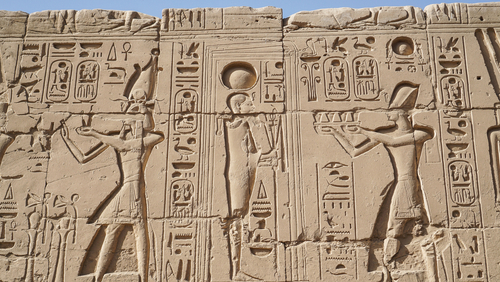
Hieroglyphic inscriptions showed up everywhere in ancient Egypt. You could see them on temple walls, big monuments, and even small everyday objects. The script worked on almost any surface. Some of the strongest examples can be found carved in stone on things like temple walls and in royal tombs. The Valley of the Kings has many of these.
But the hieroglyphs were not just for grand things. People in ancient Egypt also wrote them on things that did not last as long, which shows the writing was part of daily life. In this part, we’ll look at all the places this sacred writing appeared—from huge monuments to simple everyday items.
Temples, Tombs, and Sacred Monuments
The most beautiful examples of hieroglyphs are on the walls of temples and tombs. In ancient Egypt, people saw temples as the forever homes of the gods. They made the stone buildings to last a very long time. The temple walls were often covered from floor to ceiling with large, monumental inscriptions. These told about rituals, prayers, and what the pharaoh did in his life. These texts were not just for decoration. They were an important part of the temple and helped keep things right in the world.
In the same way, royal tombs in places like the Valley of the Kings used hieroglyphs to turn them into doors to the next life. The walls of burial rooms were written with funerary texts like the Book of the Dead. These made a map for the pharaoh who had died, helping him move through the underworld. The inscriptions were made to keep the king safe and make sure he was born again after death.
Now, you can still see these real inscriptions at many sites in Egypt like Karnak Temple and Luxor. Many museums in the world, such as the Egyptian Museum in Cairo and the British Museum, have large groups of stelae, statues, and parts of tombs. This is where you can look closely at these amazing texts and learn more about ancient Egypt.
Papyrus Scrolls and Everyday Objects
Stone monuments show the beauty of hieroglyphs, but papyrus scrolls tell us more about the daily life of ancient Egypt. Papyrus was the main portable material that people used for writing. Egyptian scribes and ancient Egyptian scribes used it for many types of documents. When writing on papyrus, they often used the quick and simple hieratic or demotic scripts instead of hieroglyphs. People wrote many things, like literary works, religious songs, also records of work, and even private letters.
The oldest papyrus that have survived go back to King Khufu’s time. Some show work logs from building the Great Pyramid. These papers give us good ideas about how people worked and stayed organized. Unlike the heavier clay tablets from Mesopotamia, papyrus was much lighter and easier to use, even if it did not last as long.
Writing was not just on papyrus. It showed up on other things people used every day. Pottery pieces, called ostraca, acted like scratch paper where people wrote notes, letters, or classroom exercises. You could see writing on furniture, jewelry, and even leather. This shows just how strongly writing was a part of egyptian culture. Writing in Egyptian life helped with things that were important, and also things that happened every day.
Tools and Artistic Techniques Behind Hieroglyphic Writing
Making hieroglyphs was both an art and a skill. It took trained hands, the right tools, and a good eye. The way ancient Egyptian scribes made hieroglyphic writing changed based on what they worked on. If they wrote on stone, egyptian scribes and artists used tools to carefully carve out every symbol, making sure each one looked just right. But on papyrus or ostraca, they used brushes from reeds along with ink made from colors found in nature.
There was a lot more to it than just making marks. Each sign took effort, with every line and space planned out. Both skill and the way the group of signs made things look were important for egyptian scribes. You can see this in the way they thought about the layout, direction, and style of how everything looked. These artistic choices made hieroglyphic writing stand out and be easy to look at.
Brushes, Carving Tools, and Pigments of Ancient Egypt
The tools that Egyptian scribes used were simple, but they worked well. For writing on papyrus, wooden boards, or pieces of pottery, their main tool was a brush made from a reed. The scribe would chew the end of the reed to split the fibers. This helped make a sharp tip for writing. This brush was dipped in ink to write the smooth lines seen in hieratic or demotic script.
When people had to make monumental inscriptions on stone walls, they used other tools. They picked chisels and mallets made from hard stone or bronze. These let them carve each hieroglyph into the walls. It was tough work that needed a lot of skill to make each line clean and deep. Some signs were painted with bright colors after they were carved.
The black and red inks that Egyptian scribes used came from nature. Black ink was made by mixing soot with gum arabic, while red ink was created from ground ochre. Red ink was used for things like headings or key words. Unlike other groups who wrote on clay tablets using a stylus, Egyptians used a brush and ink. This helped them create writing that looked more smooth and artistic.
Layout, Orientation, and Artistic Expression
The way hieroglyphic writing is set out is a big part of its looks. Unlike writing today, which goes in just one way, hieroglyphs could go in many directions. This gave a lot of freedom to how they were used on temple walls, statues, and stelae. Scribes made sure the signs were easy to read and looked good.
The direction of reading was very important. The pictures of people and animals always faced how the text should be read. This shows you if you start from the left or the right. The text can also be set up in columns, going from top to bottom. Scribes would use this to make things look balanced, like writing on both sides of a doorway or around an image.
Art and looks mattered a lot when scribes put the signs together. They didn’t like empty spaces. They set out the hieroglyphs in neat, balanced blocks.
- Directionality: Could be written left-to-right, right-to-left, or top-to-bottom.
- Symmetry: Often used to create balanced designs in art and architecture.
- Grouping: Signs were arranged in aesthetically pleasing blocks to fill the space evenly.
Decipherment and the Role of the Rosetta Stone
For almost two thousand years, people did not know what Egyptian hieroglyphs meant. The old writing had been a mystery for a very long time. But in 1799, things changed by luck. Some French soldiers in Egypt found a big stone with words on it. The same message was written three times, in hieroglyphs, demotic script, and ancient Greek. This stone is called the Rosetta Stone. The rosetta stone helped people figure out the secrets of ancient Egypt.
Now, the Rosetta Stone sits in the British Museum. It gave experts the matching texts they needed to understand hieroglyphs for the first time. Let’s talk about how people found this stone and the smart person who finally read what it said.
The Rosetta Stone’s Discovery and Its Importance
The discovery of the Rosetta Stone took place in July 1799. Napoleon Bonaparte was leading a military campaign in Egypt at the time. A French soldier named Pierre-François Bouchard found the stone slab. He was working with his unit while rebuilding a fort in the town of Rashid, called Rosetta. Right away, he saw that this stone could be very important. It had writing in three different scripts.
The Rosetta Stone shows a message from 196 BCE. The message was made for King Ptolemy V. You can see the same text written in formal hieroglyphs, the common demotic script, and ancient Greek. People still knew how to read ancient Greek, so the stone gave a clear way to figure out what was written in the other scripts. The stone was the key that helped researchers break the language barrier. They had wanted something like this for many years.
When the French lost the war, the Rosetta Stone was given to the British. It has been kept in the British Museum since 1802. After the discovery of the Rosetta Stone, there was a lot of excitement for studying the scripts. Many copies of the writing were shared with scholars. Still, it took about twenty years before they cracked the code. This breakthrough let people understand more than 3,000 years of Egyptian history.
Jean-François Champollion and the Cracking of the Code
In the early 19th century, many people in Europe wanted to figure out how to read Egyptian hieroglyphics. There was a race among scholars to win this prize. One English thinker called Thomas Young made some good early steps. He saw that cartouches on the Rosetta Stone had royal names. He also found out that some signs were there for the way words sounded. But he did not fully understand how the system of writing worked.
The last and biggest breakthrough came from a smart young French man. His name was Jean-François Champollion. He gave much of his life to learning about ancient Egypt. He knew a lot about the Egyptian language, especially Coptic. Champollion looked at the Rosetta Stone and some other texts. He put the Greek names Ptolemy and Cleopatra beside their forms in hieroglyphics, each inside a cartouche.
By 1822, Champollion shared what he found with the world. He showed that the hieroglyphic script was not just made to stand for ideas or letters. It was a mix of signs for sounds, signs for ideas, and some other special marks. Because of his work, people could start to read the stories of the ancient Egyptians. This let all of us hear from the ancient people of Egypt in their own words.
Conclusion
To sum up, Egyptian hieroglyphs give us a good look at the world of ancient Egypt. They show us the rich culture and deep language that was there. When we know about their meaning, how they were made, and how they changed, we can see how these symbols touched every part of life, from holy places to daily moments. If we learn the main symbols and what they stand for, we get a better idea of what people in that time believed and did. If you are someone who likes history, or if you just want to know more about this special way of writing, learning about hieroglyphs can be exciting. If you want to know even more and dive deeper into the world of Egyptian hieroglyphs, you can look for more help to keep exploring.
Frequently Asked Questions
Why Were Ancient Egyptian Hieroglyphs Considered Sacred?
Ancient Egyptian hieroglyphs were special to the people in Egypt. They thought these signs came from the god Thoth as a gift. People called this writing “the gods’ words.” It had strong meaning in the culture. They used these signs for religious texts and on amulets. Many believed this sacred writing gave protection while living and after death. It was important in the everyday life of Egyptian culture.
How Do Hieroglyphs Differ from Other Ancient Writing Systems?
The Egyptian hieroglyphic script is not just an alphabet like some writing systems. Instead, it is a mix. In it, you will see signs that show sounds, which are called phonograms. There are also signs that stand for whole words, called logograms. Plus, there are signs used to make things clear, and these are called determinatives. Egyptians used simple and faster ways to write, too. People had the hieratic script and the demotic script for everyday things. Later, these would lead to the coptic alphabet.