
Key Highlights
- The Cyrillic script is used as the main writing system for more than 50 Slavic languages and many non-Slavic languages too. This includes the modern Russian alphabet.
- The script started in the Bulgarian Empire in the 9th century. It came from the Greek and Glagolitic scripts.
- There are regional variations in the way people write and say Cyrillic letters. Different languages use unique letters and rules to make them stand out from one another.
- Modern Cyrillic fits with technology now. It works with Unicode and you can use online keyboards for digital messages.
- You can learn the Cyrillic script by breaking it into letter groups. Some letters will look like the ones in the Latin alphabet and some will look new to you.
- Today, the script is still a big part of people’s cultural identity and it helps connect millions around the world.
Introduction
Have you ever seen the russian language and felt a bit scared because of its different letters? You are not the only one who feels this way. The cyrillic script can seem strange at first. But the truth is, this writing system is not as hard as you may think. It has a long and rich history, and there are nearly 250 million people who use it in many countries. The cyrillic script came from the first bulgarian empire a long time ago. Today, it is used in many slavic languages and more. If you learn about the cyrillic script, you can find a good way to understand new cultures.
The Origins of the Cyrillic Alphabet
The cyrillic script has its start in the 9th century inside the First Bulgarian Empire. People made it to help spread Christianity. The idea was not to make the local people use the Greek language of the Byzantine Empire. This writing system let people put religious texts into Church Slavonic so all the Slavic-speaking people could read them.
The cyrillic script comes from the greek alphabet and an older way of writing called Glagolitic. It was made by followers of Saints Cyril and Methodius. One of these followers was Clement of Ohrid and he worked at the Preslav Literary School. The new writing system helped the Bulgarian Empire and other Slavic groups get their own way of writing and a special cultural and religious feel during the Middle Ages. Now, we can look more at where it came from and how it moved to other places.
Historical Roots and Influences
The Cyrillic script comes from the Greek alphabet. Many of its letters, like ‘A’, ‘K’, ‘M’, and ‘T’, look the same in both. This is because the Greek alphabet was used as a base for the new writing system. But the Greek script did not fit all the sounds in Slavic languages. So, the creators needed more. They added some letters from the Glagolitic script. This older script was made earlier by Saints Cyril and Methodius.
These two men were from the Byzantine Empire. They were told to make a script that would help translate church texts for Slavic people. They came up with the Glagolitic script first. Later, in the 9th century, their students built the Cyrillic script to honor Saint Cyril.
The biggest reason for making this new script was to help the Christian church. The church wanted to reach more people by giving them books they could read. This meant turning church texts into Old Church Slavonic. It helped people learn and build a culture that was not the same as the Byzantine Empire. The Cyrillic script helped many people become readers and gave the Slavs a new way to share the way they spoke and wrote.
Early Development and Spread
The Cyrillic script started in the First Bulgarian Empire. It became the official script in 893. The Preslav Literary School, led by people like Clement of Ohrid, helped shape this writing system. They added new letters to fit the sounds of Old Church Slavonic.
From the Bulgarian Empire, the Cyrillic script spread fast across eastern Europe and the Balkans in the Middle Ages. By the 10th century, the Kievan Rus’ started using it. This group later became Russia, Ukraine, and Belarus. The use of this writing system was very important for culture and religion in many Slavic languages.
As different areas took on Cyrillic, they changed the script to match their own dialects and the way they talked. With time, Cyrillic was made the official script in many new Slavic states. It became a key part of their national story and the way people learned to read and write.
Structure and Unique Features of the Cyrillic Script
The Cyrillic script can look hard at first. But the way it is set up is very logical. It is a writing system like the Latin alphabet, so it has both big (uppercase) and small (lowercase) letters. In Cyrillic, the way you write letters by hand can be very different from how you see them in print. This is something you need to get used to if you want to learn it well.
One thing that is really about this system is how many sounds it can show. Many of the Cyrillic letters come from Greek. But some were made just to show sounds in Slavic languages. This is what makes the modern Cyrillic alphabet, like the Russian alphabet, stand out. Next, we will look more at what the letters and sounds are like in this writing system.
Letterforms—Majuscule, Minuscule, and Cursive
The Cyrillic alphabet is a lot like the Latin script. It has both capital and small letters. For many cyrillic letters, the big and small forms look almost the same. They just have a size difference, like К and к. But for some, the small (lowercase) letter does not look much like its big (uppercase) version. This can make it a bit hard for people who are just starting to learn.
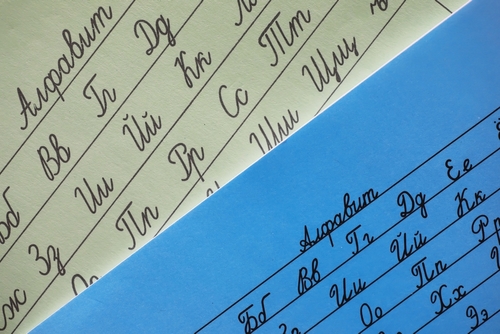
Things get even trickier when you look at writing by hand. When people write in cursive, some cyrillic letters change a lot. For example, the printed ‘т’ (which sounds like ‘t’) turns into something that looks like a small ‘m’ when you write it in cursive. If you want to read handwritten notes or special fonts, you need to know about these changes.
If you are learning this now, it’s good to remember:
- Some cursive cyrillic letters stay close to their printed form, but some look very different. You have to practice a lot to know them all.
- Watch out for letters like ‘д’, ‘г’, ‘и’, and ‘т’. Their cursive forms are not much like how they look when printed.
Phonetic System and Sound Representation
One big plus of the Cyrillic script is that its letters usually match up with single sounds. This system helps you get the pronunciation right with less guesswork. It is not as hard as some languages, where you have to learn a lot of tricky spelling rules. For example, in the Russian alphabet, the letter ‘A’ will almost always sound like /a/, the same way you say ‘a’ in “father.”
But, there are some special symbols in the script that do not show a sound by themselves. The Russian alphabet has both the soft sign (ь) and the hard sign (ъ). These do not make a sound alone. Instead, they change how you say the consonant before them. The soft sign tells you to soften the sound. The hard sign makes you pause between parts of the word.
You will find this pattern of matching sounds to letters in many different languages that use the Cyrillic script. Some of them add new letters or drop a few, to suit the sounds they use. Still, most of the same rules for sound and how letters work stay the same.
Major Languages Using the Cyrillic Alphabet
The Cyrillic script is the main alphabet for over 50 languages in Eastern Europe and Central Asia. Most people think of it with slavic languages like Russian, Bulgarian, and Serbian. But the Cyrillic script is also in many other languages that are not in the same group.
You can see people use the Cyrillic script for languages like Kazakh, Mongolian, and Tajik. The use of this writing system is because of the history and culture that shaped the area over time. Now, let’s look at some big slavic languages and other languages in Eastern Europe and Central Asia that use the Cyrillic script.
Slavic Languages (Russian, Bulgarian, Serbian, Ukrainian)
Cyrillic serves as the writing system for many major Slavic languages, forming a core part of their national identity. Russian, Bulgarian, Serbian, and Ukrainian are some of the most prominent examples. While they all share a common ancestor in Old Church Slavonic, each language has developed its own variant of the Cyrillic script to accommodate its unique phonetics.
These regional variations are noticeable in the number of letters and the presence of special characters. For instance, the Serbian Cyrillic alphabet includes letters like ‘Њ’ and ‘Љ’, which are not found in the Russian alphabet. Similarly, the Ukrainian alphabet has the letter ‘Ґ’ to represent a sound distinct from the standard ‘Г’.
These differences highlight how the script has been adapted to meet the specific needs of each language. Below is a comparison of a few key differences between these national languages.
| Feature | Russian | Bulgarian | Serbian | Ukrainian |
|---|---|---|---|---|
| Number of Letters | 33 | 30 | 30 | 33 |
| Unique Letters | Ё, Ъ, Ы, Ь | Ъ (as a vowel) | Ђ, Ј, Љ, Њ, Ћ, Џ | Ґ, Є, І, Ї |
| Script Notes | Includes hard and soft signs. | Lacks letters like Э and Ы. | Highly phonetic; one letter per sound. | Includes apostrophe for pronunciation. |
Non-Slavic Languages (Kazakh, Kyrgyz, Mongolian, Tajik)
Beyond the world of Slavic languages, the Cyrillic script spread to many other languages. This happened mostly in Central Asia and places influenced by the Soviet Union. Some of the languages that use a variant of the Cyrillic script as their writing system are Kazakh, Kyrgyz, Mongolian, and Tajik. Most of this change took place in the 20th century.
To make the Cyrillic letters work for these local languages, new symbols were added to show sounds that are not found in Slavic languages. For example, the Kazakh alphabet has some extra characters. These changes help show Kazakh’s special vowels and consonants. Before switching to the Cyrillic script, many of these languages used the Arabic or Latin script.
Now, there is a move for language reform in some of these countries. In Kazakhstan, people are working to switch back to a Latin script. These changes come as people think about their national identities and want to connect with other regions in the world.
Russian Cyrillic vs. Other Cyrillic Alphabets
Many people think of the Russian alphabet when they hear about the Cyrillic script. But there is more to it. The Russian alphabet is only one kind of variant of the Cyrillic script. Many national languages have their own version of this script. Each one is a bit different from the other. For example, the Serbian Cyrillic alphabet and the Bulgarian alphabet are not the same. Over time, each has changed to match the sounds of its own language. That is why they now have different sets of letters.
Because of these regional variations, you might find a letter in one alphabet that is not in another. Also, the same letter may sound different in different alphabets. It is important to know about these differences if you want to really understand the wide use of the Cyrillic script among national languages. Now, let’s look at some of the letter and sound differences between these alphabets.
Letter Variations and Additional Characters
One of the most clear ways the Russian alphabet is different from other Cyrillic scripts is in the letters that are used. Every national language has changed its own alphabet to show its sounds best. This is why some letters get added or left out in each one. For example, the Serbian Cyrillic alphabet uses the letters Ј, Љ, and Њ. These are not in the modern Russian alphabet.
These different letters often show up because the language needs to show sounds that are not in Russian. The Ukrainian alphabet uses the letter Ї (yi). The Bulgarian alphabet has the letter Ъ, which works as a vowel. This is not like the Russian hard sign. These extra letters let every variant of the Cyrillic script fit the language it is used for.
You should know a few more things about these scripts:
- The Serbian alphabet matches sound to letter, so each letter stands for only one sound and there is no mix-up.
- Ukrainian uses an apostrophe (‘) almost like the hard sign in Russian.
- Some languages that are not Slavic use double letters or letters with an acute accent to show their own sounds.
These things show how the cyrillic script changes for different slavic languages. The russian alphabet, the bulgarian alphabet, and the serbian cyrillic alphabet are all examples of a variant of the cyrillic script. You will also see some have the hard sign, use double letters, or show an acute accent to help show
Distinct Pronunciation and Regional Usage
The same Cyrillic letter can be said in different ways based on the language. For example, the letter ‘Г’ will sound like a ‘g’ in Russian. In Ukrainian and Belarusian though, people often say it more like an ‘h’. These regional variations are a big part of what makes each language sound and feel different.
The way the official script is used today has been shaped by local life and history. For example, where a country has old ties with others or a strong culture, the alphabet may change over time or be used in different ways. The scientific transliteration of Cyrillic into the Latin alphabet does not stay the same from one language to the next. It changes to follow the unique way words sound in each language.
There are also new changes happening now. Some countries in Central Asia are thinking about using a Latin script instead of Cyrillic. This means the way people teach, read, and write the Cyrillic script in these places can also change. All of these things show that writing systems are always on the move, and they have a close tie to what people in each place feel about who they are.
Modern Usage and Technological Adaptations
In today’s digital world, the Cyrillic script has found a great fit with new technology. With systems like Unicode, the Cyrillic writing system now works well on computers, phones, and across the internet. This makes it easy for millions of people to use their own writing system to talk to others in many ways.
People use modern Cyrillic for lots of things, from texting friends to making official papers. Online keyboards and new ways of typing have made it simple for users to type in languages like Russian. Let’s look at how these updates have helped keep the alphabet useful and important now.
Unicode and Digital Communication
The Cyrillic script has become a part of the digital age mainly because of Unicode. Unicode gives each letter a number that is always the same. It does not matter which platform, device, or language you use. With this system, Cyrillic letters show up the right way on different software and websites. This stops the problem of mixed-up letters that people saw in the past on the internet.
Thanks to Unicode, the Cyrillic script is used a lot for online talks. People send emails, share posts on social media, build sites, and chat online with their own alphabet. This is very important. It helps people who use the official script to join with others and keep their culture safe in today’s world.
It is hard to say enough about why it is good to keep digital versions of these scripts. The rich stories and history that come with the Cyrillic letters and the official script of many countries stay easy to find for all. A clear encoding method, such as the scientific transliteration of Cyrillic, also makes it easy to work together and share learning between groups.
Online Keyboards and Typing Tools
Yes, you have many ways to type modern cyrillic letters if your device does not have a Cyrillic keyboard. Most computer and phone systems like Windows, macOS, iOS, and Android let you add a Cyrillic keyboard layout. You can then switch back and forth between regular letters and cyrillic letters with an easy command.
If you do not want to remember where each letter is, you can use a phonetic keyboard. These keyboards match cyrillic letters with Latin keys that sound close. For example, you use ‘F’ for ‘Ф’ and ‘D’ for ‘Д’. There are also many sites and apps where you get online keyboards. With these, you can type modern cyrillic with your mouse or see the layout on your screen.
Here are some good choices to type cyrillic letters today:
- Operating System Keyboards: You can add Russian, Ukrainian, or other Cyrillic layouts right from your device’s settings.
- Online Virtual Keyboards: Use sites like Translit.net or Google Input Tools for easy online typing.
- Phonetic Keyboard Stickers: Get stickers to put on your keyboard. This helps you learn the layout when you type.
Learning the Cyrillic Alphabet: Tips for Beginners
Learning the Cyrillic alphabet might look hard at first, but it is not as tough as you may think. The best way is to split the work into small steps. Do not try to learn all the letters at the same time. It helps to focus on the ones that look like English letters first.
If you keep at it and pick the right way to study, you will find that you can feel sure of yourself when using Cyrillic letters. This skill will help you learn more about slavic languages and their ways of life. Here are some good steps and tips that can help you start as you learn the Cyrillic alphabet.
Easy Steps to Recognize and Write Cyrillic Letters
A good way to learn the Cyrillic script is to group the letters based on how they look compared to the Latin alphabet. You can start with letters that look and sound the same as the ones you already know. After that, move to the letters that look like they should sound the same but actually don’t—these are called “false friends.” Last, get used to the new letters you have not seen before.
To practice, write words from your language in Cyrillic letters. For example, try spelling out your name the way it sounds using these new letters. This helps the mind connect the shapes to sounds you already know. There are language apps such as Duolingo that have exercises for practicing these letters, and they work well.
Here is a short guide to help you see and write Cyrillic letters:
- Group 1 (Familiar): Start with letters like А, К, М, О, and Т. They look and sound almost the same as Latin letters.
- Group 2 (False Friends): Study letters like В (V), Н (N), Р (R), С (S), and У (U). These look familiar but stand for different sounds.
- Group 3 (New Letters): Learn letters that are new, for example Б (B), Г (G), Д (D), Ж (Zh), and Я (Ya).
- Practice Writing: Write these letters by hand often. That way
Common Challenges and Practice Recommendations
One thing that many people find hard is telling apart letters that look alike and learning “false friends.” Some cyrillic letters like ‘И’, ‘Н’, and ‘П’ look a lot like latin letters, and this can make the russian alphabet tricky. There are also cyrillic letters like ‘Ж’, ‘Ц’, and ‘Щ’ that you will not see in english. These are totally new for people learning the writing system.
To get better at this, you have to practice all the time. Try using language apps or flashcards every day to work on the cyrillic letters. It also helps to use little tricks or mnemonics. For example, if you want to remember that ‘Д’ sounds like ‘d’, you can picture it as a house with two legs—the russian word for house is ‘dom.’
Do not feel upset if you need more time. Like many new things, learning this writing system is something you need patience for. Just a few minutes of practice each day and often going back to review what you learned will make the russian alphabet much easier for you. After that, reading cyrillic letters can feel like second nature.
Conclusion
To sum up, if you learn the Cyrillic script, you can find many new languages and cultures. This writing system is more than old history. It is still important today, even in new tech. The Cyrillic script is the base for many people’s lives across the world. It is not just for Slavic languages. You can use it when you learn other languages, too.
If you get good at using the Cyrillic script, your language skills will grow. You will also start to value how different people share their lives and stories. Start your learning with an open mind. Before long, you will get used to this interesting writing system. Don’t be afraid to learn more and see what new things you can find on this road to knowledge!
Frequently Asked Questions
How long does it take to learn the Cyrillic alphabet?
Many people can get to know the Cyrillic alphabet in just a few hours or days if they spend time studying. To really master it, like reading fast or learning its cursive style, may take a few weeks of regular practice. The time it takes to learn this writing system will also depend on your native language and how much time you spend on it.
Are there easy tricks to remember tricky Cyrillic letters?
Yes! Using mnemonics is a good way to remember hard Cyrillic letters. For instance, the Russian letter ‘Ж’ (zh) looks like a bug. The word for bug in Russian is “жук” (zhuk). If you link how a cyrillic letter looks with a word that has the same sound, you can learn the alphabet much faster.
Is the Cyrillic alphabet still evolving today?
Yes, the Cyrillic script is still changing. The main Russian alphabet stays the same. However, in some countries, there are language changes going on. For example, Kazakhstan is moving from the Cyrillic script to a Latin-based official script. You can see that these regional variations and modern updates mean the use of modern Cyrillic is always shifting.