
Key Highlights
Here are the key things to know from our look at Babylonian cuneiform:
- Cuneiform writing first started with the Sumerians in the ancient Near East. The Babylonians then used it for their own needs.
- People used a wedge-shaped stylus to press marks into a soft clay tablet.
- Babylonian cuneiform was a complex way to write. People used this for things like scholarly documents and daily records in towns such as Uruk.
- The work to understand and read cuneiform tablets, like those with writing in three languages, unlocked the history of Mesopotamia.
- Babylonian cuneiform influenced the history of mathematics with its advanced base-60 number system.
Introduction
Welcome to the world of Babylonian cuneiform script. This old way of writing started a long time ago in Mesopotamia. People used a wedge to press marks into soft clay. That is how they wrote words and ideas.
These marks helped people share laws, tell stories, and pass on what they learned about science. The cuneiform script played a big part in the life of the Babylonian people. Today, we can still see its strong effect on history.
Come with us as we look at where this cuneiform script began, what makes it special, and how it keeps shaping the world.
Origins and Development of Babylonian Cuneiform
The story of Babylonian cuneiform starts with the Sumerians in the ancient Near East. It was them who made the first form of the writing system. This was the beginning of a true writing system. The word “cuneiform” comes from the Latin word cuneus. It means “wedge.” You can see this in the marks on clay. Their idea was a big step in history.
Later, the Akkadian and Babylonian cultures made the script fit their languages. These changes let cuneiform spread from places like Uruk all over Mesopotamia. Babylonian cuneiform got used to record laws, long poems, office work, and even watching stars. It was a big part of their world. We will look more at how the script changed.
Transition from Sumerian to Akkadian Script
The change from Sumerian to Akkadian script was a big move in language. The first script made by the Sumerians in Sumer was meant just for their language. When the Akkadian people started to use it, they had to change it a lot. This was because their language had different sounds and grammar.
To make the script fit the Akkadian language, they had to add ways to show new sounds. That meant using more consonants and vowels. The script turned into a mix of signs for whole words and signs for syllables. Because of this, it got harder and had more parts to learn. This system could be used for a number of languages. You can see this in the trilingual inscription at Behistun.
In the end, the Akkadian way of cuneiform was the one most used by Babylonian and Assyrian writers. This change shows that writing can grow and be shaped by new needs. It takes ideas from old scripts but also brings new ways that work for a different language and culture. The choice to use signs for syllables made it very useful and let it spread across a wide area in the old world.
Evolution of Clay Tablet Writing Techniques
The way people wrote on a clay tablet changed over time and got better. A scribe used a stylus mostly made from a reed. He pressed wedge marks into a tablet that was soft and wet. The word cuneus means “wedge” in Latin, and that is where this writing style got its name.
This work took a lot of care and skill. The scribe had to move fast so the clay did not dry out. He set up the lines of text in a careful way. There were some changes to how they did this over the years, but most of this writing used the same steps:
- Preparing a clay tablet that was smooth and wet.
- Holding a reed stylus in a tilted way.
- Pressing the stylus tip into the clay to make many wedge shapes.
This method made it possible to put together simple wedge shapes and make detailed symbols. If you wanted to write your name in Babylonian cuneiform, you would pick the syllables in your name and press each one into the clay. This type of writing was not about using letters. It was about using syllables that made the sounds in your name.
Keywords: clay tablet, lines of text, Babylonian, wedge, stylus, cuneus, syllables, scribe
Main Characteristics of Babylonian Cuneiform
What is special about Babylonian cuneiform? The main thing is the use of small wedge shapes to make a vast array of symbols. It is not like most alphabets. Instead of showing one letter, a lot of these symbols show a full sound, like “ba,” “bi,” or “bu.” This let people write out the sounds in Babylonian words.
Another thing to know is that the script is pretty complex. One cuneiform symbol can mean different things, depending on where you see it. It might stand for a whole word or just one sound. This made the Babylonian script stand out from others. It helped people record many types of texts, including legal, scientific, and literary ones. Now, we can talk about how it looks and compare it to other scripts.
Cuneiform Symbol Shapes and Styles
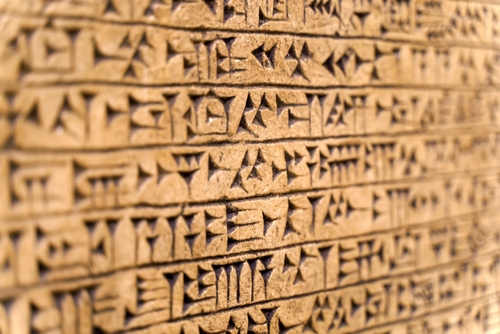
Visually, Babylonian cuneiform looks like a series of wedge-shaped impressions organized into lines of text. The shapes were formed by pressing the corner of a stylus into wet clay. The orientation and combination of these wedges created the different syllables and words of the cuneiform script. The term cuneus perfectly captures this wedge-based visual identity.
The basic building blocks of the script were simple but could be combined in complex ways. A scribe could alter the depth, angle, and grouping of the wedge marks to produce a vast vocabulary of symbols. The visual appearance is distinct from pictorial hieroglyphs, as it is more abstract.
Here’s a simplified look at how different wedges could form a numeral in the Babylonian system. Note that they used a repetitive system for numbers within a place value.
| Symbol | Meaning | Visual Description |
|---|---|---|
| ? | 1 | A single vertical wedge |
| ? | 10 | A horizontal wedge |
Combining these, the number 23 would be written with two 10-wedges followed by three 1-wedges (?????).
Differences Between Babylonian and Other Mesopotamian Scripts
Many groups used cuneiform, but the Babylonian script stood out because it had its own features. It used the same basic ideas as the cuneiform found in places like Assyria. Still, there were changes in the way people wrote, the signs they used, and which words or marks showed up in the script. You can think of it like how handwriting or how people talk is a bit different from place to place.
The Babylonian script was used for a number of languages. This includes Elamite and Old Persian. Each language made its own changes to the script. For instance, the Behistun Inscription was looked at by Rawlinson. It was written in three languages and used cuneiform for each, but there were small changes in each version. Work seen in sources like Cambridge University Press talks about these important but small differences.
A big thing about the Babylonian script is that people used it for advanced math and things like astronomy. To do this kind of work, you need the script to be very clear and have special words and marks. Scholars who used Babylonian for these subjects helped shape how the script grew and set it apart from the forms you’d see in Assyria used by other people for daily tasks or in business.
Materials, Methods, and Daily Use
The main thing used for cuneiform writing was the clay tablet. With some simple tools, a scribe could write down a lot of things on it. This was not only for big scholarly documents. It was something people in Babylon used in many parts of their lives. They would use cuneiform writing to keep track of food, record laws, and manage many other daily jobs. It was an important part of how the empire worked.
Cuneiform writing was also key in the history of mathematics and science. People in Babylon used their script along with Babylonian numerals to make records about the stars and planets. These are called astronomical diaries. So, they used the clay tablet for both learning and daily life. This made the clay tablet very important in their world. Now let’s look at the tools they used and what they did with them.
Tools and Techniques for Inscribing Clay Tablets
The main tool for a Babylonian scribe was the stylus. The scribe used the stylus to make marks on a clay tablet that was still soft. The stylus was often made from a reed. It had a sharp end, and this helped the scribe make the wedge shape that is seen in cuneiform writing. The word cuneus from Latin means “wedge,” and it tells us about how this writing was made.
A scribe followed clear steps to make a clay tablet. This is what they did:
- The scribe shaped a wet piece of clay to be flat and smooth for writing.
- The scribe then pressed the stylus into the clay, not dragging it, to make the marks.
- They placed these symbols in order, either from left to right or from top to bottom.
After writing, the clay tablet could be left to dry in the air for a short-term record. If someone wanted to keep it longer, they baked it in a kiln. Because of this good way to keep writing, these clay tablet records of the Babylonians lasted thousands of years. If a scribe wanted to write your name on a wedge-shaped clay tablet, they used the signs that fit the way your name sounded and pressed those into the clay.
Everyday Purposes and Official Uses in Ancient Babylonia
Cuneiform tablets were not made only for scholarly documents. They played a big role in daily life in ancient Babylonia. In big cities like Uruk, people made many tablets for administration tasks. These jobs included keeping track of tax payments, legal contracts, letters, and lists of goods. These tablets give us a close look at the economy and how people lived in that time.
Some famous cuneiform tablets, like the Epic of Gilgamesh and the Code of Hammurabi, show the highest official and cultural use. These important works were written on strong tablets that lasted a long time. There are even math tablets that show off the knowledge these people had. For example, the tablet from Larsa that Henry Rawlinson studied shows how they used Babylonian numerals to work out things like square roots.
Cuneiform tablets are treasures from history. Their importance comes from the detailed information they share. If it is a royal order or just a simple receipt, each tablet helps us see how people lived in ancient Mesopotamia. Without their tablets and Babylonian numerals, much of what we know about Mesopotamia and its people might be lost.
Legacy, Decipherment, and Modern Relevance
The history of Babylonian cuneiform is big, especially when you look at the history of mathematics and astronomy. But for a long time, people could not read this writing at all. In the 1800s, some brave people worked hard and figured out the meaning of cuneiform. This big step helped us learn about Mesopotamia and what people there knew a long time ago.
When this happened, people could finally see how the Babylonians were smart about many things, like science and their way of life. The story of how people cracked the code is like a real-life puzzle. It involves people who took chances and made some great new finds. Now, we are going to talk about how people solved the secrets of Babylonian writing. We will also look at how this writing still shows up in the world today.
Decoding Babylonian Cuneiform: Key Discoveries by Scholars
The decipherment of cuneiform owes much to Henry Rawlinson’s work in the mid-1800s. He bravely made a copy of a huge trilingual inscription on a cliff in Behistun, Iran. This writing used Old Persian, Elamite, and Babylonian. It told stories of Darius the Great’s wins. People already knew a bit about Old Persian, so they could use it to open up the other two languages.
This trilingual inscription became the “Rosetta Stone” for cuneiform. Rawlinson and other scholars looked for names and phrases that showed up in all three scripts. That helped them find out what the Babylonian symbols stood for. The work took a long time and was hard, but it helped with translating many scholarly documents.
This big step ahead, written about in books from cambridge university press, changed how we see ancient times. Now, people can read everything from stories about kings to math texts and much more. This showed us the people who wrote in cuneiform were smarter and further along than people once thought.
Influence on Later Writing Systems and Where to See Tablets Today
While Babylonian cuneiform is not used anymore, it left a big mark. One of the best examples of its use can be found in the history of mathematics and astronomy. The Babylonian base-60 number system is the main reason we have a 60-minute hour, a 60-second minute, and 360 degrees in a circle. These things come straight from them. The way their script could be used for a number of languages also made it easier for people to talk and share ideas between groups later on.
Its effect on later writing systems, like alphabet scripts, was not as strong. Even so, cuneiform is important because it was one of the world’s first real ways to write. It showed people how to keep and share complex information, opening the door for new scripts in time.
If you want to see original Babylonian tablets, you can go to some of the best museums in the world. Major collections are in:
- The British Museum in London
- The Louvre Museum in Paris
- The Vorderasiatisches Museum in Berlin
- University spots, like at Yale and the University of Pennsylvania
Conclusion
To sum up, Babylonian cuneiform is a big step in the story of writing and talking with others. The move from Sumerian to Akkadian script shows how this way of writing could change and grow over time. It has special features that help show how rich and full of life Mesopotamia was. The way Babylonians used tools to write on tablets lets us see how clever they were both at work and in making records for the people. When we learn more about cuneiform, we can understand how this old script has helped shape the writing systems we use now. If you want to know more about Babylonian writing and these tablets from Mesopotamia, you can get in touch for more help or news on this topic!