
Key Highlights
Here’s a quick look at what we’ll cover as we talk about the ancient Greek alphabet:
- The Greek alphabet came from the Phoenician script around 800 BCE. The Greeks made new symbols for vowels.
- There were many forms at first. The 24-letter Ionian version became the main one and is what we call the classical Greek alphabet.
- Many Greek letters, like alpha and beta, have had a big effect on the English alphabet. People still use these greek letters in science and math.
- How people say ancient Greek letters is not the same as how letters sound in the modern Greek alphabet.
- These classical greek letters had a lot of influence. The Latin alphabet and other ways people write have taken ideas from them.
Introduction
The greek alphabet is not just a set of greek letters. It is a big part of western thinking and way of life. Much like ancient greek ideas and science helped shape the world, the greek language has a huge impact on our lives today. Many words in english come from greek. For example, the word “alphabet” comes from alpha and beta, the first two letters of the greek alphabet. This writing system from ancient greek has been around for thousands of years. It is not just something from the past. The greek alphabet can still be seen today in books and in math problems.
The Ancient Greek Alphabet Overview
The classical Greek alphabet has 24 letters. It starts with Alpha and ends with Omega. This new way of writing was important because it was the first system that used different marks for both consonants and vowels. That was a big change for people at that time.
The greek alphabet let the ancient Greeks write down each word just as it sounds. Now, let’s look at the names and order of each of these greek letters. We’ll also talk about what makes the classical greek alphabet and its vowels special, from start to end.
Names and Order of Ancient Greek Letters
Memorizing the order of the Greek alphabet is the first step to understanding ancient texts. Just like learning your ABCs, knowing the sequence from Alpha to Omega is crucial. Many people find it helpful to chunk the letters into smaller groups for easier memorization, perhaps by chanting or singing them.
The 24 letters follow a specific sequence that has remained consistent for millennia. You’ll recognize many of them, from the well-known Alpha (α) and Beta (β) to the final letter, Omega (ω). Understanding this order helps not only in reading ancient texts but also in recognizing their use in modern contexts.
Here is the complete order of the Greek alphabet with both uppercase and lowercase forms:
| Uppercase | Lowercase | Greek Name |
|---|---|---|
| Α | α | Alpha |
| Β | β | Beta |
| Γ | γ | Gamma |
| Δ | δ | Delta |
| Ε | ε | Epsilon |
| Ζ | ζ | Zeta |
| Η | η | Eta |
| Θ | θ | Theta |
| Ι | ι | Iota |
| Κ | κ | Kappa |
| Λ | λ | Lambda |
| Μ | μ | Mu |
| Ν | ν | Nu |
| Ξ | ξ | Xi |
| Ο | ο | Omicron |
| Π | π | Pi |
| Ρ | ρ | Rho |
| Σ | σ, ς | Sigma |
| Τ | τ | Tau |
| Υ | υ | Upsilon |
| Φ | φ | Phi |
| Χ | χ | Chi |
| Ψ | ψ | Psi |
| Ω | ω | Omega |
Structure and Unique Features of the Classical Letters
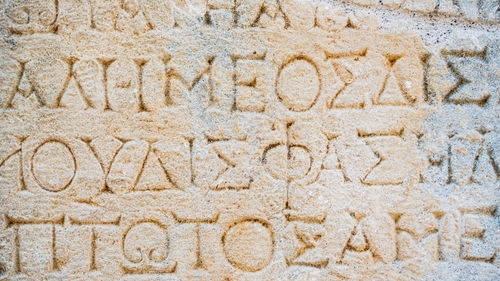
One thing that makes the classical Greek alphabet stand out is the way it uses both uppercase and lowercase letters. But this did not happen right away. At first, the ancient Greeks would only write using big, capital letters. There were no spaces between words and no punctuation, either. The lowercase forms we see now came much later. These were brought in by Byzantine writers and printers during the Renaissance. Their goal was to make writing faster and easier.
The alphabet also has special Greek symbols that you will not find in English. For example, the letter Sigma (Σ) is used for a certain sound, but its lowercase form at the end of a word is different: (ς). There are other letters too, such as Psi (Ψ) and Xi (Ξ). They can both stand for groups of consonant sounds, like “ps” and “ks,” but use only one symbol each.
All of this made the Greek alphabet a good and clear way to write. The fact that it could show single sounds and vowels was important. It was a big change from the old syllabic ways of writing. It helped people write spoken words more exactly.
Historical Origins and Development
The story of how the Greek alphabet started is a very interesting part of history. It did not happen out of nowhere. People, ideas, and hard work helped shape it. When this new alphabet came about, it changed a lot of things. It helped the growth of writing, learning, and how people handled daily work.
In this piece, we will talk about when the Greek alphabet first showed up and the way it changed as years passed. We will also see how other systems, like the Phoenician writing system, played a big part in making the greek alphabet into what we now know.
When and How the Ancient Greek Alphabet Emerged
The new alphabet that we call Greek started around 800 BCE. There is still some debate among experts about the exact date. The invention of the alphabet was not something the Greeks did all on their own. They took the Phoenician writing system, which focused mostly on consonants, and changed it in a smart way.
The Greeks used Phoenician symbols for sounds they did not have, like certain throat sounds. They changed these to stand for vowels. This change was a big step forward. For the first time, a writing system could show every sound in a word—both consonants and vowels.
Making this “true” alphabet was a major development. It gave the Greeks a way to write their language with great care to how it sounded. This helped more people learn to read and write, and the written culture in Greece grew quickly.
Influences from Phoenician and Other Scripts
The greek alphabet got its main ideas from the phoenician alphabet, which was used by a group of people who spoke a semitic language. The greeks took most of their alphabet from the phoenician alphabet and changed it a bit to fit the sounds in their own language. You can see this in the name “alpha,” which the greeks borrowed from “aleph” in phoenician.
Some parts were easy for them to take, like the letter for ‘l’ in the phoenician alphabet turning into Lambda (λ) for the greek alphabet. But other parts needed more thought. The biggest change was how the greeks used extra phoenician consonant letters for their vowel sounds. This was a new idea at the time, and it made their writing system very different from others.
The greek alphabet did not just help the greeks. Over time, people used the greek alphabet to make other writing system, too, like the latin alphabet. The latin alphabet is what we use for english and many other european language today. The greeks’ way of writing also helped with systems like the coptic alphabet, which later showed up in egypt.
Sounds and Pronunciation in Ancient Greek
Have you ever thought about how ancient Greek sounded? The way people said words back then is not the same as how words sound in modern Greek. To really get the poetry and books from that time, it helps to know the sounds for each letter, including the different consonants and vowel sounds.
Let’s look at how teachers and experts think each letter was said long ago. We will also talk about the big changes in the pronunciation of words that happened between ancient Greek and modern Greek. This way, you can really understand more about the greek language and how it changed over time.
How Each Letter Was Pronounced in Ancient Times
Approximating how ancient Greek sounded is a hard and interesting job for the people who study language. No one knows for sure what it was like. However, experts tried to work it out using old clues. Greek is different from English because it had long and short vowel sounds. People would make long vowels last about twice as long as short ones.
For instance, the letter Eta (η) was always a long vowel. It was like the ‘a’ in the word “ate.” Epsilon (ε) was always a short vowel, so it sounded like the ‘e’ in “bet.” A few vowels—like Alpha (α), Iota (ι), and Upsilon (υ)—could be long or short. It depends on the word.
Here are some ways certain letters in the greek alphabet were said in ancient greek:
- Gamma (γ): Like the ‘g’ in “go.”
- Theta (θ): Like the ‘th’ in “theater.”
- Chi (χ): A bit like the ‘ch’ sound when you say the Scottish “loch.” The sound is made at the back of your mouth.
- Zeta (ζ): Like the ‘zd’ in “wisdom.”
- Phi (φ): Like the ‘f’ in “fit.”
- Upsilon (υ): Like how you say the French ‘u’ in lune or the
Differences in Pronunciation Between Ancient and Modern Greek
The Greek language has been used for a very long time. Because of this, the way people speak Greek has changed a lot. The sounds you hear in modern Greek are not the same as those from the time of ancient Greek. If you listen to someone read an old text in ancient Greek, it will not sound much like the Greek people speak now.
One big change with the Greek language is how vowels and diphthongs sound. For example, in ancient Greek, the letters Eta (η), Iota (ι), and Upsilon (υ) all had their own sounds. In modern Greek, these letters and the diphthongs ει and οι all sound the same. They are all said as an “ee” sound, like the word “bee” in English. This is true for many words in both ancient Greek and modern Greek.
Some consonant sounds also changed in the greek language. Long ago, Beta (β) in ancient Greek was spoken like the English ‘b’ sound. In modern Greek, though, Beta sounds more like ‘v.’ Delta (δ) used to have a ‘d’ sound. Now, in modern Greek, it is said as ‘th,’ like in the English word “the.” These new ways to say vowels and consonants show how Greek keeps changing over time.
Writing System Characteristics
The Greek writing system was more than just letters you see in many languages. It had special features that made it stand out. One big change was that the Greek alphabet showed sounds, and each sign stood for one sound in a single syllable. This was very different from the writing systems that came before.
Also, the Greek alphabet brought in a group of extra marks called diacritics. In the next part, we will talk about how alphabet writing is not the same as a way that shows bigger sets of sounds, and why these complex polytonic marks were important in old Greek papers.
Alphabetic Versus Syllabic Systems
Before people used the greek alphabet, the writing system in that area used syllables. A good example is Linear B. In Linear B, each mark showed a whole single syllable. This was often a consonant and a vowel together. For example, there would be a different mark for “ba,” “be,” “bi,” and each sound like this.
The greek alphabet changed the way people wrote. Now, with the new alphabet, each letter showed one sound instead of a full single syllable. A letter could mean a single consonant or one of the vowels. This made the writing system more simple and flexible. You could use the ‘b’ letter with any vowel to create sounds like “ba” or “be,” without needing many special symbols.
Changing from a syllabic way of writing to an alphabet was a big step for writing. The greek alphabet was special because it was the first alphabet that had clear letters for both consonants and vowels. This let people write out every word sound by sound.
Use of Diacritics and Polytonic Markings
When you look at ancient Greek writing, you will see there are a lot of small marks over the letters. These are called diacritics. People added them to the Greek writing system much later. The complete set is called polytonic orthography. It uses accent marks and breathing marks.
The main job of these markings was to show how to say words. The accent marks in Greek did not show stress like English does. Instead, the accent marks showed a change in pitch. This means that some parts of a word were said with a higher or lower sound. The ancient Greek language used pitch accent, so a syllable could go up or down in pitch. Breathing marks were used when a word started with a vowel. They showed if you were supposed to make an ‘h’ sound at the beginning of the word.
Here are the main types of polytonic marks you will find in the Greek language:
- Acute accent (´): This mark showed a rise in pitch on a syllable.
- Grave accent (`): This mark showed either a flat or falling pitch. You will often see it at the end of a word.
- Circumflex accent (~ or ^): This mark showed that the pitch went up and then down during a long vowel.
- Smooth and rough breathing marks (᾿ and ῾): These marks go over vowels at the start of a word. The smooth one shows
The Classical Alphabet in Daily Life and Literature
The classical Greek alphabet was more than just a tool for learning. It was a part of everyday life in ancient Greece. People saw greek letters carved into big stones at temples. They read them in the poems of Homer and in the books of great thinkers like Plato. This writing system helped greek culture and knowledge grow fast.
Let’s take a look at how people in ancient Greece used the greek alphabet. It showed up in ancient books and on important old signs. Greek letters also mattered at school and in the homes of regular people. The alphabet played a role in almost every part of life in Greece.
Usage in Ancient Greek Texts and Inscriptions
The Greek alphabet was used to write down some of the most important works in history. This new writing system made it possible to save stories that people used to tell by word of mouth for many years. Because of this, the greek alphabet helped keep important books and stories safe for later times.
People in Greek society also used the alphabet for things they needed every day. You would see it carved into stone on buildings, on statues, and even on graves. These carvings showed laws, rules, and notes about special events or gifts. At first, the writing system used all capital letters without any breaks between the words. This style is called scriptio continua.
The greek alphabet was needed for different things like:
- Writing epic poems: Big stories like Homer’s Iliad and Odyssey were put into words so people would not forget them.
- Writing down history: Historians such as Herodotus used the writing system to shape the first real history records.
- Philosophy: People like Plato and Aristotle wrote down ideas so that others could read and learn from them.
- Religious writing: The New Testament in the Bible was first written in Koine Greek, which helped spread its message throughout the ancient world.
The Role of Greek Letters in Society and Education
In ancient Greece, the alphabet was a big part of how people learned and lived together. Most people could not read or write, but the sons of some citizens, especially in places like Athens, went to school to learn these things. Being able to read and write was needed if you wanted to be involved in things like voting or reading laws.
You could see writing all around the city, not just in schools. Public places had signs and letters. Even if someone did not read much, the greek alphabet was part of what they saw every day. This made it clear how important greek letters and the written word were for the people. It was used in running the city, in shaping the rules, and in what made them feel like they belonged in Greece.
Today, using greek letters as a symbol for special groups goes back to this old tradition. You see it when college fraternities and sororities use greek letters as their names. This is still a way to connect greek letters to education, community, and being part of a group that started a long time ago, back in ancient Greece.
Legacy and Influence of the Ancient Greek Alphabet
The greek alphabet from ancient greek times has had a big impact on the world. You can see its mark in many places, not just in greece or old history books. In fact, the letters you see right now come from this old alphabet.
The greek alphabet was the base for the latin alphabet, which most people use today. It is important to know that the way the greek alphabet spread was special and helped make many other ways for people to read and write. It also gave us signs we still use every day in things like astronomy and math.
The journey of the greek alphabet is really something. If you look around, you will find its symbols and letters still have so much to give to the work people do. It also stays a part of how we see the world.
From Greek to Latin and Other Alphabets
The most important thing that came from the greek alphabet is that it was the start of the latin alphabet. People called the Etruscans lived in ancient Italy. They took a form of the greek alphabet and used it in their own language. Later on, the Romans took what the Etruscans used and made the latin alphabet. This latin alphabet spread all over Europe when the Roman Empire grew.
Because of this line of history, the english alphabet comes straight from the greek alphabet. Many of the letters we use in english come from latin, which got them from greek forms. That is why letters like A (alpha), B (beta), K (kappa), and O (omicron) look almost the same in both.
The greek alphabet went east, too. It was the main writing system for scripts like the Gothic, Glagolitic, and Cyrillic alphabets, which are used in Eastern Europe. In Egypt, people changed it so that they could make the coptic alphabet. The greek writing system has been a big part of how hundreds of languages are written today.
Scientific, Mathematical, and Modern Applications
The greek alphabet is not just part of history. It still plays a big role in many areas today, like science and math. People use greek letters and symbols as quick ways to show ideas, numbers, or facts in their work. This special alphabet helps people all over the world understand each other when they are talking about hard topics.
For example, you may have used the greek letter π (pi) to find the size of a circle. That is only one way greek letters keep showing up. You also find these letters used in subjects like physics, math, astronomy, and even college fraternities or sororities. Greek symbols are a key part of how experts everywhere talk about their work. It helps keep the ancient greek alphabet in use, and makes it easy for people to know what is being shared.
Here are some everyday uses for greek letters:
- Mathematics: Pi (π) is for that number which shows the ratio of the distance around a circle and straight across it; Sigma (Σ) is for adding things up; Delta (Δ) is when you talk about change.
- Physics: Omega (Ω) is used when you talk about resistance in wires; Lambda (λ) shows how long a wave is; Mu (μ) means something is really small.
- Astronomy: In stars, greek letters help name them by brightness. Like, the brightest star in Centaurus is Alpha Centauri.
- Social Organizations: You
Conclusion
To sum up, the Ancient Greek alphabet is more than just a group of letters. It is a big part of history that has shaped the way people use language, write books, and share ideas in science. This greek alphabet has a special way of being set up. The old scripts before it helped it grow, and that made it easier for people to talk about big ideas and strong feelings in ancient greek writing. If you know how the alphabet sounds and how it is written, you can better enjoy old stories and feel closer to the deep greek culture from greece. When we learn about its past, we can see how this alphabet still touches our lives. It shows up in the letters we use today and in many fields. These classic greek alphabet letters still mean a lot. If you want to know more about the wonders of the ancient greek alphabet and its pronunciation, you can get in touch for more information!
Frequently Asked Questions
How does the ancient Greek alphabet differ from the modern Greek alphabet?
The big thing that sets the ancient Greek alphabet apart from the modern Greek one is how you say the words. The letters of the Greek alphabet look mostly the same, but today, vowels and even some of the other sounds are not said the same way. For example, in ancient Greek, there were a lot of different vowel sounds. Now, in modern Greek, many of those vowel sounds are said as just an “ee” sound.
Are there tools for typing in ancient Greek with polytonic diacritics?
Yes, there are many tools you can use. Most new operating systems let you add a polytonic Greek keyboard layout. This helps you type all the accents and marks you need for the greek alphabet. Just make sure to use a font that works with the right unicode letters for the greek alphabet.
What are some fun facts about the ancient Greek alphabet?
The word “alphabet” comes from the first two greek letters, Alpha and Beta. The phrase “alpha and omega” means the beginning and the end. In ancient greece, every word that started with the greek letter Upsilon (υ) got a rough ‘h’ sound at the start. This old greek rule is not used now.